
Sharing the fruits of research: studying the state of the apple industry in the Okanagan

The amount of land in the Okanagan Valley dedicated to growing apples dropped by 35 per cent between 2001 and 2011 — a shift that led to substantial changes in the industry, with broad repercussions for processing and distribution, and inspired two Okanagan College School of Business professors, Lee Cartier and Svan Lembke, to examine the situation and the new opportunities it has given rise to.

Their work looked in particular at the links among “clusters” — the interconnected businesses, suppliers and other organizations in a geographic area that are all involved in the same industry. Cartier and Lembke found that focusing on common interests and encouraging groups in the cluster to share knowledge benefits everyone involved. At a cluster-wide workshop, the researchers also revealed opportunities to improve that had been missed and recommended adopting cluster-wide quality standards, developing new types of apples, improving production technologies and doing better marketing.

Two students participated in the project. One analyzed apple packing and sales data and did a trend analysis of it. The other summarized data from 17 in-depth interview, summarizing what she had learned from them. Working on this research project provided the students with a new understanding of how companies use research to inform their business practices.

The researchers’ recommendations on the best ways to exploit the collective power of the Okanagan apple cluster were discussed during a stakeholder workshop. The research showed the local cooperative organization, BC Tree Fruits (the largest employer in the cluster), was already enabling smaller firms to share equipment, get field service advice and pool their marketing and sales costs. However, the cooperative overall remained a minor player compared to some of the operations in Washington just the other side of the border and had not been aggressive in positioning products or trying new marketing approaches. After the workshop and armed with the research, the cooperative and other industry stakeholders created a list of actions to improve the performance of the conventional apple industry in the Okanagan.


Industry: Agriculture | Food
Partner(s): BC Tree Fruits
Funded by: College and Community Innovation Program, Engage Grant, NSERC

About Okanagan College

Situated in one of Canada’s most picturesque and dynamic regions, Okanagan College offers more than 130 different programs, and credentials that range from certificates to... Learn more

A bit of research today keeps the doctor away — from the apples

Apples, the fruit that famously keeps the doctor away, are getting some help to keep away unwanted visitors themselves. Ontario’s apple trees are facing damage from a new pest – the apple leaf curling midge. The galls (bumps that appear on leaves) produced by the midges can interfere with the normal growth and development of the terminal shoots of young apple trees, which delays or stunts their structural development.

It’s a particular problem in Durham Region, where the amount of land dedicated to growing apples has doubled in the last five years, because young trees are particularly affected, but apple growers across Ontario are struggling with the midges.

In this collaborative project, the Ontario Apple Growers Association approached Durham College for help finding a way to manage apple leaf curling midges. The first step was to select three apple orchards where data could be collected for a degree-day model (which establishes the rate of the midges’ growth, based on temperature). The researchers use that information for predicting and managing the midges’ development.

The researchers also identified biological control agents for the midges in the orchards and evaluated what impact spraying for midges might have on their survivability.

The project team developed two techniques to research the leaf-curling midges in the lab — one for studying the emergence of adult midges from pupa under different temperatures and the other for looking at the transfer of eggs from field samples to potted trees in the lab, to determine how midges successfully establish themselves on new trees.

The field data showed there are four adult “flights” over the summer and a partial flight in the fall. Egg counts increased very soon after each peak adult flight in May, late June, late July and late August. This is crucial information for effective use of insecticides to control the midges.

Two students from Durham College’s Food and Farming program completed the project in six months, collecting data from the three orchards and tabulating and analyzing it for predictions. Using various concepts, tools and techniques they had learned in the classroom to manage and analyze models for pest management gave the students an opportunity to apply their knowledge in a real-world, collaborative project.

All the 235 members of the Ontario Apple Growers Association will adopt management techniques from this project.

Industry: Agriculture | Food
Funded by: College and Community Innovation Program, Engage Grant, NSERC

About Durham College

At Durham College, the student experience comes first. With campuses in Oshawa and Whitby, Ont. along with a learning site in Pickering, the college offers... Learn more

A mobile platform to keep patients safely in one place — home

When something goes wrong and patients have to return to hospital for the same problem in the month after they’ve been discharged, it takes a toll both on the individual and the health system. According to the Canadian Institute for Health Information, hospital readmissions cost the healthcare system as much as $1.8 billion per year.

It’s estimated, however, that almost 60 per cent of those readmissions could be avoided if those who were most likely to have to return to hospital could be identified and given better care before and after discharge. Older people, those with multiple health problems, those admitted the first time through the emergency department, and men are all more likely to be readmitted within 30 days.

It’s to help such vulnerable patients that ForaHealthyMe.com, a web and mobile virtual care tele-health system, was developed. ForaHealthyMe.com supports pre-operative consultations and post-hospitalization follow-ups for chronically ill and acute-care patients.

The company recently collaborated with Durham College to design and develop a framework to include video conferencing in its platform. It also worked with the college on a tool to help patients manage their chronic conditions at home, with the hospital monitoring them and providing education, consultation and counselling.

The project, which was completed in eight months, involved two computer programming students, who used their skills in HTML, CSS, JavaScript, SQL and data management and — with the integration of Adobe Connect — also experienced a framework that was new to them. Working on this project required the students to learn and expand their skill sets and enhanced their problem-solving skills.

This project considerably expanded the range of services ForaHealthyMe.com offers. The mobile site is live and helping health-care institutions improve the quality of their care and reduce readmissions while enabling patients to do better managing their conditions at home.

Partner(s): ForaHealthyMe Inc.
Funded by: College and Community Innovation Program, Engage Grant, NSERC

About Durham College

At Durham College, the student experience comes first. With campuses in Oshawa and Whitby, Ont. along with a learning site in Pickering, the college offers... Learn more

Bridging the gap between parking management and technology

Drivers with smart cars and smart phones are looking for smarter parking spots, and Precise ParkLink is working to meet that demand. Precise ParkLink is a North York, Ontario-based company involved in all aspects of the parking business, from building parking lots to providing equipment and attendants for them, to managing the revenue they generate.

Having recognized that as the public becomes more tech savvy and dependant on its mobile phones, its expectation for a different way to pay for parking would grow, Precise ParkLink developed a web-based portal called i PASS, designed to streamline the process.

Precise ParkLink then approached Durham College to develop a new multi-platform software system by upgrading its existing system and adding many capabilities to improve the technical infrastructure and enhance the end-user experience.

Durham College worked with Precise ParkLink to develop iPass-X, an iOS app. Combined with a developed Web API, the app creates a secure login portal for the data infrastructure in the company’s control centre. It allows clients to register, update and maintain their personal and parking profiles, view past transactions, and find out about new parking services. The user-friendly design conforms to industry standards and Apple’s application requirements.

Two students from the Computer Programmer Analyst program developed the iOS application, completing the project in nine months. Through the project, they advanced their skills in planning and constructing a structured outline for mobile apps for both iOS and Android.

“The students that we have worked with provide a depth of knowledge to keep the project on track, both in timing and budget. It is refreshing to connect with our future leaders,” the company said in a statement.

f

Partner(s): Precise ParkLink
Funded by: College and Community Innovation Program, Engage Grant, NSERC

About Durham College

At Durham College, the student experience comes first. With campuses in Oshawa and Whitby, Ont. along with a learning site in Pickering, the college offers... Learn more

A barren patch of ground becomes a place to grow knowledge

Exposed soil — whether it’s left unprotected by farming, construction or industrial activity — has an increased risk of eroding. The environmental impact of erosion can include loss of farmland, sedimentation of waterways, reduced air quality, and, in severe cases, total abandonment of the land for any productive purpose.

However, there are methods available to temporarily control erosion and minimize its environmental impact during construction and until permanent ground cover can be re-established.

Lakeland College’s Centre for Sustainable Innovation became a candidate for temporary erosion control when a section of its grounds was left bare after a gasifier and solar concentrator were installed. That gave students from the Environmental Conservation and Reclamation program a chance to put what they were learning into practice.

The students were asked to develop an erosion-control strategy for the site. They decided to seed the land with a native seed mix before installing temporary erosion-control matting to protect against erosion while the seeds germinated and grew.

Matting was chosen because the site was small, it’s easy to install and affordable. However, the students took the opportunity to use the site to test and compare three types of matting with different lifespans — wood fibre, which lasts 12 months, straw, which lasts 18-24 months, and coconut fibre which persists for more than 36 months. The question was whether a more persistent mat would influence regrowth on the site; students continue to evaluate and report on that experiment.

Funded by: College and Community Innovation Program, Innovation Enhancement (IE) Grant, NSERC

About Lakeland College

All colleges say they are educating the leaders of tomorrow. At Lakeland College in Alberta, our students are leading today. Students have the opportunity to... Learn more

Battling Arctic weather to test climate change monitoring equipment

Temperatures are warming in the Arctic much faster than in other parts of the planet, and are having a serious impact on Northern Canadian ways of life, roads, infrastructure and wildlife, to an extent unimagined in the south.

However, it is possible the North is a harbinger of things to come elsewhere and offers an early chance to learn about what climate change does, and perhaps how to mitigate its effects.
Furthermore, the arctic contains huge stores of greenhouse gases; the potential impact of their release is not well understood.

For all those reasons, tracking changes in arctic temperatures and understanding the release of greenhouse gases from tundra regions are key scientific challenges. But collecting data in the Arctic winter is fraught with difficulties including logistics, power, the resilience of equipment and resources in remote areas.

Researchers at Aurora College in Yellowknife worked on a project to test and develop equipment capable of monitoring climate change (specifically carbon dioxide gas, temperature and CO2 soil flux) in the difficult conditions of the Arctic tundra in summer and winter in Inuvik.

The researchers found that testing areas of low and high shrub on the tundra in summer led to significant fluctuation in CO2 in the ground, depending on temperature and vegetation cover; higher shrubs led to more fluctuation. At the Aurora Research Institute in Inuvik in the winter, sampling interval and the snow cover were found to have some impact on measurements. This information will be used to refine equipment for winter use.

Energy and Natural Resource Technician students from the college helped to dig out and make observations on equipment on a very cold (-35C) January day with little available sunlight. It was an opportunity for them to learn about climate change while using field equipment to take field measurements about the impact of snow cover on temperatures under snow pack. The work, made possible by a grant from NSERC, gave students an invaluable opportunity to see firsthand how scientific experiments are conducted.

Aurora College researchers are working with Eosense Inc., an environmental gas monitoring company, on a second stage project for a monitoring network across the Canadian North. This study will be very helpful as Eosense works on further development of winter testing equipment and understanding the issues and challenges of arctic monitoring. It will also enable scientists to more accurately measure the impact of greenhouse gases on climate change.

Industry: Environmental
Partner(s): Eosense Inc.
Funded by: College and Community Innovation Program, Engage Grant, NSERC

About Aurora College

Aurora College has been providing education and training for Northerners for nearly 50 years. From its roots as a technical-vocational school operating out of Fort... Learn more

Plugging into a new housing concept

Family dynamics in Canada are fast becoming more diverse, but the housing industry has been slow to adapt to them. It used to be that families remained in one house for decades or even generations. Today, according to the Vanier Institute of the Family, each Canadian on average owns five houses over a lifetime, upsizing and downsizing as children are born, age, and eventually move out of the nest. Often, families renovate rather than move, which can be an expensive and disruptive process.

This is making the traditional notion of the family home obsolete. Families today need innovative housing models that can quickly and easily adapt to their changing needs. One possible solution is a housing model that can expand or contract as a family evolves. But adapting house models requires adapting everything in them — so this research project examined “plug-in” electrical circuits that can be snapped in and out as needed.

It was visionary Okanagan developer Andrew Gaucher, president of the Okanagan chapter of the Urban Development Institute and of Catalyst Land Development and its parent company, G Group, who approached Okanagan College in 2016, asking for research assistance to explore his idea.

Gaucher teamed up with a 17-year-old carpentry student, an electrical apprenticeship student and an electrical trades instructor, who is an emerging researcher, to explore the possibility of developing a revolutionary concept for housing units. Gaucher wanted help to realize his vision of living-space modules that could be joined and separated again.

“To bring this idea of modularity to reality we need to think about making it easy for families to add another module to their home or take it away as things change,” says Gaucher. “Safe, reliable, dependable and easy connections are vital. And while you’d think there were already-developed systems that meet that criteria, I wasn’t able to come up with any. The idea is to move away from hardwiring all connections to the grid.”

Investigation let Okanagan College researcher to recommend a plug-in system for electrical wiring that’s already commonplace in heavy industry. This system was chosen because it was weather resistant, complied with the Canadian Electrical Code and homeowners can operate it safely and simply, even when the electricity is connected. Now, with the electrical problems addressed, Mr. Gaucher is tackling other construction and infrastructure issues for his adaptable housing.

“I really appreciate and value the support of the College, Luke, and Noah, and the federal government,” Gaucher said. “The opportunity to innovate and create or refine different approaches to housing needs is clearly here and it’s tremendous to have this kind of resource at our fingertips in the Okanagan.”

Partner(s): The G Group
Funded by: Applied Research and Development (ARD) Grant, College and Community Innovation Program, The G Group

About Okanagan College

Situated in one of Canada’s most picturesque and dynamic regions, Okanagan College offers more than 130 different programs, and credentials that range from certificates to... Learn more

A big problem for Little Harbour

In picturesque Little Harbour, Nova Scotia, the livelihoods and pastimes of residents are inextricably linked to the water. More than 650 permanent and seasonal homes, along with six commercial shellfish harvesting areas, lie along Little Harbour’s 31.5 kilometres of shoreline.

But the beauty and prosperity of the area is being undermined by water contamination levels in the harbor, which have been on the rise for some years. The main contaminant is fecal coliform—the bacteria found in feces, and one that can accumulate in shellfish tissue. The presence of fecal coliform and the disease-causing pathogens it can contain has had an impact on both recreational and aquaculture sites around Little Harbour — two of Little Harbour’s six shellfish-growing areas are under restrictions that require costly additional steps to ensure the product is safe for consumption.

It’s believed two factors are to blame for the degradation of Little Harbour’s water — more houses that rely on residential septic fields are being built in the area, and precipitation patterns that are changing. The combination has increased the number of land-based contaminants being flushed into the water.

In August of 2016, Nova Scotia Community College’s Applied Geomatics Research Group partnered with AquaDelights Seafood Inc. and the Aquaculture Association of Nova Scotia to investigate the sources and circulation patterns of the bacterial contamination.

They began by modelling water circulation patterns; results showed that many bacteria particles released into Little Harbour were transported only a few meters from their points of origin. They also discovered the changing tide left low concentrations of contaminates settling along the shorelines and increasing the mean fecal coliform count.

The work included a spatial and statistical analysis of 25 years of water quality data and gathered integrated underwater mapping data and aerial photographs of Little Harbour.

Once the work was completed, the information was shared with the community to influence future actions and encourage remediation of sources of contamination. Most Little Harbour residents were aware of the environmental impact of septic runoff in general, but many believed the tide cycle carried contaminants out to sea, and only learned that was not true from this project. As a result, this research stimulated interest in remediating sources of contamination, and increased local understanding that deteriorating water quality is a hindrance to both environmental and economic health.

Since the conclusion of NSCC’s research in November 2016, the community of Little Harbour has formed the Community Watershed Management Group to spearhead necessary changes and improve water quality in the area.

“The Little Harbour water monitoring project is an important first step in understanding and communicating the need to work with coastal communities to provide the research that will pave the way forward for a brighter future,” said Tom Smith, executive director of the Aquaculture Association of Nova Scotia.

Funded by: College and Community Innovation Program, Engage Grant, NSERC

About Nova Scotia Community College

Nova Scotia Community College (NSCC) is committed to building Nova Scotia’s economy and quality of life through education and innovation, transforming Nova Scotia one learner... Learn more

Flying out of college to a job with kiteboarding innovation

Ocean Rodeo came to Camosun College with a problem. The company, a kiteboard manufacturer, wanted to build a new kind of composite control bar for kiteboards — but could a “plastic” bar hold up to the rigours of kiteboarding?

After meeting with the Camosun Innovates team, Ocean Rodeo agreed to partner with the college on an NSERC Engage Grant, and first year mechanical engineering technology student Ben Costin was hired to work part time with Camosun Innovates on the project. Ben conducted a series of destructive tests that mimicked and exceeded the stresses and forces that kite-boarders would put on the bar used that controls the kite and influences where the boarder is heading.

Ben’s controlled studies showed the bars were breaking in roughly the same place with identical patterns. With the help of a local expert in injection molding, he created an injected-molded control bar, which ultimately solved Ocean Rodeo’s breakage problem. The new bar has since been launched with great success; some call it a game-changer for kite-boarding.

The company was so pleased with the results of the collaboration it worked with Camosun Innovates to pursue a three-year NSERC Applied Research grant to continue their joint research and development efforts. The funding allowed Camosun Innovates to hire Ben after his graduation to work with Ocean Rodeo on designing and fabricating other prototypes.

Industry: Manufacturing
Partner(s): Ocean Rodeo
Funded by: College and Community Innovation Program

About Camosun College

Camosun College is located in beautiful Victoria, British Columbia. Our two campuses serve approximately 18,000 learners a year in certificate, diploma, bachelor’s degree and continuing... Learn more

A vest with sensations — the next fashion sensation

Entering a virtual reality world may soon be as easy as slipping on a life jacket with the development of ARAIG — a wearable wireless, multi-sensory, immersive suit for gaming and simulation training. The suit is the brainchild of Michael and Brodie Stanfield, founders of Inventing Future Technologies Inc.—IFTech for short — a start-up from Oshawa, Ontario.

ARAIG, an acronym for “As real as it gets,” was developed with computer gaming in mind. It consists of an inner T-shirt-like layer and an outer exoskeleton that looks like a high-tech version of a football player’s pads. ARAIG offers wearers surround sound, vibration, pressure and resistance feedback —basically allowing users to feel what’s happening in the virtual world, where in the past they only saw graphics and heard sound tracks.
ARAIG also has possibilities beyond gaming. The Stanfields have even heard from the Canadian Armed Forces, interested in the product’s potential as a hyper-realistic way to train and simulate combat.

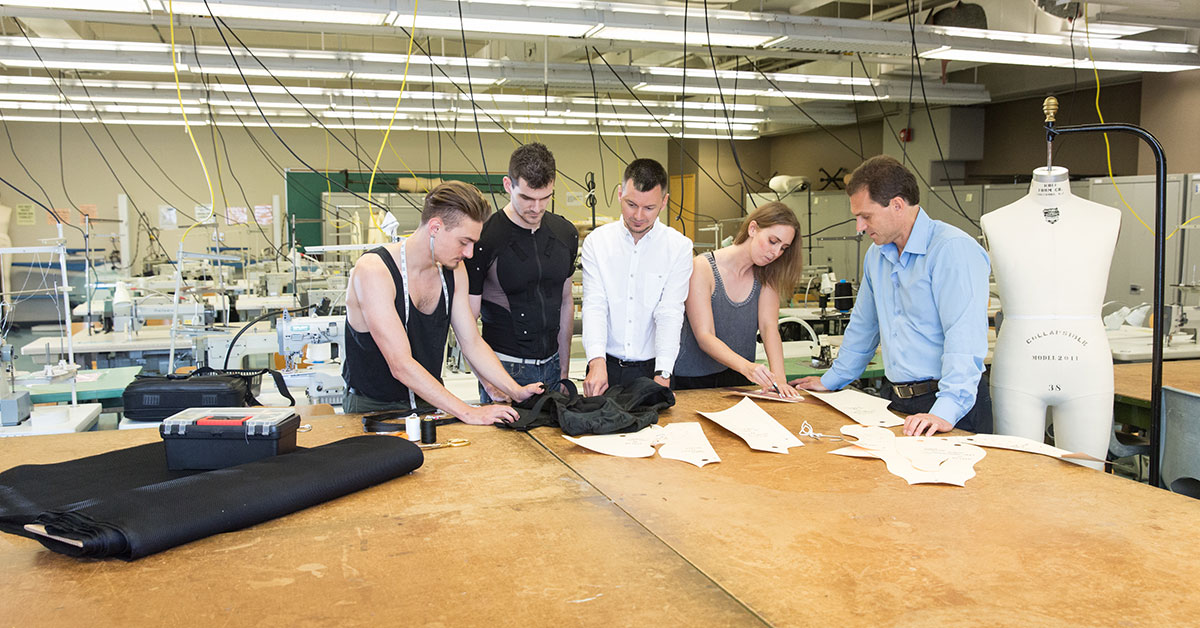
When they approached George Brown, the Stanfields already had a proof-of-concept model. They had worked with Durham College on the vest’s electronics and their online community advised on its look and feel. What they needed from George Brown was help with the challenge of making the ARAIG vest washable, breathable and in line with aesthetic requirements. Two fashion studies students were recruited to undertake the design

They were supervised by principal investigator and faculty member Zoran Dobric, who noted that “IFTECH is a great example of the next level of wearable technology. It can be implemented in both entertainment and gaming industries, as well as simulation and training.”

After many iterations and pattern prototypes, IFTech now has product specifications, and is working closely with manufacturers for commercialization. Recently, IFTech won in the Durham region of the Spark Ignite Competition, taking home a prize of $25,000.

Funded by: Applied Research and Development (ARD) Grant, College and Community Innovation Program, NSERC

About George Brown College

George Brown strives to build a seamless bridge between learners and employment by developing dynamic programs that are informed by industry and workplace-ready graduates who... Learn more