
Plugging into a new housing concept

Family dynamics in Canada are fast becoming more diverse, but the housing industry has been slow to adapt to them. It used to be that families remained in one house for decades or even generations. Today, according to the Vanier Institute of the Family, each Canadian on average owns five houses over a lifetime, upsizing and downsizing as children are born, age, and eventually move out of the nest. Often, families renovate rather than move, which can be an expensive and disruptive process.

This is making the traditional notion of the family home obsolete. Families today need innovative housing models that can quickly and easily adapt to their changing needs. One possible solution is a housing model that can expand or contract as a family evolves. But adapting house models requires adapting everything in them — so this research project examined “plug-in” electrical circuits that can be snapped in and out as needed.

It was visionary Okanagan developer Andrew Gaucher, president of the Okanagan chapter of the Urban Development Institute and of Catalyst Land Development and its parent company, G Group, who approached Okanagan College in 2016, asking for research assistance to explore his idea.

Gaucher teamed up with a 17-year-old carpentry student, an electrical apprenticeship student and an electrical trades instructor, who is an emerging researcher, to explore the possibility of developing a revolutionary concept for housing units. Gaucher wanted help to realize his vision of living-space modules that could be joined and separated again.

“To bring this idea of modularity to reality we need to think about making it easy for families to add another module to their home or take it away as things change,” says Gaucher. “Safe, reliable, dependable and easy connections are vital. And while you’d think there were already-developed systems that meet that criteria, I wasn’t able to come up with any. The idea is to move away from hardwiring all connections to the grid.”

Investigation let Okanagan College researcher to recommend a plug-in system for electrical wiring that’s already commonplace in heavy industry. This system was chosen because it was weather resistant, complied with the Canadian Electrical Code and homeowners can operate it safely and simply, even when the electricity is connected. Now, with the electrical problems addressed, Mr. Gaucher is tackling other construction and infrastructure issues for his adaptable housing.

“I really appreciate and value the support of the College, Luke, and Noah, and the federal government,” Gaucher said. “The opportunity to innovate and create or refine different approaches to housing needs is clearly here and it’s tremendous to have this kind of resource at our fingertips in the Okanagan.”


Partner(s): The G Group
Funded by: Applied Research and Development (ARD) Grant, College and Community Innovation Program, The G Group

About Okanagan College

Situated in one of Canada’s most picturesque and dynamic regions, Okanagan College offers more than 130 different programs, and credentials that range from certificates to... Learn more

Aclarus

Easy access to high-quality drinking water can be a challenge for people outside urban areas — and it was to improve that access that Aclarus Ozone Water Systems approached Lambton College in Sarnia for help to test, develop and optimize its ozone water purification system.

Aclarus, based in Peterborough, Ontario, specializes in water purification through the use of ozone technology. Ozone, an inorganic molecule, is extremely efficient at removing bacteria, pesticides, odours, chemicals (and more) from water.

In June of 2015, Aclarus partnered with the Lambton Water Centre at Lambton College on a research project to validate its system’s effectiveness in treating and disinfecting bacterial contamination in drinking water. The project included installation of a remote monitoring system that allows the consumer or Aclarus technical staff to monitor the system from a smart phone or central control station.

Dino Evangelista, coordinator of the Lambton Water Centre, led the research project together with faculty researcher Kevin Ryan. Two students from Lambton’s Instrumentation Control and Engineering Technology program worked with them.

The research project with Lambton allowed Aclarus to improve and validate its technology, while at the same time improving the customer experience by creating remote monitoring options for the system. Due to the success of this project, Aclarus is planning to continue doing research projects with the Lambton Water Centre.

Partner(s): Aclarus
Funded by: Applied Research and Development (ARD) Grant, Community and College Social Innovation Fund, NSERC, Ontario Centres of Excellence

About Lambton College

As a post-secondary leader in education, training and research, Lambton College has experienced tremendous growth in recent years. In addition to a significant rise in... Learn more

Refining brewing at Refined Fool Brewery

The idea of students getting immersed in beer doesn’t exactly go hand in hand with words like “efficiency” and “productivity,” — but they did when a group from Lambton College worked with Refined Fool Brewing Company, a micro-brewery in the heart of downtown Sarnia.

Refined Fool approached Lambton College for help in minimizing the space and labour their brewing process required, while increasing energy savings, efficiency and productivity. The first part of the project allowed the brewers to monitor the brewing process off site using smart devices. The second part automated keg washing, which was previously done by hand.

Faculty Researcher Kevin Ryan and three students from Lambton’s Instrumentation Control Engineering Technology program worked in collaboration with the Refined Fool team to implement the new technology in their facility.

Refined Fool’s partners say working with Lambton College helped increase profits and reduce production and operation costs.

Partner(s): Refined Fool
Funded by: Applied Research and Development (ARD) Grant

About Lambton College

As a post-secondary leader in education, training and research, Lambton College has experienced tremendous growth in recent years. In addition to a significant rise in... Learn more

A vest with sensations — the next fashion sensation

Entering a virtual reality world may soon be as easy as slipping on a life jacket with the development of ARAIG — a wearable wireless, multi-sensory, immersive suit for gaming and simulation training. The suit is the brainchild of Michael and Brodie Stanfield, founders of Inventing Future Technologies Inc.—IFTech for short — a start-up from Oshawa, Ontario.

ARAIG, an acronym for “As real as it gets,” was developed with computer gaming in mind. It consists of an inner T-shirt-like layer and an outer exoskeleton that looks like a high-tech version of a football player’s pads. ARAIG offers wearers surround sound, vibration, pressure and resistance feedback —basically allowing users to feel what’s happening in the virtual world, where in the past they only saw graphics and heard sound tracks.
ARAIG also has possibilities beyond gaming. The Stanfields have even heard from the Canadian Armed Forces, interested in the product’s potential as a hyper-realistic way to train and simulate combat.

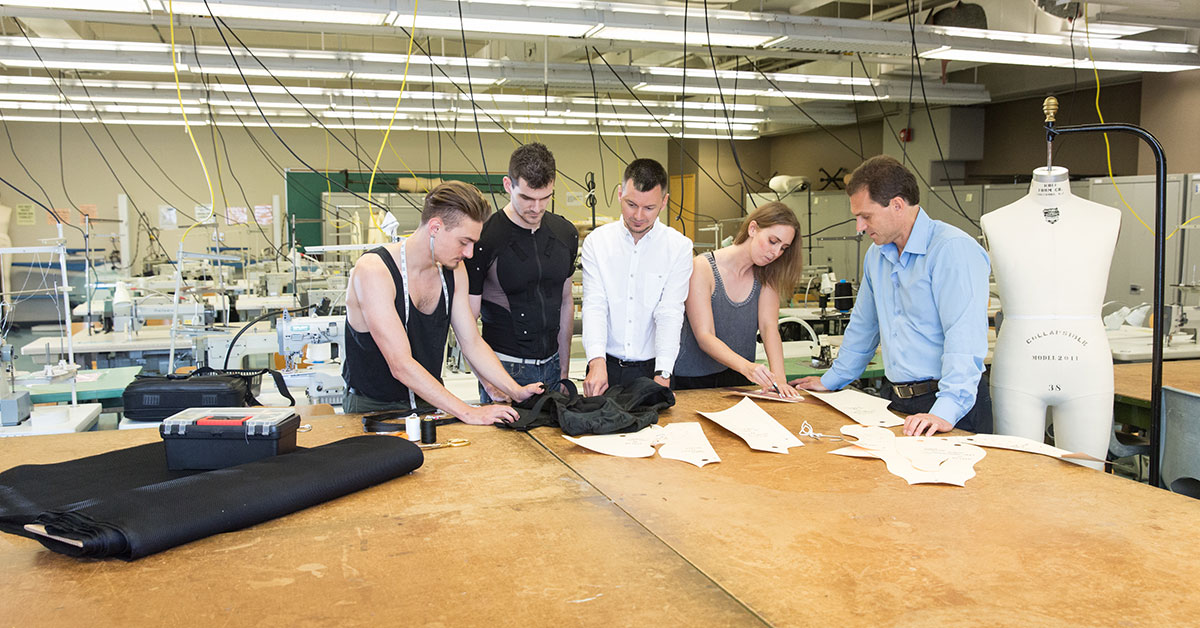
When they approached George Brown, the Stanfields already had a proof-of-concept model. They had worked with Durham College on the vest’s electronics and their online community advised on its look and feel. What they needed from George Brown was help with the challenge of making the ARAIG vest washable, breathable and in line with aesthetic requirements. Two fashion studies students were recruited to undertake the design

They were supervised by principal investigator and faculty member Zoran Dobric, who noted that “IFTECH is a great example of the next level of wearable technology. It can be implemented in both entertainment and gaming industries, as well as simulation and training.”

After many iterations and pattern prototypes, IFTech now has product specifications, and is working closely with manufacturers for commercialization. Recently, IFTech won in the Durham region of the Spark Ignite Competition, taking home a prize of $25,000.

Funded by: Applied Research and Development (ARD) Grant, College and Community Innovation Program, NSERC

About George Brown College

George Brown strives to build a seamless bridge between learners and employment by developing dynamic programs that are informed by industry and workplace-ready graduates who... Learn more

Passive Treatment of Leachates from Forestry Waste

Wood waste from the Quebec forest industry is often stored in large piles that can degrade the soil under and around the stockpiles. Forestry researchers at the Centre technologique des résidus industriels (CTRI) at Cégep de l’Abitibi-Témiscamingue are testing ways to decontaminate water that may be affected by leaching from these stockpiles.

The cégep’s researchers applied their knowledge about treatment of wastewater from mine tailings to the problem of leachates from bark heaps for a local forestry company, Coopérative forestière du NordOuest, Mabarex.

The research team is designing, installing and monitoring a pilot passive treatment of leachate waters in wood residue concentration areas. The system is being set up in two stages. First, the team will design and install hydraulic works upstream of the forest depot. This facility will serve as a reactive barrier. The phenolic compound leachates in the water will be absorbed in the multiple reactive columns in the barrier. Several inexpensive absorption materials will also be tested in this stage. The second stage is neutralizing the phenolic compounds concentrated in the absorption materials. Using the aerobic enzymes in mushrooms, this organic process will improve the biodegradability of phenolic compounds.

This process is a passive treatment technique requiring no pumping or injection system. The new system could provide an effective and low cost alternative to existing techniques that are complex and often ineffective for treating leachate waters in wood residue stocking areas.

“Thanks to this project, CTRI is now a major player in innovation in the region,” says Sylvain Blais, Director General of Cégep de l’AbitibiTémiscamingue. “This project also advances applied research on passive treatment of organic pollutants and develops expertise to meet the increased needs in depolluting effluents in tailing areas, which is currently a major environmental issue.”

Equipment recently purchased by Cégep de l’Abitibi-Témiscamingue for CTRI make it possible to prepare samples, and identify and quantify microorganisms. The polymerase chain reaction (PCR), in which micro-organisms are used to treat a range of pollutants, is one of the potential processes being explored. This equipment will help address regional environmental problems and allow the cégep to offer additional expertise to local partners.

Funded by: Applied Research and Development (ARD) Grant

About Cégep de l’Abitibi-Témiscamingue

La communauté du Cégep de l’AbitibiTémiscamingue est animée par la conviction profonde que la santé d’une société est intrinsèquement liée au développement global des individus... Learn more

Cloud Mapping for Forestry Planning

Geographic Information System (GIS) mapping of forestry resources is moving from desktop to the cloud with assistance from Selkirk College.

Selkirk College’s Geospatial Research Centre (SGRC) conducts applied research, develops applications, and delivers Selkirk’s Advanced Diploma and Bachelor of GIS programs. The research centre has experience developing sophisticated web-based map services. A local forestry software company, Valhalla, approached SGRC for assistance expanding its suite of software designed to help the British Columbia forest industry to manage harvesting operations, production and sales of lumber to domestic and international markets.

The software can run on both the desktop and in the cloud. Valhalla has customized its software for forest operators in southeastern B.C., however, core elements have applications that could be used across the global forest industry. Forestry instructors are working closely with BOS Forestry and research team members to model forest workflows and identify where geospatial software tools could add value.

“This joint project with the Selkirk Geospatial Research Centre has provided a great opportunity to engage with our industry advisory group, staff and faculty at the college to enhance the geospatial aspects of our technology roadmap and development plans for BOS Forestry,” says Grant Sutherland, CEO of BOS Forestry.

The project required a development server that collaborators and BOS clients could all access. Fortunately, the SGRC was able to use the free services in the DAIR cloud. As part of the CANARIE system, DAIR provides excellent bandwidth as well as built-in tools and resources. This is the SGRC’s first exposure to development in the cloud. As software applications move to the cloud, this experience will equip SGRC researchers and Selkirk GIS instructors for the future.

Partner(s): BOS Forestry
Funded by: Applied Research and Development (ARD) Grant

About Selkirk College

Nestled in one of the most spectacular locations in Canada, Selkirk College mirrors the communities it serves. With an eclectic economy built on primary industry,... Learn more

An Android App for Better Energy Use

Lambton College has partnered with global startup Liricco Technologies Ltd. to develop a new android application that can help users save energy.

Liricco’s Valta line energy product is a remote energy management system that can detect standby power, identify waste, and notify users to help them save energy. Currently, only iOS-based smartphone control applications exist for this green-energy technology.

This was a ground-breaking project for Lambton College. The students applied the college’s android development expertise to a project straight out of the energy management industry. Faculty from the Information Technology programs who conducted the research were able to increase their knowledge and skills by troubleshooting in the development stages.

With the developed product, Liricco was able to show off side-by-side functional apps for iOS & Android at Germany and Hong Kong tech trade shows, attracting more investors, and increasing their potential customer base 400%.

“Liricco has benefited greatly by partnering on the development of our android app that we have now commercialized. We are currently looking into a second phase of this project that we are excited to partner with Lambton College with once again,” says Jeff Lin, Executive Director of Liricco Technologies.

Funded by: Applied Research and Development (ARD) Grant

About Lambton College

As a post-secondary leader in education, training and research, Lambton College has experienced tremendous growth in recent years. In addition to a significant rise in... Learn more

3D Configuration Helps Sell Products

Real-time rendering on the web is still a relatively new technology. But it holds great potential for helping customers visualize products they are planning to buy.

Enterprise Resource Planning (ERP) software firm Seradex engaged a research team of applied computing students working with Sheridan’s Screen Industries Research and Training Centre (SIRT) to help incorporate 3D visualization and configuration into its website. Sheridan students and faculty worked to take the product and service to a later stage of commercialization.

By integrating a 3D application developed with the support of Sheridan researchers into its customer website, the software firm will be on the leading edge of innovation in its field, using product configuration and visualization to provide accurate quotes, improve job costing, and streamline processes.

This project will allow Seradex to meet the visualization needs of client companies in a variety of sectors more effectively, using the results to provide better information to internal staff such as engineers and sales people, as well as dealers and customers. This software is applicable in a number of sectors served by Seradex including cabinetry, metal fabrication medical supplies, and capital equipment. It will help increase sales as companies are able to recommend solutions more rapidly and to configure and visualize complex products on a computer screen.

Mark Corker, President of Seradex Web Services, says, “The collaboration with Sheridan through this NSERC/OCE project resulted in a key 3D revisualization prototype that will significantly enhance our software and our customers’ experience. The work of these talented students will result in brand new commercialization possibilities for Seradex.”

Sheridan was able to provide the students with collaborative opportunities with the industry partner, maximizing the engagement of the students, faculty and staff at SIRT throughout the applied research process. Seradex has asked about hiring the students involved in the project once they have graduated.

Funded by: Applied Research and Development (ARD) Grant

About Sheridan College

Sheridan College is one of Canada’s leading postsecondary institutions, serving over 23,000 full time students at four campuses in the western Greater Toronto Area. We... Learn more

A Posture Correction Aid for Wheelchair Users

Wheelchair-bound patients in long-term care facilities often have discomfort from slouching and being unable to reposition themselves. And caregivers suffer from strain injuries trying to lift patients into a more upright posture.

In response to a request from a Halifax long-term care facility several years ago, Nova Scotia Community College occupational therapy students designed a posture correction aid to assist both patients and caregivers. A Nova Scotia manufacturer is now refining the design with the help of the college’s mechanical engineering technology researchers.

MacKenzie Atlantic Tool & Die is a Nova Scotia-based company specializing in manufacturing highly diverse products ranging from steel stampings and precision-machined products to fixtures and gauges used in the aerospace, marine, and renewable energy industries. The company is expanding its business into assistive devices for use in long-term care facilities and has partnered with NSCC to validate the design of the slouch correction aid.

The device consists of a chair cover with adjustable straps that can be used to pull a patient into a more upright posture, or to lift the patient from a wheelchair to a chair or bed. This device was previously developed by NSCC Mechanical Engineering Technology students, refined by subsequent student graduates, and licensed to MacKenzie Atlantic.

“The support provided by NSCC has been critical to the success of the project thus far. The ability to draw on the knowledge and experience of such a dedicated and seasoned research team has given us the jump start we needed,” says Matthew MacKenzie, President and Owner of MacKenzie Atlantic Tool & Die.

NSCC has expertise and facilities in bio-mechanics ideally suited for validation and design improvement that will support the company’s commercialization of the product. The team conducted field evaluations at Northwoodcare Halifax Inc. and ran lab testing on the product’s mechanical design to make improvements to the product’s performance. This project has involved students and faculty from Mechanical Engineering and Continuing Care Assistant and Disability Support programs in the Dartmouth, Bridgewater, and Middleton campuses.

Funded by: Applied Research and Development (ARD) Grant

About Nova Scotia Community College

Nova Scotia Community College (NSCC) is committed to building Nova Scotia’s economy and quality of life through education and innovation, transforming Nova Scotia one learner... Learn more

Biological Pest Control for B.C. Blueberries

Huge numbers of insect predators and parasitoids are reared each year by the biological control industry to control agricultural insect pests in greenhouses.

Although more than 200 of these products are available globally, their use for management of pests on field crops is rare. Douglas College in New Westminster, British Columbia has tested the efficacy of predator releases to control the blueberry aphid, Ericaphis fimbriata, a serious pest of highbush blueberries in B.C. A recent research project was undertaken in partnership with the British Columbia Blueberry Council and Applied Bio-nomics Ltd., a producer of biological control agents.

The applied research project tested the effectiveness of two possible insects to act as biological pest control agents for B.C. blueberries. The brown lacewing, Micromus variegatus, is a relatively new product for aphid biological control while the predatory midge, Aphidoletes aphidimyza, is a well-established product that has been used successfully on many crops worldwide. Researchers released both predators at organic blueberry farms and recorded dramatic declines in aphid populations after releases. These predators show enormous potential to provide an effective alternative for aphid management and establish a new market for biological control products in field crops.

Brian Spencer, President of Applied Bio-nomics Ltd. says, “Our industry is perched on the brink of expanding traditional markets from protected crops into field crops. The Douglas College project on blueberry aphid will enable wider adoption of our sustainable pest control products in field agriculture. Because of this thoughtful and careful research, we have recently entrusted Douglas College to help us develop another product, Amblyseius fallacis, that will have similar acceptance and relevance for the field crop community.”

Industry: Agriculture | Food
Funded by: Applied Research and Development (ARD) Grant

About Douglas College

Founded in 1970, Douglas College provides educational experiences that challenge, enlighten and open doors to lives of passion and purpose. It is the largest degree-granting... Learn more