
Sharing the fruits of research: studying the state of the apple industry in the Okanagan

The amount of land in the Okanagan Valley dedicated to growing apples dropped by 35 per cent between 2001 and 2011 — a shift that led to substantial changes in the industry, with broad repercussions for processing and distribution, and inspired two Okanagan College School of Business professors, Lee Cartier and Svan Lembke, to examine the situation and the new opportunities it has given rise to.

Their work looked in particular at the links among “clusters” — the interconnected businesses, suppliers and other organizations in a geographic area that are all involved in the same industry. Cartier and Lembke found that focusing on common interests and encouraging groups in the cluster to share knowledge benefits everyone involved. At a cluster-wide workshop, the researchers also revealed opportunities to improve that had been missed and recommended adopting cluster-wide quality standards, developing new types of apples, improving production technologies and doing better marketing.

Two students participated in the project. One analyzed apple packing and sales data and did a trend analysis of it. The other summarized data from 17 in-depth interview, summarizing what she had learned from them. Working on this research project provided the students with a new understanding of how companies use research to inform their business practices.

The researchers’ recommendations on the best ways to exploit the collective power of the Okanagan apple cluster were discussed during a stakeholder workshop. The research showed the local cooperative organization, BC Tree Fruits (the largest employer in the cluster), was already enabling smaller firms to share equipment, get field service advice and pool their marketing and sales costs. However, the cooperative overall remained a minor player compared to some of the operations in Washington just the other side of the border and had not been aggressive in positioning products or trying new marketing approaches. After the workshop and armed with the research, the cooperative and other industry stakeholders created a list of actions to improve the performance of the conventional apple industry in the Okanagan.


Industry: Agriculture | Food
Partner(s): BC Tree Fruits
Funded by: College and Community Innovation Program, Engage Grant, NSERC

About Okanagan College

Situated in one of Canada’s most picturesque and dynamic regions, Okanagan College offers more than 130 different programs, and credentials that range from certificates to... Learn more

A bit of research today keeps the doctor away — from the apples

Apples, the fruit that famously keeps the doctor away, are getting some help to keep away unwanted visitors themselves. Ontario’s apple trees are facing damage from a new pest – the apple leaf curling midge. The galls (bumps that appear on leaves) produced by the midges can interfere with the normal growth and development of the terminal shoots of young apple trees, which delays or stunts their structural development.

It’s a particular problem in Durham Region, where the amount of land dedicated to growing apples has doubled in the last five years, because young trees are particularly affected, but apple growers across Ontario are struggling with the midges.

In this collaborative project, the Ontario Apple Growers Association approached Durham College for help finding a way to manage apple leaf curling midges. The first step was to select three apple orchards where data could be collected for a degree-day model (which establishes the rate of the midges’ growth, based on temperature). The researchers use that information for predicting and managing the midges’ development.

The researchers also identified biological control agents for the midges in the orchards and evaluated what impact spraying for midges might have on their survivability.

The project team developed two techniques to research the leaf-curling midges in the lab — one for studying the emergence of adult midges from pupa under different temperatures and the other for looking at the transfer of eggs from field samples to potted trees in the lab, to determine how midges successfully establish themselves on new trees.

The field data showed there are four adult “flights” over the summer and a partial flight in the fall. Egg counts increased very soon after each peak adult flight in May, late June, late July and late August. This is crucial information for effective use of insecticides to control the midges.

Two students from Durham College’s Food and Farming program completed the project in six months, collecting data from the three orchards and tabulating and analyzing it for predictions. Using various concepts, tools and techniques they had learned in the classroom to manage and analyze models for pest management gave the students an opportunity to apply their knowledge in a real-world, collaborative project.

All the 235 members of the Ontario Apple Growers Association will adopt management techniques from this project.

Industry: Agriculture | Food
Funded by: College and Community Innovation Program, Engage Grant, NSERC

About Durham College

At Durham College, the student experience comes first. With campuses in Oshawa and Whitby, Ont. along with a learning site in Pickering, the college offers... Learn more

A mobile platform to keep patients safely in one place — home

When something goes wrong and patients have to return to hospital for the same problem in the month after they’ve been discharged, it takes a toll both on the individual and the health system. According to the Canadian Institute for Health Information, hospital readmissions cost the healthcare system as much as $1.8 billion per year.

It’s estimated, however, that almost 60 per cent of those readmissions could be avoided if those who were most likely to have to return to hospital could be identified and given better care before and after discharge. Older people, those with multiple health problems, those admitted the first time through the emergency department, and men are all more likely to be readmitted within 30 days.

It’s to help such vulnerable patients that ForaHealthyMe.com, a web and mobile virtual care tele-health system, was developed. ForaHealthyMe.com supports pre-operative consultations and post-hospitalization follow-ups for chronically ill and acute-care patients.

The company recently collaborated with Durham College to design and develop a framework to include video conferencing in its platform. It also worked with the college on a tool to help patients manage their chronic conditions at home, with the hospital monitoring them and providing education, consultation and counselling.

The project, which was completed in eight months, involved two computer programming students, who used their skills in HTML, CSS, JavaScript, SQL and data management and — with the integration of Adobe Connect — also experienced a framework that was new to them. Working on this project required the students to learn and expand their skill sets and enhanced their problem-solving skills.

This project considerably expanded the range of services ForaHealthyMe.com offers. The mobile site is live and helping health-care institutions improve the quality of their care and reduce readmissions while enabling patients to do better managing their conditions at home.

Partner(s): ForaHealthyMe Inc.
Funded by: College and Community Innovation Program, Engage Grant, NSERC

About Durham College

At Durham College, the student experience comes first. With campuses in Oshawa and Whitby, Ont. along with a learning site in Pickering, the college offers... Learn more

Bridging the gap between parking management and technology

Drivers with smart cars and smart phones are looking for smarter parking spots, and Precise ParkLink is working to meet that demand. Precise ParkLink is a North York, Ontario-based company involved in all aspects of the parking business, from building parking lots to providing equipment and attendants for them, to managing the revenue they generate.

Having recognized that as the public becomes more tech savvy and dependant on its mobile phones, its expectation for a different way to pay for parking would grow, Precise ParkLink developed a web-based portal called i PASS, designed to streamline the process.

Precise ParkLink then approached Durham College to develop a new multi-platform software system by upgrading its existing system and adding many capabilities to improve the technical infrastructure and enhance the end-user experience.

Durham College worked with Precise ParkLink to develop iPass-X, an iOS app. Combined with a developed Web API, the app creates a secure login portal for the data infrastructure in the company’s control centre. It allows clients to register, update and maintain their personal and parking profiles, view past transactions, and find out about new parking services. The user-friendly design conforms to industry standards and Apple’s application requirements.

Two students from the Computer Programmer Analyst program developed the iOS application, completing the project in nine months. Through the project, they advanced their skills in planning and constructing a structured outline for mobile apps for both iOS and Android.

“The students that we have worked with provide a depth of knowledge to keep the project on track, both in timing and budget. It is refreshing to connect with our future leaders,” the company said in a statement.

f

Partner(s): Precise ParkLink
Funded by: College and Community Innovation Program, Engage Grant, NSERC

About Durham College

At Durham College, the student experience comes first. With campuses in Oshawa and Whitby, Ont. along with a learning site in Pickering, the college offers... Learn more

Battling Arctic weather to test climate change monitoring equipment

Temperatures are warming in the Arctic much faster than in other parts of the planet, and are having a serious impact on Northern Canadian ways of life, roads, infrastructure and wildlife, to an extent unimagined in the south.

However, it is possible the North is a harbinger of things to come elsewhere and offers an early chance to learn about what climate change does, and perhaps how to mitigate its effects.
Furthermore, the arctic contains huge stores of greenhouse gases; the potential impact of their release is not well understood.

For all those reasons, tracking changes in arctic temperatures and understanding the release of greenhouse gases from tundra regions are key scientific challenges. But collecting data in the Arctic winter is fraught with difficulties including logistics, power, the resilience of equipment and resources in remote areas.

Researchers at Aurora College in Yellowknife worked on a project to test and develop equipment capable of monitoring climate change (specifically carbon dioxide gas, temperature and CO2 soil flux) in the difficult conditions of the Arctic tundra in summer and winter in Inuvik.

The researchers found that testing areas of low and high shrub on the tundra in summer led to significant fluctuation in CO2 in the ground, depending on temperature and vegetation cover; higher shrubs led to more fluctuation. At the Aurora Research Institute in Inuvik in the winter, sampling interval and the snow cover were found to have some impact on measurements. This information will be used to refine equipment for winter use.

Energy and Natural Resource Technician students from the college helped to dig out and make observations on equipment on a very cold (-35C) January day with little available sunlight. It was an opportunity for them to learn about climate change while using field equipment to take field measurements about the impact of snow cover on temperatures under snow pack. The work, made possible by a grant from NSERC, gave students an invaluable opportunity to see firsthand how scientific experiments are conducted.

Aurora College researchers are working with Eosense Inc., an environmental gas monitoring company, on a second stage project for a monitoring network across the Canadian North. This study will be very helpful as Eosense works on further development of winter testing equipment and understanding the issues and challenges of arctic monitoring. It will also enable scientists to more accurately measure the impact of greenhouse gases on climate change.

Industry: Environmental
Partner(s): Eosense Inc.
Funded by: College and Community Innovation Program, Engage Grant, NSERC

About Aurora College

Aurora College has been providing education and training for Northerners for nearly 50 years. From its roots as a technical-vocational school operating out of Fort... Learn more

A big problem for Little Harbour

In picturesque Little Harbour, Nova Scotia, the livelihoods and pastimes of residents are inextricably linked to the water. More than 650 permanent and seasonal homes, along with six commercial shellfish harvesting areas, lie along Little Harbour’s 31.5 kilometres of shoreline.

But the beauty and prosperity of the area is being undermined by water contamination levels in the harbor, which have been on the rise for some years. The main contaminant is fecal coliform—the bacteria found in feces, and one that can accumulate in shellfish tissue. The presence of fecal coliform and the disease-causing pathogens it can contain has had an impact on both recreational and aquaculture sites around Little Harbour — two of Little Harbour’s six shellfish-growing areas are under restrictions that require costly additional steps to ensure the product is safe for consumption.

It’s believed two factors are to blame for the degradation of Little Harbour’s water — more houses that rely on residential septic fields are being built in the area, and precipitation patterns that are changing. The combination has increased the number of land-based contaminants being flushed into the water.

In August of 2016, Nova Scotia Community College’s Applied Geomatics Research Group partnered with AquaDelights Seafood Inc. and the Aquaculture Association of Nova Scotia to investigate the sources and circulation patterns of the bacterial contamination.

They began by modelling water circulation patterns; results showed that many bacteria particles released into Little Harbour were transported only a few meters from their points of origin. They also discovered the changing tide left low concentrations of contaminates settling along the shorelines and increasing the mean fecal coliform count.

The work included a spatial and statistical analysis of 25 years of water quality data and gathered integrated underwater mapping data and aerial photographs of Little Harbour.

Once the work was completed, the information was shared with the community to influence future actions and encourage remediation of sources of contamination. Most Little Harbour residents were aware of the environmental impact of septic runoff in general, but many believed the tide cycle carried contaminants out to sea, and only learned that was not true from this project. As a result, this research stimulated interest in remediating sources of contamination, and increased local understanding that deteriorating water quality is a hindrance to both environmental and economic health.

Since the conclusion of NSCC’s research in November 2016, the community of Little Harbour has formed the Community Watershed Management Group to spearhead necessary changes and improve water quality in the area.

“The Little Harbour water monitoring project is an important first step in understanding and communicating the need to work with coastal communities to provide the research that will pave the way forward for a brighter future,” said Tom Smith, executive director of the Aquaculture Association of Nova Scotia.

Funded by: College and Community Innovation Program, Engage Grant, NSERC

About Nova Scotia Community College

Nova Scotia Community College (NSCC) is committed to building Nova Scotia’s economy and quality of life through education and innovation, transforming Nova Scotia one learner... Learn more

Power line research shocks and impresses

Shannon Developments Corp. assesses power lines around the world. For more than 20 years its assessments have helped utilities to replace only the power lines that are wearing out, instead of going through scheduled replacement, which may mean lines that are still performing are taken down.

Recently, Shannon’s assessment process has evolved toward digitized analysis — and company owner Douglas Shannon needed samples of power lines that had deteriorated in different ways. With them, he could create digital files to be used in an analytical computer model. Rather than using actual corroded power lines for his research, Shannon needed a method to simulate aging on conductors.

“This is a very high-stakes game for utility providers because of the expense to replace the lines,” Shannon said. “Creating this analytical system from the physical models will allow us to provide our clients with a comprehensive and cost-effective assessment of their aging power line infrastructure.”

Shannon approached the Southern Alberta Institute of Technology (SAIT) to undertake an applied research project with design, testing and fabrication researchers in the institute’s Applied Research and Innovation Services (ARIS) department. The researchers created 15 samples of simulated power lines affected by different types of corrosion.

“Now that we have the physical samples, we’re looking to create the digital models that reflect them. These digital files will then be used in an analytical computer model,” Shannon explained. “What has been advantageous for me about working with [the Applied Research and Innovation Services department] is that it allowed me to focus on the computer model while researchers developed the physical samples, very hands-on work that required a lot of time and attention to detail.”

There were also advantages for SAIT students who got an opportunity to collaborate with SAIT researchers on the work, and for utility companies which will ultimately get efficient, fast and accurate information about the state of their power lines and whether they need to be replaced from this multi-faceted research.

Industry: Manufacturing
Funded by: Engage Grant

About SAIT

SAIT (Southern Alberta Institute of Technology) is a leader in action-based learning, delivering relevant, skill-oriented education. We offer two baccalaureate degrees, three applied degrees, 73... Learn more

Parisian Pastries from Prairie Pulses

The rich food value of dried peas, beans, lentils and chickpeas has been known for centuries — their collective name, “pulses”, comes from puls, a Latin word that means both “seeds” and “porridge”. Pulses are widely consumed both as animal feed and in savoury dishes for humans around the world, and research continues to expand their uses.

Some of those new uses are remarkable — the crowning achievement of this project was to create a nut-free, egg-free French macaron using navy bean flour as a butter substitute.

Best Cooking Pulses is a family-owned Canadian processor of pulse crops grown in Manitoba. Established in 1936, it keeps a close eye on developments in new ways to use pulses. Thanks to funding from the Natural Science and Engineering Research Council (NSERC), Best Cooking Pulses partnered with Red River College’s culinary research program to investigate the possibility of using pulse flour in baking to replace eggs.

One student, Alyssa Houston, was brought in to work on the project as part of her culinary work experience placement — the first time a culinary student has gained work experience through research rather than in food service. She even had the chance to demonstrate the research in public, at table-top discussions with industry. After the project, she went on to a job in food manufacturing, helping the company with production as well as recipe creation using the skill from this project.

Best Cooking Pulses is using research from this project to showcase the advantages and versatility of navy bean flour at conferences (such as the Research Chef Association), and to prepare papers demonstrating this new application for bean flour to clients and potential clients.

Industry: Agriculture | Food
Funded by: Engage Grant, NSERC

About Red River College Polytechnic

Red River College (RRC) is Manitoba’s largest institute of applied learning. The institution is renowned for providing accessible, innovative, applied learning and research in an... Learn more

Making power wheelchairs smarter

Many people who use power wheelchairs have poor manual dexterity because of spinal cord, stroke or head injuries, or because of degenerative diseases. Even getting in and out of an accessible vehicle can be time-consuming, and sometimes dangerous, for them. Other tasks — such as taking a shower — require an attendant to drive the wheelchair away.

SmartChair gives people who use wheelchairs more freedom and self-reliance while significantly improving their safety and mobility. SmartChair is a control system which can easily be integrated with any existing power wheelchair. The goal of the project is to give users added independence by improving their control of their power wheelchair, regardless of their level of ability.

A power wheelchair outfitted with the SmartChair control system will also offer computer-assisted autonomous movement to its user, letting him or her automate certain tasks. That might include following a pre-defined path, getting in and out of an accessible van, or navigating indoors in narrow hallways, through doorways and around tight corners. It’s a technology based on lived experience: several years ago, Eightfold Inc.’s president, Ke Wang, had an accident; he has used a power wheelchair ever since, and the idea for SmartChair grew from barriers he faces every day.

The SmartChair project got a boost when it partnered with a team of four students from Algonquin College, led by researchers Dr. Theo Mirtchev and Dr. Bruno Rocha. With funding from Ontario Centres of Excellence and the Natural Sciences and Engineering Research Council, the students worked as research assistants from January 2016 to April 2017. They acquired experience in developing both hardware and software, control engineering, sensors and in testing and measuring technology.

SmartChair can change the lives of power wheelchair users every day, in a variety of ways. They include better control in narrow spaces such as doorways and ramps and the ability to “drive” the wheelchair when it’s empty because the user has transferred from it to bed, the couch or the shower. Changes such as those can reduce the cost of attendants and allow for greater independence. It’s also small and lightweight.

Funded by: Engage Grant, Ontario Centres of Excellence

About Algonquin College

The mission of Algonquin College is to transform hopes and dreams into lifelong success. Algonquin College, a national leader in applied and online learning, offers... Learn more

A cool new way (literally!) to make ethanol

Biofuels, processed from agricultural waste and other living matter, have long been seen as a key element in providing cleaner energy and fighting global warming. For more than two decades, scientists and engineers have been developing methods for producing ethanol from straw, wood chips, corn cobs and other waste material, called biomass.

But use of ethanol has been limited by the high cost of producing it. One key driver of cost is the inability of the microorganisms used in the process (which are usually genetically modified) to tolerate high levels of ethanol.

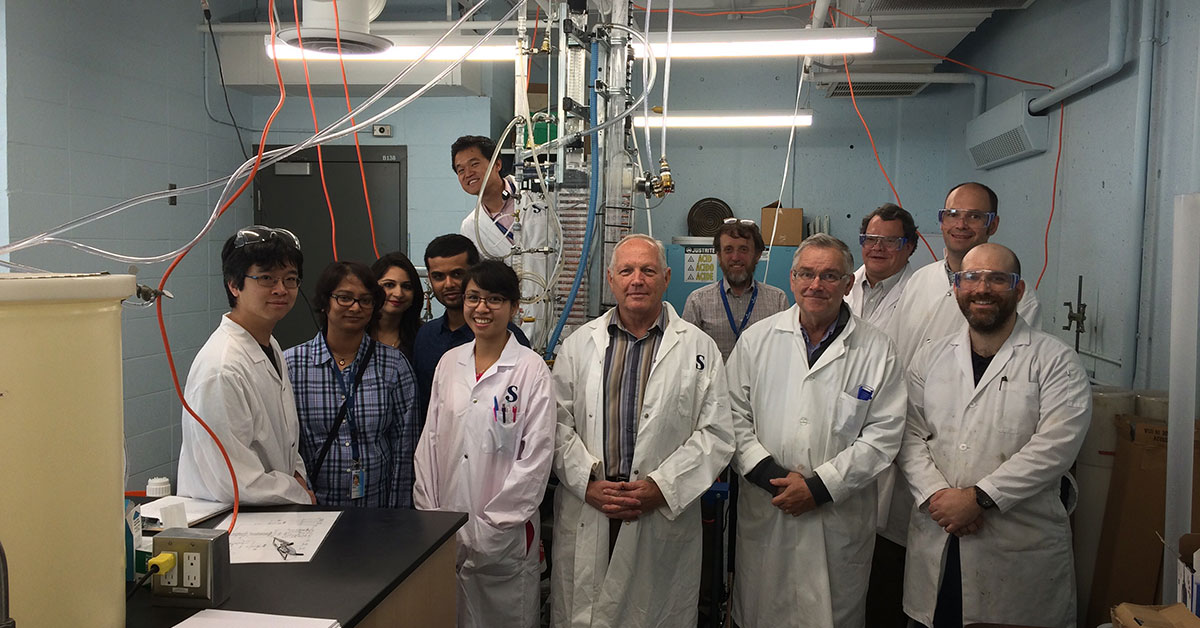
This was the focus of a partnership between Sheridan College and Drystill, a company that has developed an innovative process known as pass-through distillation. Its advantage is that it can be done at lower temperatures than most distillation, which preserves the expensive enzymes needed to create ethanol from biomass, thus greatly reducing cost.

The aim of the project was to design, construct, commission and test a pilot unit to demonstrate whether pass-through distillation can passively remove volatile components from a fermentation broth at room temperature and absorb them into a non-toxic brine solution with no net heat input in the process. The answer was yes, and once commercialized, this technology has the potential to make biofuel — such as ethanol made from agricultural residue — economically feasible.

The project took nine months from developing the proposal to completion, and involved four students. Two were Chemical Engineering Technology students, mainly involved in designing the process and constructing peripheral processes and the auxiliary equipment driving the pilot unit. Two Environmental Control students were involved in commissioning the unit and analysing samples from the trials. Because the process was so novel, many of the students’ activities focused on problem-solving and rapid prototyping, which allowed them to gain new skills that are in demand in Canada’s growing biofuel sector.

Every country that signed the Paris Agreement, including Canada, pledged to slow the build-up of carbon dioxide in the atmosphere. Biofuels such as ethanol are seen by governments and advocacy groups as one way to help do that. However, the high cost of producing them has stood in the way of widespread use. By distilling the ethanol economically at room temperature, this project could make advanced biofuels profitable to manufacture and sell.

Industry: Environmental
Funded by: College and Community Innovation Program, Engage Grant, NSERC

About Sheridan College

Sheridan College is one of Canada’s leading postsecondary institutions, serving over 23,000 full time students at four campuses in the western Greater Toronto Area. We... Learn more