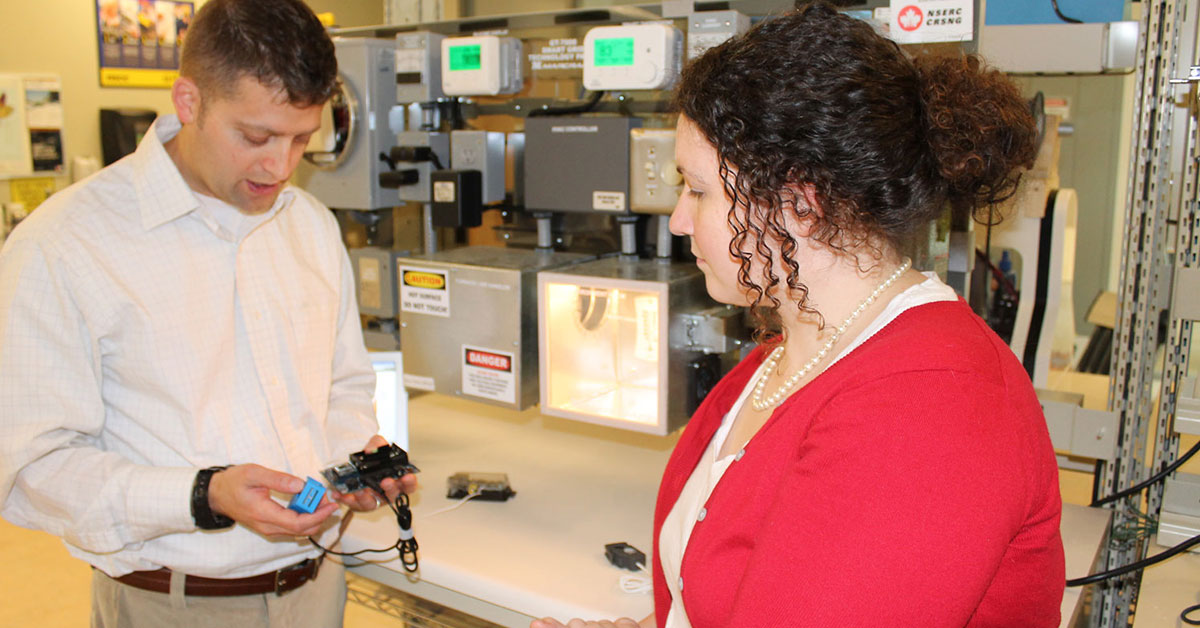

A Precision Watering System for Turfgrass

Urban lawn watering is the single largest water demand on municipal water supplies.

An Alberta company developing irrigation technology recognized that water scarcity and a need for greater irrigation efficiency could provide a market opportunity.

Olds College was approached by the company, 1318552 Alberta Limited, and asked to test its novel turfgrass irrigation system for residential and commercial applications. The computer-generated program alters the flow of water to the head depending on the shape and size of areas to be watered. This system requires fewer irrigation heads and less underground piping, which would reduce installation costs.

Through its partnership with the college, the company gained access to the expertise of college irrigation specialists and state-of-the-art indoor and outdoor test facilities. Initial testing found that the system provided a uniform distribution of water superior to the industry standard. The ease of installation and the computer program that optimizes flow are the key market advantages of the system.

“Olds College provided a unique opportunity to compare our system with an industry standard,” stated company representative Cam Cote. “We were able to install our head in the indoor facility and with the variable speed pump were able to precisely control water flow. This allowed us to make necessary adjustments to the head and the computer program. Outdoors, we were able to compare our system with their new decoder system. Nowhere else could we have accessed facilities like these!”

A critical component for the Prairie Turfgrass Research Centre at Olds was attracting highly qualified personnel to the research program. Katie Dodson, a Canadian researcher with considerable industry experience in drought tolerance of grasses for recreational turf, was hired as lead research scientist. Her research will provide information that could lead to significant water savings.

Turfgrass research at the centre is focused in four areas: strategies to reduce winter injury, biotic stress management, grass selection for alternative uses, and water conservation. Partners include the Canadian Turfgrass Research Foundation, local golf courses, turf and sod growers, and the City of Lethbridge.

Funded by: Innovation Enhancement (IE) Grant

About Olds College of Agriculture & Technology

Olds College of Agriculture & Technology is a technical institution offering industry demand-driven programming with an intensive focus on agriculture and technology. Founded in 1913,... Learn more

Raising Fish to Grow Good Gardens

The results of one of Lethbridge College’s most delicious applied research projects can be found in restaurants throughout southern Alberta – produce grown in a greenhouse on the college’s campus.

This produce is grown using an innovative combination of aquaponics and aquaculture. Aquaculture and aquaponics are exciting developments in agriculture where fish and plants are cultivated together in a growing system with re-circulating water that produces plants year-round safely and efficiently. The novel system also enhances growth rates of greenhouse crops. The plants are seeded each March and nurtured by a water supply provided by fish. The water is then re-circulated back to the college’s fish facility for reuse. No herbicides or pesticides are used, and the aquaponics produce is harvested twice weekly starting from May until the end of October and for sale to the public.

In 2013, Lethbridge College received funding to advance applied research in aquaponics. Principal investigator Charlie Shultz assists aquaponics producers in the region to overcome technical problems and policy obstacles in their systems.

“This [project] could go a long way to addressing food security issues,” Schultz says.

Industry: Agriculture
Funded by: Innovation Enhancement (IE) Grant

About Lethbridge Polytechnic

Lethbridge Polytechnic has been a leader in education and innovation since becoming Canada’s first publicly funded community college in 1957. Each year, the institution welcomes... Learn more

A Hub for Smart Energy Use

A small Nova Scotia company has gained a reputation for developing innovative, custom designed energy analysis software to improve energy efficiency. Launched in 2013, The Efficiency Store offers a range of energy analysis services for homeowners and local businesses.

The company founder, Megan McCarthy, came to Nova Scotia to complete her post-secondary education. While studying, she recognized an opportunity to become an entrepreneur in the energy efficiency sector. A researcher encouraged her to contact the Nova Scotia Community College (NSCC) Applied Energy Research Lab. The result was a collaboration, with NSCC and The Efficiency Store working together to develop new energy monitoring hardware and analysis tools that will allow the company to offer a more comprehensive range of energy services.

“Working with NSCC is like having my own team of experts that will help fast track my prototype and get to commercialization faster.” McCarthy says.

In 2014, NSCC was awarded a CCI Innovation Enhancement grant for research on energy data using advanced telemetry and analytics (Energy DATA). The aim of the Energy DATA program is to develop a cluster of research and development partnerships with local industry, build new applied research capacity in the region, and create new technology products and services. The research program has allowed NSCC to become an important hub for smart energy research, and to attract interest from a variety of partners in the region, ranging from small innovative startups, like The Efficiency Store, to industry leaders such as IBM Canada.

Funded by: Innovation Enhancement (IE) Grant

About Nova Scotia Community College

Nova Scotia Community College (NSCC) is committed to building Nova Scotia’s economy and quality of life through education and innovation, transforming Nova Scotia one learner... Learn more

Better Connections for Electronic Health Records

Easy patient-access to health records in Ontario has lagged behind the rest of the country and the world. While data on treatment and health history is now collected electronically, until recently there has not been a safe and simple way for health facilities to share this information with patients.

Hospitals and healthcare providers want to offer patients access to records, data, recommendations, advice and support. This access can increase patient knowledge and compliance, and lead to increased health and wellness. Secure communication is the key.

Mohawk College teamed up with researchers at McMaster University to explore secure methods to integrate Electronic Medical Records (EMRs) and Patient Health Records (PHRs) to put more relevant data in the patient’s hands – with less chance of losing data.

The Mohawk/McMaster research team came up with a communicative and connected process.

A customizable, open-source medical records system developed at McMaster, OSCAR, feeds patient data to a patient identifier cross-referencing tool (PIX manager). The PIX manager updates patient records to a cross-enterprise document sharing system (an XDS registry). This data is then available for a third party patient health record system to fetch, by cross-referencing the patient’s record identifier and fetching the document identifier from the cross-enterprise shared system. This means patient information about lab results, diagnostics and treatment from several hospital departments or clinics can be stored in the cross-enterprise registry and retrieved by a patient using a secure patient identifier.

The coordinated system offers new capabilities for doctors to offer their patients better insight into their own health history.

Funded by: Innovation Enhancement (IE) Grant

About Mohawk College

Mohawk College educates and serves 30,000 full-time, part-time and apprenticeship students at three campuses in Hamilton, Ontario. More than 1,200 international students from over 70... Learn more

Making Technology Accessible for Wheelchair Users

People with mobility issues often have difficulties using smart phones and other common electronic devices.

In an attempt to meet this need, a small Toronto technology start-up has developed a set of open software and hardware tools called Tecla that facilitates access to electronic devices for people with mobility impairments. Komodo Open Labs (KOL) envisioned a user-friendly Bluetooth interface device that would give individuals with special needs access to commercial smart phones. But the goal went further: the company wanted to make it smaller, mountable, and lower-cost, letting more people join the conversation.

The device had to be easy to access, simple to install and maintain, and still affordable. For help with this, KOL came to George Brown College’s Centre for Construction and Engineering Technology (CCET). The students were challenged to design a device that allowed someone with limited mobility to join the same communication network that able-bodied people access easily.

After many rounds of prototypes, CCET students developed a product that is a compact and less costly version of KOL’s initial prototype. The result was an aesthetically pleasing, unobtrusive device to mount on a wheelchair. Students gained much from the collaboration, learning that ultimately, accessibility is something that all good design should accommodate.

“George Brown’s students bring more ‘out of the box’ thinking,” said Mauricio Meza, head of Business Development at KOL. “They try to find more creative solutions to the project.”

Partner(s): Komodo Open Labs
Funded by: Innovation Enhancement (IE) Grant

About George Brown Polytechnic

George Brown strives to build a seamless bridge between learners and employment by developing dynamic programs that are informed by industry and workplace-ready graduates who... Learn more