
Wave Energy Research

College researchers in Burin, Newfoundland are experimenting with wave energy to develop a pump that could provide water for aquaculture operations inland.

The College of the North Atlantic team is in the fourth year of a research project on wave pump application, development and optimization. Over the course of the project, the team has developed a wave-powered device to pump water to shore for a land-based aquaculture pilot farm.

Along with the original project plan, this multiparty funding has supported the development of the Wave Energy Research Centre (WERC), a field station with significant infrastructure, for long term research and development work. WERC operates out of four buildings on the wharf in Lord’s Cove, in southeastern Newfoundland. The research centre has six mooring sites within 1.5 kilometres of the station permitted under the Canadian Navigable Waters Protection Act. In addition to a weather station, wave data collection and device mooring sites, WERC also houses the Multi-Trophic pilot aquaculture farm, a lab and workshop space. The site is equipped with an emergency back-up power supply sufficient to run the farm, data acquisition equipment and high speed data connections for onsite monitoring and control of equipment.

Wave energy researchers have measured waves as high as 11 metres at 25 metres depth; and six-to-eight-metre waves are not uncommon in winter. When scaled to the full depth, these conditions represent the extremes of environmental conditions experienced in offshore installations. The research team is currently discussing the potential for other projects at the site with a number of institutions and companies.

A remotely operated vehicle (ROV) was purchased through a CCI Applied Research Tools Instruments grant and deployed to increase the ability, effectiveness and safety of performing underwater inspections of the equipment being tested and of the installed instrumentation. This system is small enough to be easily deployed from a local fishing vessel, while powerful enough to be able to operate during non-storm conditions at the site. Additional instrumentation will enhance researchers’ ability to collect data at the site.


Funded by: Applied Research Tools and Instruments (ARTI) Grant, Government of Newfoundland and Labrador, Research and Development Corporation of Newfoundland and Labrador

About College of the North Atlantic (CNA)

College of the North Atlantic is Newfoundland and Labrador’s public college – one of the largest post-secondary educational and skills training centres in Atlantic Canada,... Learn more

Large Building Air Leakage Testing

Air leakage is now widely recognized as one of the most critical parameters affecting a building’s energy use, indoor air quality, comfort and durability. This is particularly true in Manitoba’s extreme climate, where there have been several notable and expensive large building envelope failures.

Red River College (RRC) and its research partner, Manitoba Hydro, have recently completed a project investigating the air leakage characteristics of 26 buildings. A CCI Applied Research Tools and Instruments grant provided funding to purchase equipment to conduct these tests.

This research project has helped to establish baseline air leakage rates and to develop a practical air leakage testing protocol for current building standards. The project findings have also influenced at least two building retrofit projects by identifying critical air leakage pathways.

“The whole idea of commercial building air leakage was not very well understood. The results from this project have provided significantly more data than we’ve ever had in the past,” said Harry Schroeder, Building Systems Engineer with Manitoba Hydro. “An advantage of working with the college has been that they have the resources and staff, but they also have the facilities, and there really aren’t a lot of facilities in Manitoba to do buildings-related research.”

Four RRC students were part of the research team. Continued work in this area will significantly expand knowledge about air leakage characteristics and testing techniques for commercial buildings at both a provincial and national level.

Learn more in this video.

Industry: Building
Partner(s): Manitoba Hydro
Funded by: Applied Research Tools and Instruments (ARTI) Grant

About Red River College Polytechnic

Red River College (RRC) is Manitoba’s largest institute of applied learning. The institution is renowned for providing accessible, innovative, applied learning and research in an... Learn more

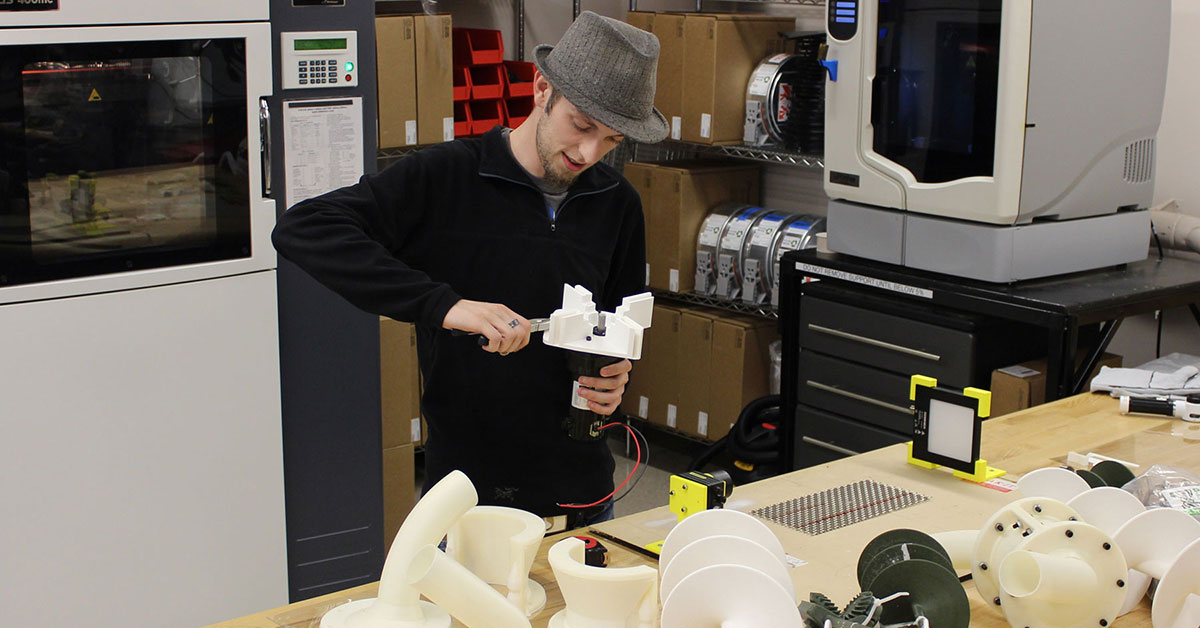
3D Cloud Design for Mining Hydraulics

A leading specialist in industrial drive and control technologies was contracted to manufacture and install a hydraulic system at the Ontario Graphite mine site in remote Kearney, Ontario. But the company, Bosch Rexroth, did not have the means to obtain the precise measurements of existing plant components that were needed to manufacture the new hydraulic system for the mine.

Bosch Rexroth asked for assistance from the Advanced Manufacturing Innovation Centre team at Niagara College, which used the Faro Focus 3D laser scanner to scan the plant to capture geometric and physical proportions of the machinery. This innovative program used cloud-capacities to reveal the internal design limitations of the building in 3D images. The team then developed the scan data for the mine, and provided Bosch Rexroth with design information for its engineering team to use as the base for the hydraulic piping layout.

“By using 3D point cloud technology, the project team completed the entire design process ahead of schedule and below budget,” according to Jim Lambert, C.E.T., Design Manager with Bosch Rexroth. “Fully detailed piping drawings were created, allowing all pipes to be prefabricated ahead of time, eliminating the need for costly welding equipment and trades people on-site during the installation phase.”

Bosch estimates a 42 per cent savings in time and labour will be realized using the services and expertise at Niagara College and the Faro Focus and related software, purchased with an Applied Research Tools and Instruments grant.

Industry: Manufacturing
Partner(s): Bosch Rexroth
Funded by: Applied Research Tools and Instruments (ARTI) Grant

About Niagara College

Established in 1967, Niagara College has grown to become a leading global college and one of Canada’s most enterprising postsecondary institutions. With a mission to... Learn more

Animal Semen Sexing

Being able to determine the sex of animal offspring is of significant value for animal producers, and offers opportunities for research to develop new commercial processes. The only sexing tool currently on the market is expensive, leads to lower fertility, and is only effective with heifers.

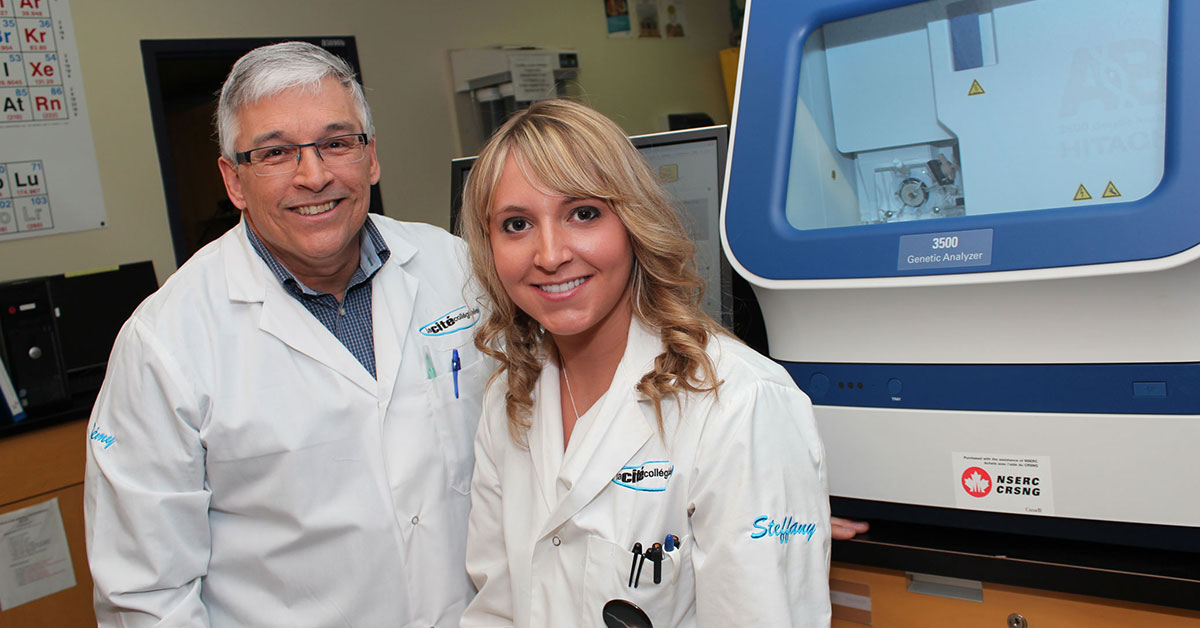
Ab Biotech Inc. in Gatineau, Quebec is a company working to develop an immunological approach to sexing semen for all species, including humans. It has collaborated with the Centre de recherche en biovalorisation (CRAB) at La Cité since 2009 to design a process for producing and purifying antibodies in animal semen sexing.

New equipment at La Cité purchased through an Applied Research Tools and Instruments grant allows the research team to 1) produce recombinant immunogens and antibodies using an accelerated process 2) produce bacteriophages for the immunocapture of sperm cells, and 3) do genotyping and quantification of fractionated animal semen and sex-specific embryos.

Ab Biotech President Robert Letellier says, “Ab Biotech has benefitted tremendously from the ultramodern equipment acquired by La Cité over the past several years. This helps biotech companies like ours a lot because a number of us can share expensive tools we truly need but call on only occasionally. It’s saved us hundreds of thousands of dollars and attracted investors. We’re extremely thankful.”

La Cité’s professors and technologists bring their scientific expertise to these bio-industrial innovation research projects and help to train highly specialized workers for cutting-edge fields. Through the Ab Biotech Inc. partnership, four students a year complete co-op work terms, get part-time jobs, and complete practical in-course projects. Six of the program’s graduates have secured jobs with Ab Biotech.

Industry: Agriculture
Partner(s): Ab Biotech Inc.
Funded by: Applied Research Tools and Instruments (ARTI) Grant

About La Cité

La Cité est un collège d’arts appliqués et de technologie situé à Ottawa, la capitale nationale du Canada. L’établissement est le seul collège francophone de... Learn more

Upgrading Precision Optical Micro-assembly

In the biomedical field, integrating micro-optical devices requires very tight assembly tolerances and reliable processes that are scalable to industrial production. Designing and testing these systems for micro-assembling in manufacturing can only be done with highly specialized and precise equipment.

The Centre collégial de transfert technologique en optique-photonique (Optech) was able to acquire the specialized equipment for micro-assembly of optical components in 2013 through a College and Community Innovation grant. This allowed the college to outfit a laboratory specialized in optical micro-systems where industrial manufacturing conditions could be reproduced to encourage automation of micro-manufacturing, micro-assembly, and quality control methods.

Over the past few years, the Optech centre has carried out several optical micro-assembly projects in sectors requiring high-precision optical elements, such as telecommunications and biomedical and industrial engineering. One of its industry partners has been Dental Wings, which produces dental system technologies to help measure and plan dental implants, bridges, and dentures.

“Outfitting Optech with a lab for the microassembly of optical components has allowed Dental Wings to accomplish several projects,” says Jean-Marc Perot, Director of Dental Wings. “Our work of designing and implementing assembly processes for high-level optical microsystems called for cutting-edge expertise and equipment. Without local access to these skills and tools, we would certainly have had to subcontract a larger part of our R&D outside of Canada.”

Partner(s): Dental Wings
Funded by: Applied Research Tools and Instruments (ARTI) Grant

About Cégep André-Laurendeau

Le Cégep André-Laurendeau est un cégep public de langue française, situé dans l’arrondissement Lasalle à Montréal. Le Cégep, pour qui les étudiantes et étudiants sont... Learn more

Cleaning up Contamination at Mine Sites

Bioremediation is a promising technique that can assist in mine closure and reduce heavy metal contamination of mine sites. Yukon College researchers have been working to advance bioreactors from the lab to the field through applied research. Pilot-scale bioreactors, or constructed wetlands, were introduced to the Minto mine site in central Yukon by Dr. Amelie Janin, Yukon Research Centre’s Industrial Research Chair in Mine Life Cycle, and her students.

Yukon College students worked in both the lab and the field, with one student coordinating the experimental design and purchase of research materials while two other students built the pilot bioreactor at the mine site.

Dr. Janin was able to further her research in northern bioremediation with one of her industrial partners, Capstone Mining Corp.

“Working with Dr. Janin has been very beneficial so far and has allowed us to engage in the testing of this new technology here, in the Yukon,” said Martin Haefele, Permitting Manager at Capstone Mining Corporation.

A technical report on the preliminary results has been co-written by the industrial partner and student researchers. Both students and mine employees have learned the science behind this technology and can apply this technique in future planning and applications.

Industry: Environmental
Funded by: Applied Research Tools and Instruments (ARTI) Grant

About Yukon University

Yukon University is the only publicly funded post-secondary education institution in Yukon, a territory of 36,000 inhabitants spread out over 482,000 square kilometers. The University... Learn more