
Easier video surveillance

Lanoptic Video Solutions Inc. designs, sells and supports digital video devices for security and surveillance. It recently developed a system for installing digital video cameras that combines the mounting system with tools and a fastener. Called Novattach, the system makes cameras much simpler and faster to install than traditional methods.

Lanoptic, however, wanted to reduce the device’s overall cost without affecting its functionality and turned to researchers and students at Durham College for help, with a goal of ultimately creating a family of engineered solutions.

Two students from the Mechanical Engineering Technology Program worked on this project, creating designs for the mounting bracket and 3-D printing the prototypes. The students involved got to use the latest manufacturing technology, as well as developing a broad range of skills, from project planning and management, prototyping, researching material, sourcing components and choosing suppliers. They also had to make presentations, collaborate and manage conflict — all increasing their likelihood of being hired quickly after graduation.

The project was a key step towards the commercialization of Novattach as a highly competitive product. The new mounting bracket enabled Lanoptic to capture 10 per cent of the digital camera installation business in its first year. The company expects to get more orders, expand into new markets, and bring manufacturing of the product to Canada, creating jobs and a positive economic impact.

Industry: Manufacturing
Funded by: NSERC

About Durham College

At Durham College, the student experience comes first. With campuses in Oshawa and Whitby, Ont. along with a learning site in Pickering, the college offers... Learn more

Not paving, but paradise — creating an organic garden

White Oaks Resort and Spa in Niagara on the Lake, Ontario, wanted to convert 1,152 square feet of its property from grass into a sustainable garden. The area abuts a road and is exposed to high winds, car residue and pollution.

Michael Wakil, White Oaks’s chief development officer, said the original plan was to extend the resort’s parking lot but he just couldn’t go through with it. “I realized when you look out, it would just be asphalt. There’s the parking that’s already here, then a roadway and then [another] parking lot. That’s a lot of asphalt,” he said. “It’s been a dream and a vision for about three years, and finally we’ve started developing it,” he added.

Because White Oaks did not have the expertise to convert the neglected lawn, the key to taking action was to form a partnership with Niagara College’s Research and Innovation team. The college team consisted of a faculty research lead, a graduate student on the CICan Clean Tech internship program, and a junior co-op student. The project started in June and ended the following November.

The team began by exploring the best methods to build soil structure, converted the area from grass to an organic garden using sheet mulch and researched plant selections that would thrive in the roadside conditions. But it didn’t end there. The team also provided a plan for maintaining a healthy garden in the harsh conditions. As well, the hotel now grows its own produce that it uses in its restaurants and can showcase sustainable food and property use for its clients.

The partnership between Niagara College and White Oaks continued when the resort teamed up with the food and beverage innovation division to test different methods of preserving the garden’s produce for use year-round in a new White Oaks restaurant. Several jobs were created there, which takes the impact of the project even further.
At the conclusion of the project the graduate student was hired by Niagara College’s greenhouse as a technician to oversee greenhouse operations.

Funded by: CICan Careerlauncher Internships, Environment and Climate Change Canada

About Niagara College

Established in 1967, Niagara College has grown to become a leading global college and one of Canada’s most enterprising postsecondary institutions. With a mission to... Learn more

A vest with sensations — the next fashion sensation

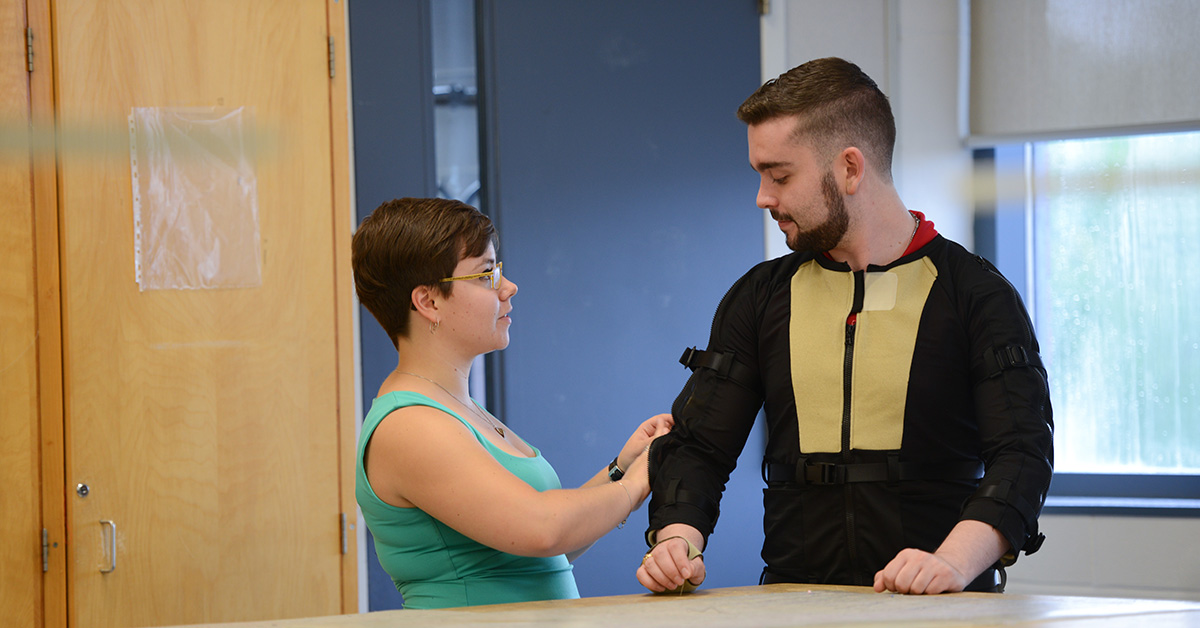
Entering a virtual reality world may soon be as easy as slipping on a life jacket with the development of ARAIG — a wearable wireless, multi-sensory, immersive suit for gaming and simulation training. The suit is the brainchild of Michael and Brodie Stanfield, founders of Inventing Future Technologies Inc.—IFTech for short — a start-up from Oshawa, Ontario.

ARAIG, an acronym for “As real as it gets,” was developed with computer gaming in mind. It consists of an inner T-shirt-like layer and an outer exoskeleton that looks like a high-tech version of a football player’s pads. ARAIG offers wearers surround sound, vibration, pressure and resistance feedback —basically allowing users to feel what’s happening in the virtual world, where in the past they only saw graphics and heard sound tracks.
ARAIG also has possibilities beyond gaming. The Stanfields have even heard from the Canadian Armed Forces, interested in the product’s potential as a hyper-realistic way to train and simulate combat.

When they approached George Brown, the Stanfields already had a proof-of-concept model. They had worked with Durham College on the vest’s electronics and their online community advised on its look and feel. What they needed from George Brown was help with the challenge of making the ARAIG vest washable, breathable and in line with aesthetic requirements. Two fashion studies students were recruited to undertake the design

They were supervised by principal investigator and faculty member Zoran Dobric, who noted that “IFTECH is a great example of the next level of wearable technology. It can be implemented in both entertainment and gaming industries, as well as simulation and training.”

After many iterations and pattern prototypes, IFTech now has product specifications, and is working closely with manufacturers for commercialization. Recently, IFTech won in the Durham region of the Spark Ignite Competition, taking home a prize of $25,000.

Funded by: Applied Research and Development (ARD) Grant, College and Community Innovation Program, NSERC

About George Brown Polytechnic

George Brown strives to build a seamless bridge between learners and employment by developing dynamic programs that are informed by industry and workplace-ready graduates who... Learn more

Deep down safety for miners

Ultra-deep mines are those that reach 2.5 kilometres below the earth’s surface. They are not an easy place to work; as the depth increases, so does the temperature. In an ultra-deep mine, ambient heat from rocks and humidity meets heat from machinery and human activity to create a hazardous mix. Miners in ultra-deep mines follow a reduced work-rest cycle to prevent heat stress.

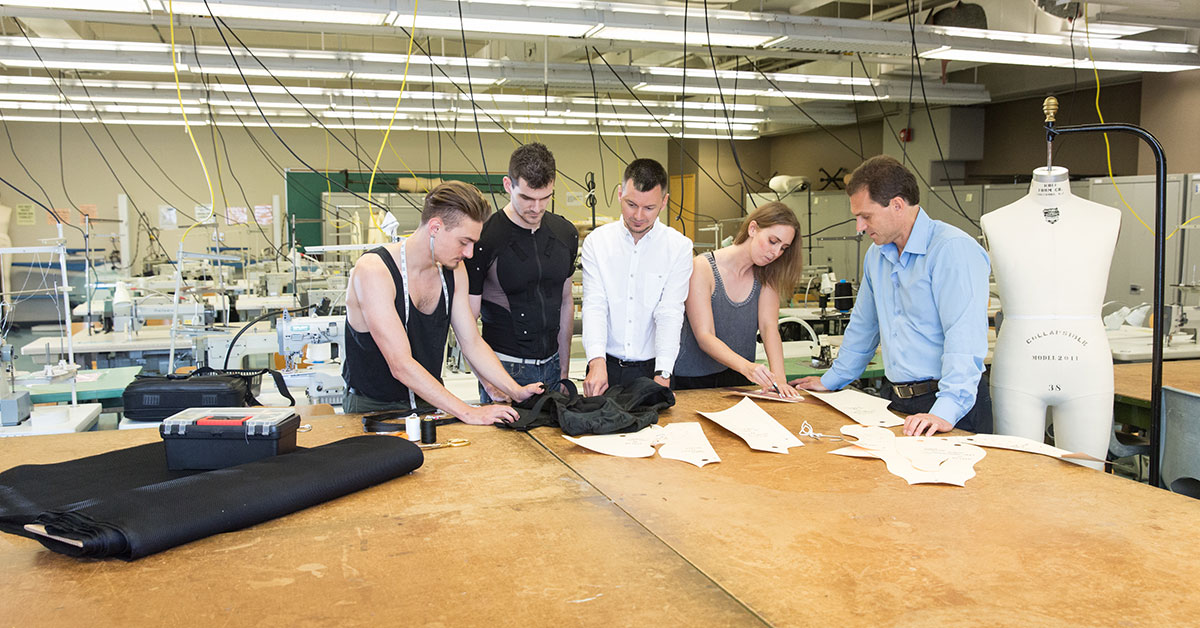
Modified hours are only part of what it takes to keep miners safe and Jannatec Technologies, which has been developing safety products for the mining industry for over 25 years, undertook to design a new kind of coverall that could complement deep-mine thermal management systems, meet safety standards and keep miners comfortable as they worked.

To achieve its goal of creating innovative work wear for ultra-deep mining employees, Jannatec Technologies partnered with researchers at two Canadian institutions — George Brown College’s School of Fashion Studies and the Olds College Apparel Innovation Centre. George Brown’s research team was headed by investigators Edith Strasser and Daniel Somsavath and included three students from the School of Fashion. Throughout the project, the team relied on guidance from Jannatec as it evaluated current designs in work wear for ultra-deep mines, looking for feedback on efficiencies and wearer requirements.

“This project helped hone my skills,” one of the fashion students said. “It introduced me to the people working in sciences that rely on people in design — who have little understanding of the scientist’s goals.”

When they were ready, the research team first created a prototype in cotton canvas, then produced the next prototype in two textiles in standard sizes, to allow Jannatec to test and compare them. The final deliverables also included a pattern with a sizing sheet for the prototype design.

Applied research in this area is expanding at the college, and student-faculty teams have completed a range of successful projects to solve apparel design problems and commercialize new products. The work of this George Brown team will lead to a safer working environment for miners everywhere, as Jannatec Technologies gets one step closer to manufacturing on a large scale.

Funded by: Ontario Centres of Excellence

About George Brown Polytechnic

George Brown strives to build a seamless bridge between learners and employment by developing dynamic programs that are informed by industry and workplace-ready graduates who... Learn more

The fine art of 3D printing

Alongside the wheels and kilns in the pottery studio at Mohawk College’s Stoney Creek campus is a new way to create art — a 3D printer for ceramics.

Two faculty members of Mohawk’s Continuing Education program, Duncan Aird and Reid Flock, collaborated on this revolutionary work. Their ongoing quest for innovation in the classroom and expertise in ceramics was the spark that lead them to create new courses to take advantage of the computer software designed for producing ceramics in a 3D printer.

The project leads used Mohawk College’s Additive Management Resource Centre to help them choose the best 3D printer for ceramics.

The first 3D ceramics course, “3D printing with clay,” began in the summer of 2017.

Industry: Manufacturing
Funded by: Mohawk College Applied Research and Innovation in Education Fund (ARIE)

About Mohawk College

Mohawk College educates and serves 30,000 full-time, part-time and apprenticeship students at three campuses in Hamilton, Ontario. More than 1,200 international students from over 70... Learn more

Low-radiation X-rays offer powerful insights

Liz Lorusso, a professor at Fanshawe College School of Health Sciences, is being hailed internationally for her research on reducing radiation dose levels in X-rays. Lorusso worked with London area hospitals, capturing images using varying levels of X-ray radiation on mannequins with human bone anatomy. The results were astounding, showing today’s advanced digital imaging technology does not require the same quantity of radiation as film-based X-rays do.

“People are exposed to radiation through general X-ray imaging all the time, but using digital imaging we proved we could save patient dose by 50 to 75 per cent — without compromising diagnostic results,” Lorusso said. “Working in tandem with clinical colleagues at health care campuses in London and beyond, we confirmed it is possible to use far lower doses of radiation, and this discovery reinforces the ALARA (“As low as reasonably achievable”) principle every radiological professional follows.”

Since completing the study, Prof. Lorusso has made presentations at numerous conferences, most recently at the 2016 International Society of Radiographers and Radiological Technologists (ISRRT) World Congress held in Seoul, Korea, where more than 1,000 delegates heard about the safety breakthrough. “People all over the world share difficulties in this practice with technological advances, and educating the next generation of global radiological professionals on how to fully embrace the principle ALARA is pivotal,” Lorusso said.

Back home in London, protocols are being reviewed as a result of the study. Prof. Lorusso says work could not have been done without the collaboration among the broader London area’s clinical teams.

About Fanshawe College of Applied Arts and Technology

Fanshawe College is one of the largest colleges in Ontario, with campuses located in London, Simcoe, St. Thomas, and Woodstock. The institution offers more than... Learn more

Technology better suited to assessing Parkinson’s disease

Precisely measuring the severity of tremors suffered by people with Parkinson’s Disease is difficult but vital when it comes to determining the correct dosage of Levodopa, a drug therapy for patients with Parkinson’s. Fanshawe College was proud to partner with Movement Disorder Diagnostic Technologies Inc. (MDDT) to create a prototype of a motion-capture suit and tremor arm sleeve to help with diagnosing and monitoring Parkinson’s patients.

Movement Disorder Diagnostic Technologies is a London-based medical device company using technology to advance care for people whose lives are being limited by tremors. It collaborated with Fanshawe’s School of Design to create a prototype motion-capture suit, which uses MDDT software to capture data from sensors placed at fixed points across the body. The suit can be adapted for home assessment and for commercial mass production. Data obtained from the suit will be used in the ongoing monitoring and assessment of patients with Parkinson’s disease.

Louise Marchand, a student in Fashion Design at Fanshawe College, was involved in developing the suit and won in the Applied Research Category at the 2016 CICan Student Showcase.

Fanshawe College’s School of Design has also designed a prototype TremorTek sleeve based on an earlier design by Movement Disorder Diagnostic Technologies. The sleeve contains multiple sensors that can accurately analyze complex movements. Using data from the sleeve, doctors can isolate specific areas in the arm to guide drug treatments, reducing tremors over the course of seven to 10 days.

“The collaborative efforts between MDDT and Fanshawe College allowed us to address an unmet patient need in medicine,” said Jack Lee, chief technology officer at Movement Disorder Diagnostic Technologies.

About Fanshawe College of Applied Arts and Technology

Fanshawe College is one of the largest colleges in Ontario, with campuses located in London, Simcoe, St. Thomas, and Woodstock. The institution offers more than... Learn more

Building a wall to keep memories in their place

Hospital stays are hard on people struggling with impaired memory. Disoriented by unfamiliar surroundings and stripped of their usual activities, elderly patients may see their mental abilities decline even as their physical problems are being treated.

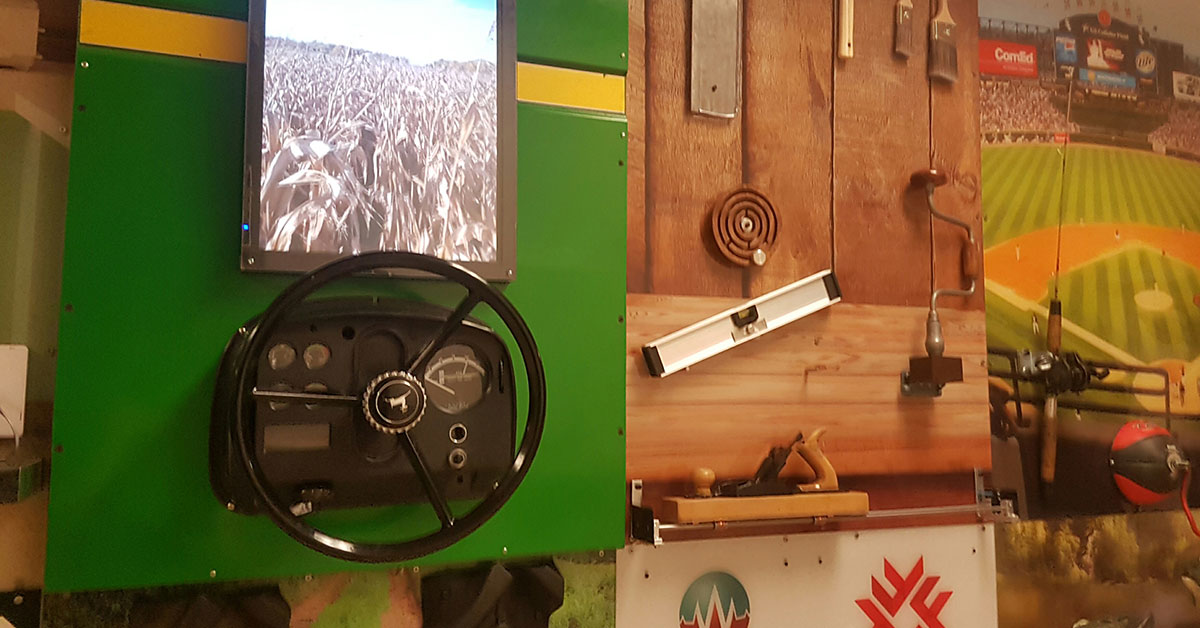
To prevent deterioration in patients with memory problems, Woodstock General Hospital partnered with Fanshawe College to design and install a “cognition wall” in its complex continuing care unit. The CogWall, as it’s called, is divided into four sections, each featuring familiar objects against a background photo.

The idea is that in each section the background photo and the familiar items displayed in front of it will stir reminiscences and encourage activities that will give patients a sense of success. A photo of a 1950s kitchen, for example, is complemented with real kitchenware patients can handle. There’s a rotary-dial phone that rings periodically and when answered, plays a message. There’s a mailbox where letters can be dropped. There’s also a fishing pole and, in front of a farm scene, a tractor steering wheel and monitor mounted on the wall simulate a drive through a field for patients.

The CogWall at Woodstock General was designed by four students from Fanshawe’s Mechanical Engineering program. They also found all the material, built, and installed the wall. The students had to work through a variety of challenges and gained valuable research skills including project management, procurement, problem solving and critical thinking during the project, which ran from May to November of 2016. The CogWall was unveiled on January 31, 2017.

Since the wall was installed, the hospital has been encouraging patients with impaired memory to interact with it regularly, in hopes of improving their cognitive function and staving off memory loss. The hospital says both patients and their families are reacting positively. The CogWall has also garnered the attention of local media and has been well received by the community.

Funded by: General Research Fund, NSERC

About Fanshawe College of Applied Arts and Technology

Fanshawe College is one of the largest colleges in Ontario, with campuses located in London, Simcoe, St. Thomas, and Woodstock. The institution offers more than... Learn more

Making power wheelchairs smarter

Many people who use power wheelchairs have poor manual dexterity because of spinal cord, stroke or head injuries, or because of degenerative diseases. Even getting in and out of an accessible vehicle can be time-consuming, and sometimes dangerous, for them. Other tasks — such as taking a shower — require an attendant to drive the wheelchair away.

SmartChair gives people who use wheelchairs more freedom and self-reliance while significantly improving their safety and mobility. SmartChair is a control system which can easily be integrated with any existing power wheelchair. The goal of the project is to give users added independence by improving their control of their power wheelchair, regardless of their level of ability.

A power wheelchair outfitted with the SmartChair control system will also offer computer-assisted autonomous movement to its user, letting him or her automate certain tasks. That might include following a pre-defined path, getting in and out of an accessible van, or navigating indoors in narrow hallways, through doorways and around tight corners. It’s a technology based on lived experience: several years ago, Eightfold Inc.’s president, Ke Wang, had an accident; he has used a power wheelchair ever since, and the idea for SmartChair grew from barriers he faces every day.

The SmartChair project got a boost when it partnered with a team of four students from Algonquin College, led by researchers Dr. Theo Mirtchev and Dr. Bruno Rocha. With funding from Ontario Centres of Excellence and the Natural Sciences and Engineering Research Council, the students worked as research assistants from January 2016 to April 2017. They acquired experience in developing both hardware and software, control engineering, sensors and in testing and measuring technology.

SmartChair can change the lives of power wheelchair users every day, in a variety of ways. They include better control in narrow spaces such as doorways and ramps and the ability to “drive” the wheelchair when it’s empty because the user has transferred from it to bed, the couch or the shower. Changes such as those can reduce the cost of attendants and allow for greater independence. It’s also small and lightweight.

Funded by: Engage Grant, Ontario Centres of Excellence

About Algonquin College

The mission of Algonquin College is to transform hopes and dreams into lifelong success. Algonquin College, a national leader in applied and online learning, offers... Learn more

Cutting-edge technology makes prize-winning cutting edges

Joseph Hofer is an award-winning industrial designer based in Kitchener-Waterloo, Ontario. He was intrigued by the possibilities of 3D printing but wanted to take it outside the realms of the aerospace and medical industries where it is most often used. In his own words, he was seeking to create “something more human as a product, something understandable. Something people could see in their lives.”

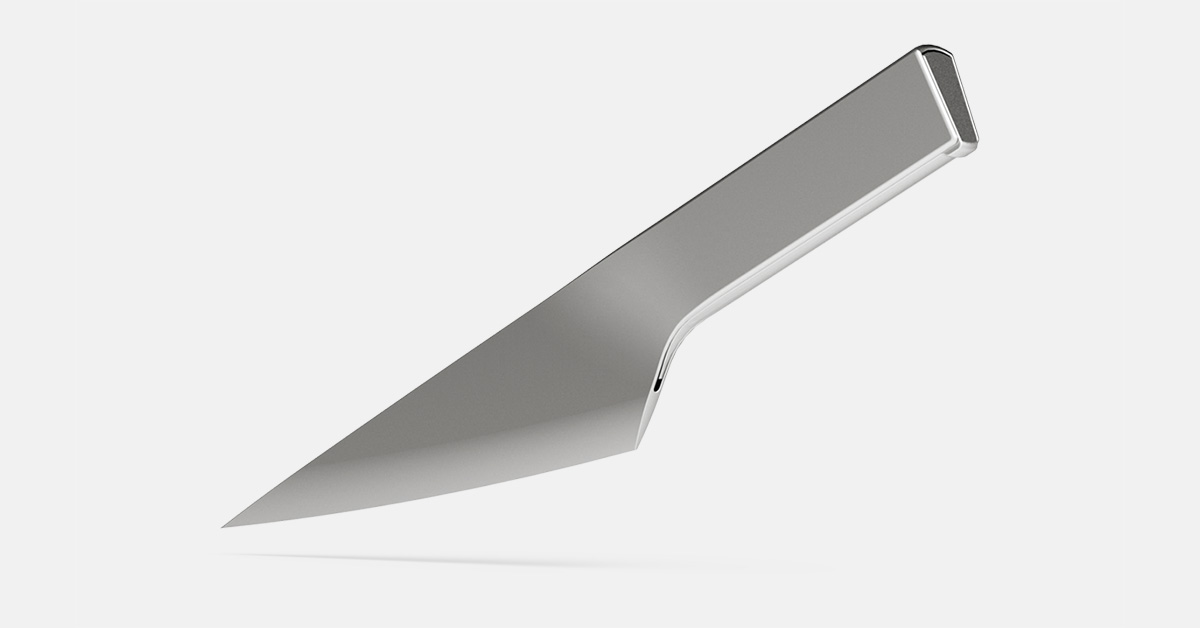
Hofer started by considering how some common household items are made, leading him and his team to come up with the “pair knife,” a design that combines the two most commonly used kitchen knives: the paring knife and the chef’s knife. In the stainless-steel design, the smaller paring knife is shaped to nest inside the larger chef’s knife. The design of the chef’s knife has a double purpose: in addition to storing the paring knife, its handle is shaped to suit the way professional chefs hold knives, which also helps home chefs learn to cut properly.

Turning the vision into reality was possible because of Hofer’s partnership with Mohawk College’s Advanced Manufacturing Resource Centre, where additive manufacturing technology — better known as 3D printing — was used to produce the innovative knife.

Two fourth-semester Mohawk students worked on the project. They particularly enjoyed having the ability to optimize the designs for the 3D metal printing.

The knife has already won a Designlines Award for showcasing the potential of future technology and has also been awarded a 2016 European Design Award. Hofer Studios is investigating larger-scale production of the knives.

Industry: Manufacturing
Partner(s): Hofer Studios

About Mohawk College

Mohawk College educates and serves 30,000 full-time, part-time and apprenticeship students at three campuses in Hamilton, Ontario. More than 1,200 international students from over 70... Learn more