
A Precision Watering System for Turfgrass

Urban lawn watering is the single largest water demand on municipal water supplies.

An Alberta company developing irrigation technology recognized that water scarcity and a need for greater irrigation efficiency could provide a market opportunity.

Olds College was approached by the company, 1318552 Alberta Limited, and asked to test its novel turfgrass irrigation system for residential and commercial applications. The computer-generated program alters the flow of water to the head depending on the shape and size of areas to be watered. This system requires fewer irrigation heads and less underground piping, which would reduce installation costs.

Through its partnership with the college, the company gained access to the expertise of college irrigation specialists and state-of-the-art indoor and outdoor test facilities. Initial testing found that the system provided a uniform distribution of water superior to the industry standard. The ease of installation and the computer program that optimizes flow are the key market advantages of the system.

“Olds College provided a unique opportunity to compare our system with an industry standard,” stated company representative Cam Cote. “We were able to install our head in the indoor facility and with the variable speed pump were able to precisely control water flow. This allowed us to make necessary adjustments to the head and the computer program. Outdoors, we were able to compare our system with their new decoder system. Nowhere else could we have accessed facilities like these!”

A critical component for the Prairie Turfgrass Research Centre at Olds was attracting highly qualified personnel to the research program. Katie Dodson, a Canadian researcher with considerable industry experience in drought tolerance of grasses for recreational turf, was hired as lead research scientist. Her research will provide information that could lead to significant water savings.

Turfgrass research at the centre is focused in four areas: strategies to reduce winter injury, biotic stress management, grass selection for alternative uses, and water conservation. Partners include the Canadian Turfgrass Research Foundation, local golf courses, turf and sod growers, and the City of Lethbridge.

Funded by: Innovation Enhancement (IE) Grant

About Olds College of Agriculture & Technology

Olds College of Agriculture & Technology is a technical institution offering industry demand-driven programming with an intensive focus on agriculture and technology. Founded in 1913,... Learn more

Helping Beekeepers Mind Their Own Beeswax

Neil Bertram, owner of Bertram Honey Ltd., was ready to move past the mess and expense of current technologies for beeswax extraction.

With market demand for beeswax not only from the beekeeping industry, but also for the chewing gum, cosmetics, food production, and pharmaceutical industries, Bertram wanted to optimize the amount of beeswax he could get from his hive frames.

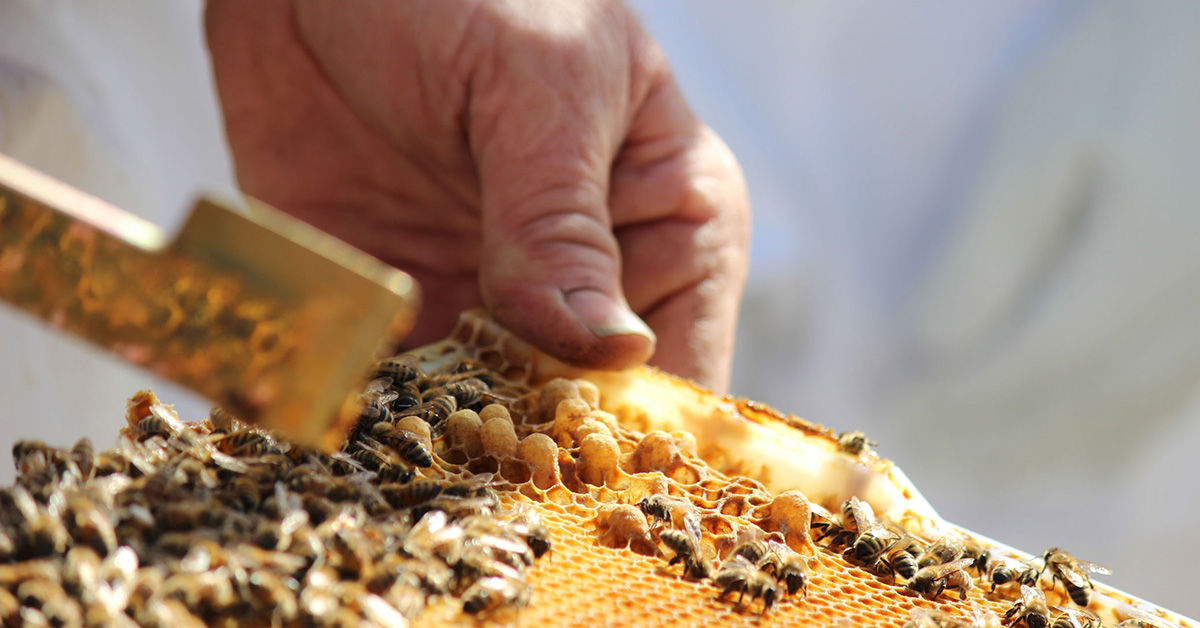
Bertram and other beekeepers usually extract beeswax by boiling hive frames, squeezing out the wax, and trucking it to rendering facilities. The Alberta beekeeper came up with an idea for his own solution. He built a steam beeswax extractor but needed to refine his design and get help with commercialization. He approached Applied Research and Innovation Services (ARIS) at SAIT Polytechnic to refine the design, fabricate, and validate his product.

A second-generation beekeeper, Bertram worked with ARIS’s new Culinary and Urban Agriculture researchers to develop the prototype of a cost-effective, compact, and durable extractor that uses steam to melt beeswax from hive frames. The end product will be replicable for commercialization and will be used to increase business for Bertram Honey Ltd.

“With this technology ready for market, I hope to introduce it to the beekeeping industry,” says Bertram. “It would be ideal for mid-sized beekeepers to do their own onsite beeswax extraction.”

Industry: Agriculture
Partner(s): Bertram Honey Ltd.

About SAIT

SAIT (Southern Alberta Institute of Technology) is a leader in action-based learning, delivering relevant, skill-oriented education. We offer two baccalaureate degrees, three applied degrees, 73... Learn more

Diagnosing the Health of Honey Bees

Concerns about declining bee populations in North America have been major news in the past couple of years as many beekeepers have suffered large losses of bees. There has been increased urgency to find causes for the deaths of bees in hives across Canada.

The National Bee Diagnostic Centre (NBDC) is a state-of-the-art laboratory of Grande Prairie Regional College that opened in April 2013 through a partnership with Agriculture and AgriFood Canada. The same month, it was awarded an NSERC Technology Access Centre grant which helped expand its mandate to include applied research, training, outreach, and innovation for the beekeeping industry.

The Centre has grown exponentially since then, training students and working on applied research projects with beekeepers as well as provincial and federal researchers, and delivering timely and reliable results.

The centre is now able to provide new diagnostics and expand to all Canadian provinces. The NBDC research team has recently been chosen to lead a four-year industry initiated ‘National Honey Bee Health Survey’ aiming to establish the nature, extent and incidence of endemic and exotic pathogens affecting bee colonies. This study will provide information that will help maintain a healthy, dynamic, and profitable beekeeping industry in Canada.

The bee diagnostic centre is already making a difference to Canadian beekeepers. In the words of one of its clients, “It wasn’t until I took bee samples to the National Bee Diagnostic Centre did an accurate diagnosis occur. I am now in the position to treat properly for my problem. Needless to say, the two years with the wrong diagnosis have cost me in excess of $100,000 dollars.”

Industry: Agriculture
Funded by: Technology Access Centre (TAC) Grant

About Northwestern Polytechnic

Northwestern Polytechnic (NWP), formerly known as Grande Prairie Regional College (GPRC), is a comprehensive community institution, publicly supported to provide opportunities in post-secondary education in... Learn more

Smart Sheep Help with Feed Research

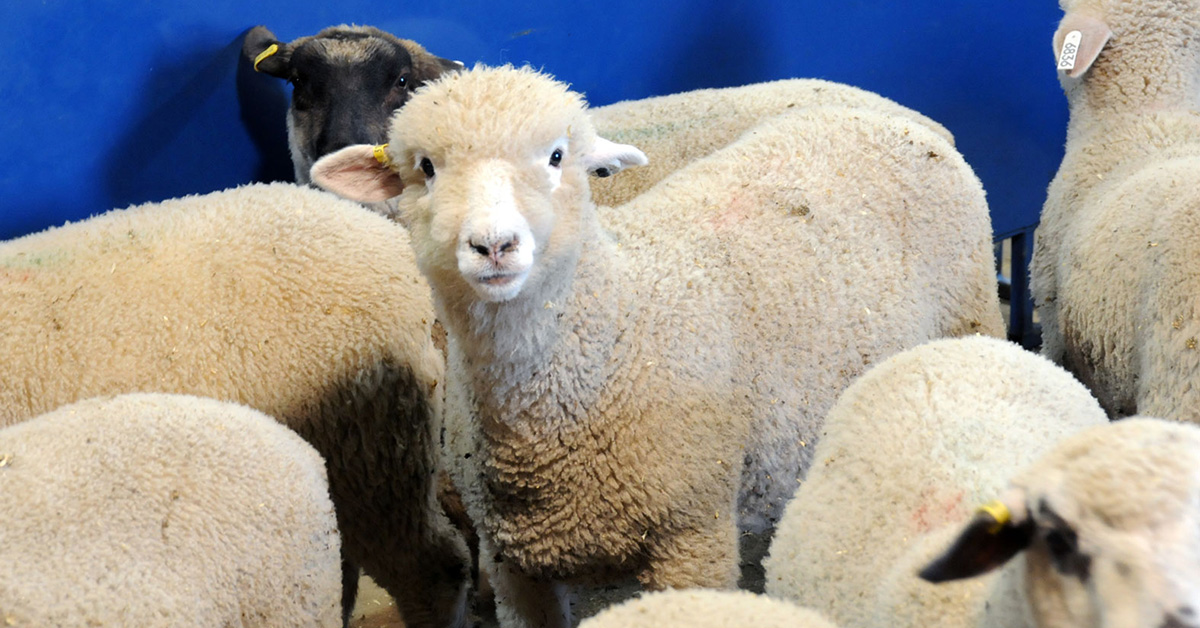
A group of 80 lambs participated in a research trial at Lakeland College in the summer of 2014 and collected their own data!

The lambs, fitted with individual radio frequency identification (RFID) tags, were given the task of comparing two different rations for the finishing period before slaughter. The GrowSafe feeding system in the Livestock Research Centre at Lakeland College collected data about the amount of feed each lamb consumed daily, as well as their individual eating behaviour patterns.

The experiment was conducted for Alberta Agriculture and Rural Development. Susan Markus, a Livestock Research Scientist with Alberta Agriculture, designed the trial to validate SheepBytes® feeding recommendations. The purpose of the trial was to compare a standard barley finishing ration to one designed using the SheepBytes Ration Balancer. Alberta Agriculture would like to know if the growth of the feeder lambs correlates well with that predicted by SheepBytes, and to see the effect of nutrition and management on carcass grades. A second, similar trial is planned for 2015.

Larry Bingham, Ag Research Project Coordinator, noted “This trial had some interesting challenges. The GrowSafe system was originally designed for cattle, and had to be adapted for lambs. They needed a little boost to be able to reach into the feed troughs, and access to the feed trough had to be restricted to one lamb at a time. The lambs adapted very quickly to the system and certainly did their part in making the trial a success.”

About Lakeland College

All colleges say they are educating the leaders of tomorrow. At Lakeland College in Alberta, our students are leading today. Students have the opportunity to... Learn more

New Technology Helps Asthma Patients Breathe Easy

Globally, 180,000 people die of acute asthma attacks every year, many with a rescue inhaler in hand. Some of these asthmatics are resistant to available medications, but for most the rescue medicine could not penetrate their constricted airways.

SAIT Polytechnic is working with industry partner SolAeroMed to develop the first innovation in asthma treatment in more than 30 years. SolAeroMed has patented a drug, S-1226, that can overcome the shortcomings in current standards of care for acute airway constriction. But the company met a stumbling block after it was approved for human trials. Compressed CO2 is the key to success for SolAeroMed’s treatment and also created the largest challenge in bringing it to market.

That’s where SAIT Polytechnic came in.

SolAeroMed contacted SAIT Polytechnic’s Applied Research and Innovation Services (ARIS) and asked its Sports and Wellness Engineering Technologies researchers to help develop a safe drug-delivery system to administer S-1226, which relies on compressed CO2 to open pathways in the lungs.

SAIT Polytechnic engineers designed and fabricated a prototype, producing a smaller and easy-to-use alternative to its predecessor – a bulky CO2 canister. This asthma drug-delivery system will allow emergency responders and emergency room doctors to administer this fast-acting airway opener in time to save lives.

Beyond the potential for S-1226 to improve the quality of life for asthmatics, the drug is projected to save Canada nearly $500 million per year in health care costs by shortening or eliminating visits to intensive care units.

Partner(s): SolAeroMed
Funded by: Applied Research and Development (ARD) Grant

About SAIT

SAIT (Southern Alberta Institute of Technology) is a leader in action-based learning, delivering relevant, skill-oriented education. We offer two baccalaureate degrees, three applied degrees, 73... Learn more

Floating Fence Skims Oil Spills from Lake and River Water

A floating fence being tested and refined at SAIT Polytechnic offers new potential for making a difference in oil spill clean-up.

The XBOOM hydrocarbon containment technology was developed by Canadian Floating Fence Corporation with testing, validation and design refinement done in cooperation with researchers in SAIT Polytechnic’s Applied Research and Innovation Services (ARIS) department.

The upright floating fence has a unique design that allows water to flow through it while enabling the effective containment, collection and redirection of spilled oil or debris in preparation for skimming and clean up. A working prototype of the XBOOM is being used in live spill testing as the next phase of its development process.

Mark Neal, president of Canadian Floating Fence Corporation, says the initial concept for XBOOM came from his father in the 1970s. While traditional booms typically fail to contain hydrocarbons effectively in water at more than 0.7 knots, the XBOOM contains spills at an estimated 2.0 knots. While current booms are large, bulky and time consuming to deploy, a single person can deploy a 50-metre XBOOM roll in under a minute. Furthermore, in SAIT Polytechnic’s small-scale prototype trials, the XBOOM was capable of containing 99.6 per cent of crude oil in still water and 94 per cent in water moving under one knot.

Industry: Environmental

About SAIT

SAIT (Southern Alberta Institute of Technology) is a leader in action-based learning, delivering relevant, skill-oriented education. We offer two baccalaureate degrees, three applied degrees, 73... Learn more

Dark Laser Detects Nano Particles of Oil in Water

NAIT’s Nanotechnology Centre for Applied Research, Industry Training and Services (NanoCARTS) was established in 2012 with a Technology Access Centre grant from the Natural Science Engineering Research Council of Canada. The centre provides nanotechnology and microtechnology support to small-and medium-sized enterprises (SMEs) in the areas of prototyping, product development and enhancement, testing, as well as characterization and training.

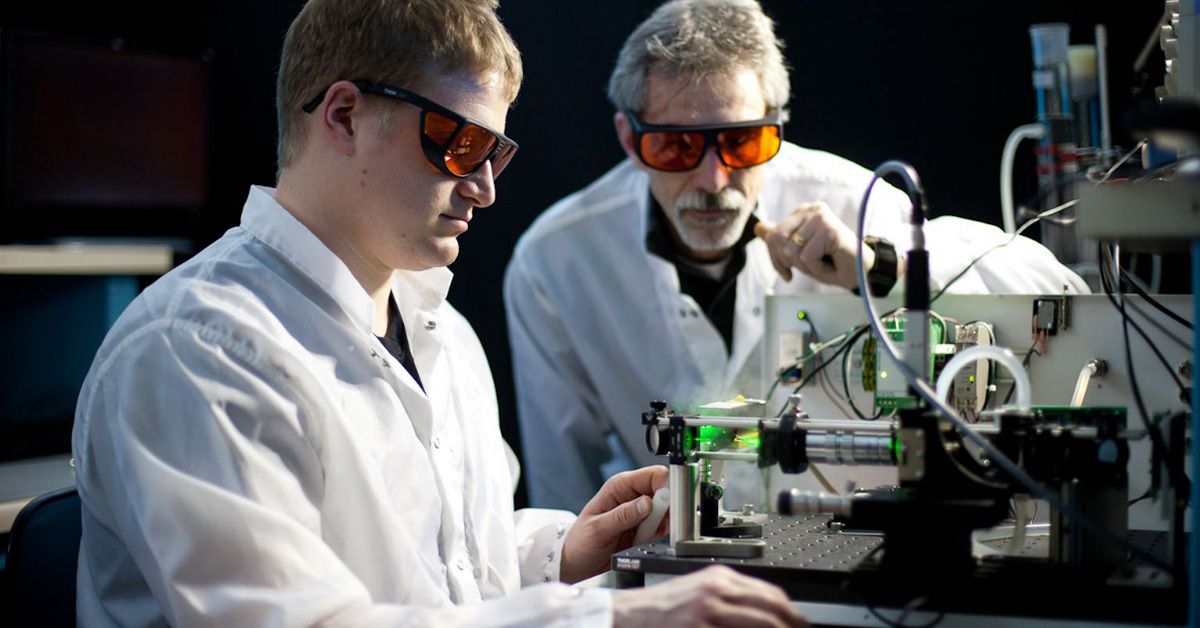
One of the projects within nanoCARTS involves a collaborative effort between NAIT, Alberta Nano-Monitoring Systems (ANMS), Benchmark Instrumentation and Analytical Services and a major Alberta oil sands company. The project is focused on the development of a unique structured “dark” laser beam, based on IPSA® which stands for Individual Particle Sensing Approach, developed by ANMS. This approach enables automatic, continuous, on-line monitoring of particle sizes (including nano-particles) and concentrations, in liquids, air or vacuum.

A field trial of this new technology’s application for detecting oil particles in a steam-assisted gravity drainage (SAGD) process occurred in December 2014. The system developed by ANMS and NAIT successfully detected emulsified oil in produced water while ignoring the background hydrocarbon solution, addressing the current challenge with conventional analytical and monitoring equipment.

The intent of the field trial was to analyze the oil content in produced water samples collected from different treatment stages (warm-lime softener (WLS), organic removal filter (ORF) and skim tank outlet) in the SAGD process.  The new system measurements were compared to a conventional method that provides the oil in water analysis at the facility by means of solvent extraction and fluorescence.

“Preliminary results from the field trial demonstrated excellent correlation between the number of droplets counted and the concentration measured. We continue to be very optimistic about the exploitation of this technology for solving difficult measurement challenges that are important to Alberta, as well as Canada. We look forward to an ongoing mutually beneficial relationship between the organizations and to seeing NAIT establish themselves as a partner in the technology development arena in Alberta.” Steven McDougall, M.E.Sc., P.Eng., Vice President, Operations of Benchmark Instrumentation and Analytical Services Inc.

Industry: Environmental
Funded by: Technology Access Centre (TAC) Grant

About Northern Alberta Institute of Technology (NAIT)

For 60 years, the Northern Alberta Institute of Technology (NAIT) has delivered experiential, hands-on, technology-based education to meet the demands of industry. NAIT’s proudly polytechnic... Learn more

Winter Planting Enhances Wetland Reclamation for Oil Sands

Reclaiming lands deforested by oil sands excavation has been one of the greatest challenges of the burgeoning oil industry in Alberta. Success with winter replanting of spruce trees undertaken by researchers from Grande Prairie Regional College offers an exciting new remedy for this industry problem.

Boreal wetlands disturbed by oil sands operation are not accessible in the summer for reclamation. And the excessive moisture content of the soil reduces seedling survival. Therefore, reclamation of the wetlands is difficult and limited during the regular planting season. The novel idea of winter planting to avoid these limitations was advanced by Dr. Weixing Tan, the principal investigator of Pollutants-toProducts (P2P) initiative at Grande Prairie. Frozen wetland soil was broken by a backhoe and seedlings were planted in the warmer peaty soil exposed.

Over 94 per cent of black spruce seedlings survived on a wetland site when planted during winter in 2011 at -17°C. This success was so significant that industry put it into practice immediately on large scale even before the trial was fully completed. And Suncor’s CEO Steve Williams highlighted it as one of the major innovations in oil sands reclamation effort in 2012.

The trial was conducted at the Evergreen Centre for Resource Excellence & Innovation in Grande Prairie, Alberta with additional funding and support from Oil Sands Leadership Initiative (now COSIA), the Alberta Government, Next Generation Reforestation, and Global Restoration Corp.

“This unique concept of planting trees in winter will allow us to have an easier access to the wetlands so as to enhance the restoration processes of natural ecosystems in the boreal region,” enthused Jeremy Reid, Environmental Specialist with Nexen Inc.

Funding support from the College and Community Innovation program, industry and government has also contributed to the development of three other innovative Pollutants-to-Products (P2P) projects at Grande Prairie: bio-capture of CO2 and air pollutants using microalgae, white spruce reforestation, and turning waste water to wood.

Industry: Environmental

About Northwestern Polytechnic

Northwestern Polytechnic (NWP), formerly known as Grande Prairie Regional College (GPRC), is a comprehensive community institution, publicly supported to provide opportunities in post-secondary education in... Learn more