Improving Automated Financial Trading

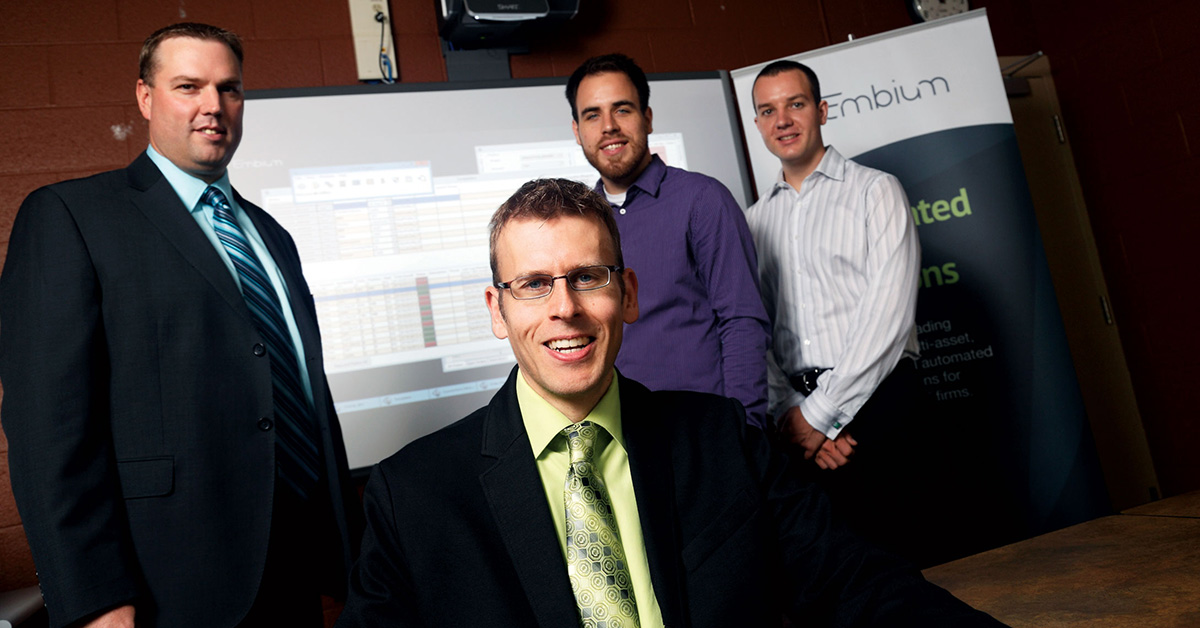
An Ontario company specializing in automated technology for financial trading is working with Fanshawe College and Western University students to give their products a competitive edge in the financial trading sector.

The research project hopes to improve Embium’s real-time trading cloud computing infrastructure.

Embium was founded in London in 2008 as Cyborg Trading Systems. It specializes in developing automated trading technology for global financial firms, including hedge funds, brokers, banks, exchanges, and professional traders. In addition to its London presence, the company has offices in Waterloo and Toronto and headquarters in New York City.

According to Jason Lukez, vice-president of finance with Embium, the algorithm under development will be ready for commercialization early next year. He says it is crucial that new global market technologies are tested and re-tested prior to release, and the work of Fanshawe students has been an essential component of the firm’s technology development and deployment process.

Embium is the only Canadian provider of a complete trading solution that enables the rapid development, testing and global execution of sophisticated proprietary strategies.

“Timing of producing the product is critical,” says Lukez. “Having collaborative partners to keep the progress moving is so important given the competitive market, especially since we are contending with large global firms. Fanshawe has been a strong partner.”

This initiative has led to full-time jobs and raised the profile of Fanshawe’s Computer Programmer Analyst program as it continues to produce high calibre students to fill many knowledge-based jobs in southern Ontario. Six students from Fanshawe College have been hired full-time at Embium, with three more currently on work placement.

Funded by: College-University Idea to Innovation (CU-I2I) Grant

About Fanshawe College of Applied Arts and Technology

Fanshawe College is one of the largest colleges in Ontario, with campuses located in London, Simcoe, St. Thomas, and Woodstock. The institution offers more than... Learn more

Skate Manufacturing Analysis for Graf Canada

Graf Canada Ltd. is working with researchers at SAIT Polytechnic’s Applied Research and Innovation Services (ARIS) department to develop better performing, lighter-weight skates.

SAIT’s Sports and Wellness Engineering Technologies specialists are hoping to provide Graf with the necessary information to manufacture more of its skate components in Canada at a higher quality with shorter lead times and smaller batch orders. The project will also provide Graf with some preliminary models of a skate that incorporates new materials and manufacturing processes.

Graf approached ARIS for assistance in reviewing the manufacturing processes and materials used in the production of its ice hockey skates in 2014. The company would like to improve the quality and cost of its product while bringing more of its manufacturing to Canada. In addition, the majority of Graf’s current components and processes are not documented with proper Computer Aided Design (CAD) files and therefore cannot be shared with potential manufacturing partners. This review and documentation project is the first step towards a larger project involving the design and prototyping of a new-model ice hockey skate.

Industry: Manufacturing
Partner(s): Graf Canada Ltd.
Funded by: College-University Idea to Innovation (CU-I2I) Grant

About SAIT

SAIT (Southern Alberta Institute of Technology) is a leader in action-based learning, delivering relevant, skill-oriented education. We offer two baccalaureate degrees, three applied degrees, 73... Learn more

Eco-Friendly Clean-Up of Old Gas Station Sites

Cleaning up contaminated soil at former gas station sites is fraught with hurdles. Traditional remediation methods involve excavating impacted soils and moving them to a landfill or treatment facility. This is costly, prohibits use of the site during the process, and can expose people to contamination.

Hoping to change that, Federated Co-operatives Limited (FCL), a collective of 500 co-op grocery stores and gas stations in Western Canada, has partnered with Saskatchewan Polytechnic and the University of Saskatchewan to explore how to advance soil remediation techniques and technology developed by FCL and university soil scientists.

There are about 30,000 gas contaminated sites in towns and cities across Canada. If the research proves fruitful, the use of naturally occurring bacteria and fungi to break down hydrocarbons at contaminated municipal “brownfield” sites could reduce clean-up costs by more than 30 per cent.

As a key part of the investigation, students and faculty at Saskatchewan Polytechnic’s BioScience Applied Research Centre are developing tests and collecting and analyzing groundwater and mineral samples from a former gas station site to determine the effectiveness of eco-friendly soil remediation.

Trevor Carlson, Director of Sustainability at Federated Co-operatives Limited says, “This technology will enable FCL to remediate contaminated sites without negatively impacting the environment, transferring contaminated soil to a landfill or disrupting business activities on site.”

Industry: Environmental
Funded by: College-University Idea to Innovation (CU-I2I) Grant

About Saskatchewan Polytechnic

Saskatchewan Polytechnic serves students through applied learning opportunities on Treaty 4 and Treaty 6 Territories and the homeland of the Métis people. Learning takes place... Learn more

Cleaning up Mine Water Contaminated by Cyanide

Cyanide has been widely used in gold mining to separate gold from ore. However, cyanide contaminates water and water tables in and around a mining site, and requires sophisticated clean-up technologies. Because concentrations of cyanide are toxic for fish, birds and animal life, there are strict regulations on clean-up at gold mine sites.

A research project at the Centre technologique des résidus industriels (CTRI) affiliated with Cégep de l’Abitibi-Témiscamingue aims to increase the effectiveness of cleaning up cyanide at Agnico Eagle mines through chemical and biological treatment. The objectives of the research project are to improve the effectiveness of SCN treatments and nitrogen and remove metals and rare metalloids. The CTRI research project is defining the properties of the effluent to be treated and evaluating alternative solutions (including pre-treatment or alternative treatments) that can increase the effectiveness of the existing system. The use of ferrates for simultaneous treatment of both cyanides and metals is one alternative approach being investigated.

As part of this research project, three graduate students, three university interns, a post-doctoral researcher and six college-level interns are receiving training. Mabarex, a company specialized in the design, manufacture and installation of drinking water treatment processes, grey water and sludge, will be actively involved in the technology transfer to adapt technologies to water treatment.

“Mabarex is enthusiastic to join the research team. It will be a fantastic opportunity to contribute our knowledge to accelerating technological development with research and mining industry partners,” said Mabarex’s Vicepresident of Sales and Marketing, François Séguin.

Industry: Environmental
Funded by: College-University Idea to Innovation (CU-I2I) Grant

About Cégep de l’Abitibi-Témiscamingue

La communauté du Cégep de l’AbitibiTémiscamingue est animée par la conviction profonde que la santé d’une société est intrinsèquement liée au développement global des individus... Learn more