
An animated conversation — with no words

The global marketplace presents many challenges to Canadian companies. How, for example, do you boil complex molecular science down for the layman — without using any words? The sales and marketing team at CSL Silicones Inc., a Guelph-based manufacturer of silicone coatings, lubricants, compounds and adhesives, used presentations with two-dimensional images to demonstrate how the coating functions — a fairly standard approach.

But the company needed to find a way to communicate with a global audience —regardless of language or technical expertise. It wanted explanations that transcended language, designed for visual learners. They brought that challenge to a research team at George Brown College’s Centre for Arts and Design.

A team of students from the game development program was set to work developing an animation that would capture the complex science behind CSL’s products in a visual presentation easy for anyone—layman or expert—to understand.

The first animation focused on the flagship coating, Si-COAT® 570™ High Voltage Insulator Coating, which protects insulators from damage caused by weather, moisture and pollutants. The students worked in two groups, one focused on designing graphics and the other on developing animation, parsing out the exact science behind the product and how to explain that in a simplified, visual way.

Three game development students— Xuan Zhang, Megan Mattes and Thuc Phuong Lu—and one George Brown graduate, 3D artist Emanuel Melo, worked on the animation. They were supervised by the principal investigator, Billy Matjiunis (a game development professor) and Alexis Rodziewicz, the project manager.

The team at CSL Silicones is looking forward to doing further animations across multiple products and market projects, and anticipates this innovative approach could change the way they promote and sell all their products.

“In approximately 2½ minutes, you get a seamless story of the product value proposition, a visualization of the science, its application and supporting benefits. It takes our team about 3½ hours to do the same thing to a roomful of people,” said Rae Townsend, vice-president of strategic business initiatives at CSL. “What this animation allows us to do is grow from serving a global English-speaking audience of 350 million people, to an audience of over 6 billion people overnight.”

Partner(s): CSL Silicones
Funded by: College and Community Innovation Program, NSERC

About George Brown Polytechnic

George Brown strives to build a seamless bridge between learners and employment by developing dynamic programs that are informed by industry and workplace-ready graduates who... Learn more

Bonding Children to School, Building Bonds to Their Futures

A solid foundation helps a structure last: it’s true of buildings and it’s true of education. The challenge for educators is to bond children more firmly to the foundation their school and teachers create for them.

“Many kids, especially in First Nations, start to lose interest in school between Grade 5 and Grade 8,” says Gwen Machnee, university and research coordinator at Parkland College in Saskatchewan. “That’s when they start skipping, and the more they do, the harder it is for them. School keeps moving on and they get left behind.”

That four-year window before high school is the target of the Community and College Social Innovation Fund project Parkland and two partners are working on for the next two years. Together with the Good Spirit School Division and Yorkton Tribal Council, the researchers will study school bonding and attachment, looking for ways to help keep kids in school through their teenage years. The project is funded by the Social Sciences and Humanities Research Council.

How to keep children interested in education is particularly important to First Nations communities, because their children have much higher attrition rates than non-Aboriginal youth, Machnee said. Saskatchewan as a whole has low graduation rates, at about 75 per cent (across Canada, rates are between 80 and 85 per cent). Among Saskatchewan’s First Nations, only 33 per cent graduate from high school.

First Nations children also tend to leave school younger, between grades 7 and 9, but most research on leaving school prematurely looks only at high school students, Machnee and her team have found. “There’s almost nothing on the middle-school years,” she said. “Everyone just assumes if they are involved in extra-curricular activities they’ll be fine. And no one has looked at First Nations anywhere.”

The team is trying to learn what factors bond children to their schools — what makes them feel they belong, and should keep going back.

To find the answers, the project is using a questionnaire, which asks children to rate, from one to four, statements such as “I feel like a real part of my school,” “People here notice when I am good at something,” or “I would not be sad if this school closed.”

In addition to being available on paper on and online, the questionnaire will be administered in schools by students from Parkland College’s teaching and social work programs. In many cases, they will be from the communities they are studying; their own children may attend the schools.

Machnee does not know what the findings will be, but she has a sense many children don’t think anyone cares whether they are in school or not. If someone shows that they do — and it might be a teacher, or it might be their bus driver or the janitor — and the child feels they matter, then school starts mattering to the child.

Funded by: College and Community Innovation Program

About Suncrest College

Suncrest College was established in 2023 after the merging of Cumberland College and Parkland College, two regional colleges in Saskatchewan. The creation of Suncrest College... Learn more

Art, Science and Traditional Knowledge

Finding Understanding of the Thawing Northern Landscape

In Canada’s north, climate change is not just manifested in more storms and hotter summers. As the world warms up and permafrost melts, the landscape itself is transforming. Life for northerners is transforming with it, as they experience climate change through shifts in everything they do and have always understood.

Scientists’ understanding of climate change, on the other hand, is couched in hard data, things that are physically quantifiable: temperature increases, greenhouse gases, water vapour loss.

The challenge for Graham Strickert, adjunct faculty at Yukon College and research fellow at the University of Saskatchewan’s Global Institute for Water Security, is to bring together those two types of knowledge in what he calls human dimensions research, looking for ideas that will help northerners to adapt to the changes confronting them.

“The idea is there’s lots of biophysical research out there on climate change and its impacts and it usually gets put into a report that’s useful for the science community and sometimes for policy but it’s not particularly useful for First Nations or isolated communities,” said Strickert.

To bridge that gap, Strickert and his team, funded by one of the Social Sciences and Humanities Research Council’s Community and College Social Innovation Fund grants, will capture knowledge from both sides in a third way of understanding — which, in this project, will be through art. (In an earlier project on water security in the Saskatchewan River basin, Stickert and his colleagues presented their research findings as a play).

The art will be created by students at Yukon School of Visual Art in response to what they hear and learn from spending time with residents of two communities, Vuntut Gwitchin First Nation in Old Crow, Yukon, and the Jean Marie River First Nation in the Northwest Territories. The art — likely involving maps and audio and visual recordings of the residents and their land — becomes what are called “boundary objects.”

The objects will capture changes such as wetlands that have turned to lakes as the thawing permafrost releases ancient water, and the collapse of the caribou population as the ground they once ran over and fed off turns to wetlands.

“Boundary objects allow people who have very different ways of knowing the world and different backgrounds — science and traditional knowledge — to bridge boundaries,” Stickert explained. “You don’t have to define the object in the same way or even think in the same way.” Essentially, the artistic language created by the students becomes the common language.

The students and scientists will meet for a three-day workshop for training before heading to the communities. While working with the residents, the team will embed the art in social science tools, such as getting people to sort pictures in the order they matter to them, so the researchers can see how much community members agree on issues and priorities to provide pathways for community adaptation to climate change

Funded by: College and Community Innovation Program

About Yukon University

Yukon University is the only publicly funded post-secondary education institution in Yukon, a territory of 36,000 inhabitants spread out over 482,000 square kilometers. The University... Learn more

A cool new way (literally!) to make ethanol

Biofuels, processed from agricultural waste and other living matter, have long been seen as a key element in providing cleaner energy and fighting global warming. For more than two decades, scientists and engineers have been developing methods for producing ethanol from straw, wood chips, corn cobs and other waste material, called biomass.

But use of ethanol has been limited by the high cost of producing it. One key driver of cost is the inability of the microorganisms used in the process (which are usually genetically modified) to tolerate high levels of ethanol.

This was the focus of a partnership between Sheridan College and Drystill, a company that has developed an innovative process known as pass-through distillation. Its advantage is that it can be done at lower temperatures than most distillation, which preserves the expensive enzymes needed to create ethanol from biomass, thus greatly reducing cost.

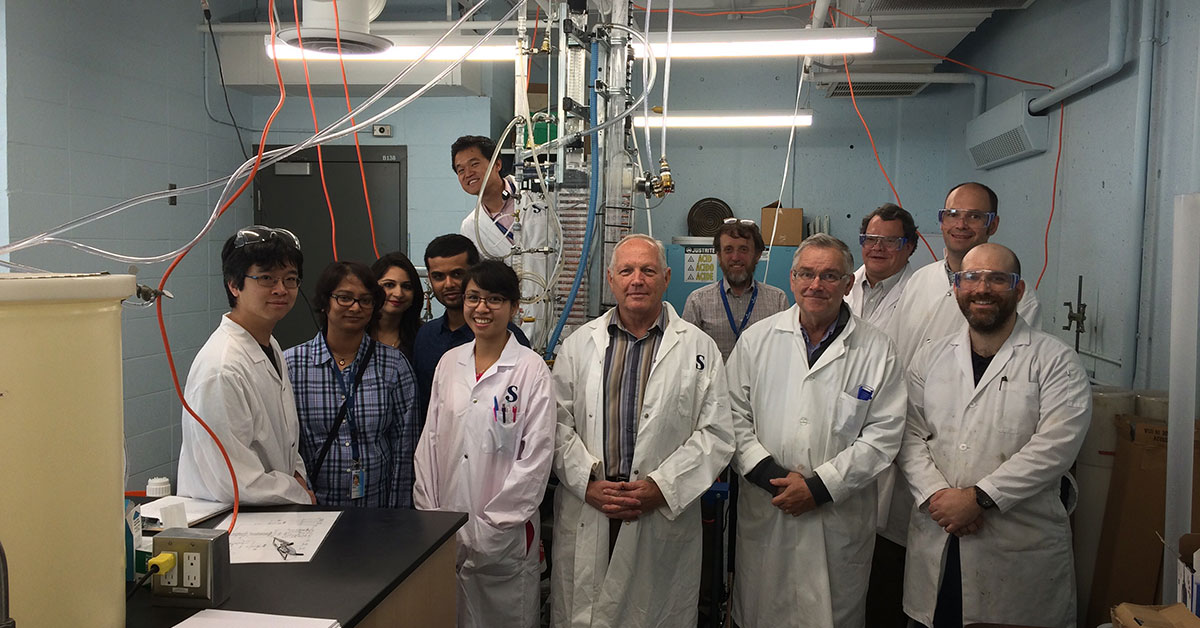
The aim of the project was to design, construct, commission and test a pilot unit to demonstrate whether pass-through distillation can passively remove volatile components from a fermentation broth at room temperature and absorb them into a non-toxic brine solution with no net heat input in the process. The answer was yes, and once commercialized, this technology has the potential to make biofuel — such as ethanol made from agricultural residue — economically feasible.

The project took nine months from developing the proposal to completion, and involved four students. Two were Chemical Engineering Technology students, mainly involved in designing the process and constructing peripheral processes and the auxiliary equipment driving the pilot unit. Two Environmental Control students were involved in commissioning the unit and analysing samples from the trials. Because the process was so novel, many of the students’ activities focused on problem-solving and rapid prototyping, which allowed them to gain new skills that are in demand in Canada’s growing biofuel sector.

Every country that signed the Paris Agreement, including Canada, pledged to slow the build-up of carbon dioxide in the atmosphere. Biofuels such as ethanol are seen by governments and advocacy groups as one way to help do that. However, the high cost of producing them has stood in the way of widespread use. By distilling the ethanol economically at room temperature, this project could make advanced biofuels profitable to manufacture and sell.

Industry: Environmental
Funded by: College and Community Innovation Program, Engage Grant, NSERC

About Sheridan College

Sheridan College is one of Canada’s leading postsecondary institutions, serving over 23,000 full time students at four campuses in the western Greater Toronto Area. We... Learn more

A Light of Hope at a Dark Time

Services for victims of crime have been multiplying in recent decades, as a kind of formalized compassion in the face of pain that was often terrible to witness, let alone experience.

Those services, however, were more instinctive than scientific in design and information on how victims navigate their way through the system that’s intended to help them is sparse. Researchers at Algonquin College in Ottawa are exploring how victims of violence navigate obstacles as they deal with the aftermath of a crime, and whether negotiating the system and their own trauma helps them develop resilience.

“So much focus goes on the harm and vulnerability, that if those are the conversations you are always having, it can reinforce the negatives,” said Benjamin Roebuck, coordinator of Algonquin’s graduate Victimology program. He is the principal investigator on a Community and College Social Innovation Fund project, sponsored by the Social Sciences and Humanities Research Council.

Roebuck is a strong believer in focusing on strengths. “We can learn a great deal about how to help people rebuild their lives by talking about the deep resilience some people develop.”

While aware people who have been traumatized should not be pressured to look for a bright side, Roebuck finds some people are very glad to talk about how they are coping and what they have been able to do to navigate the aftermath of the crime they suffered.

“You wouldn’t go to the parents of a murdered child and ask positive-toned questions,” he explained. “But we have so many examples of people talking about strengths, and if you can share with other survivors stories of people who really found a way to live again, it provides hope.”

Timing, knowing what not to say, and recognizing that trauma and strength exist side by side in many people are all crucial in efforts to draw out resilience, Roebuck said. But learning about growth factors — when people feel resilience, and what helped or hindered it growing — will allow the research team to build them into lessons in the college’s victim assistance training program.

The multiphase project involves victims and service providers throughout — asking in interviews and questionnaires about what services have been most helpful, what gaps there are in knowledge about resilience and how it is built. Broadly distributed questionnaires will be followed up by one-on-one interviews to explore experiences of strength and resilience.

Partners in the research include the Victim Justice Network, which connects victims of crime, victim services providers and victim advocacy organizations across the country. It is one of several groups wanting to improve services for victims. Indeed, enhanced training on victims’ particular vulnerabilities and sensitivities has frequently been recommended for people who work with them, including service providers and legal professionals.

Funded by: College and Community Innovation Program

About Algonquin College

The mission of Algonquin College is to transform hopes and dreams into lifelong success. Algonquin College, a national leader in applied and online learning, offers... Learn more