
Floating islands — first responders in water reuse

Too much of anything can be bad, we’re told, and it’s certainly true of nutrients in water. Too many nutrients in rivers, lakes and ponds — often the result of runoff from nearby fields, towns and cities — can over-stimulate the growth of water plants, which in turn choke off oxygen and kill water creatures. The process is known as eutrophication.

Lakeland College’s Centre for Sustainable Innovation is looking at the possibility of reducing the dangers of eutrophication by taking nutrients right out of the water, through an innovative method known as “floating islands.”

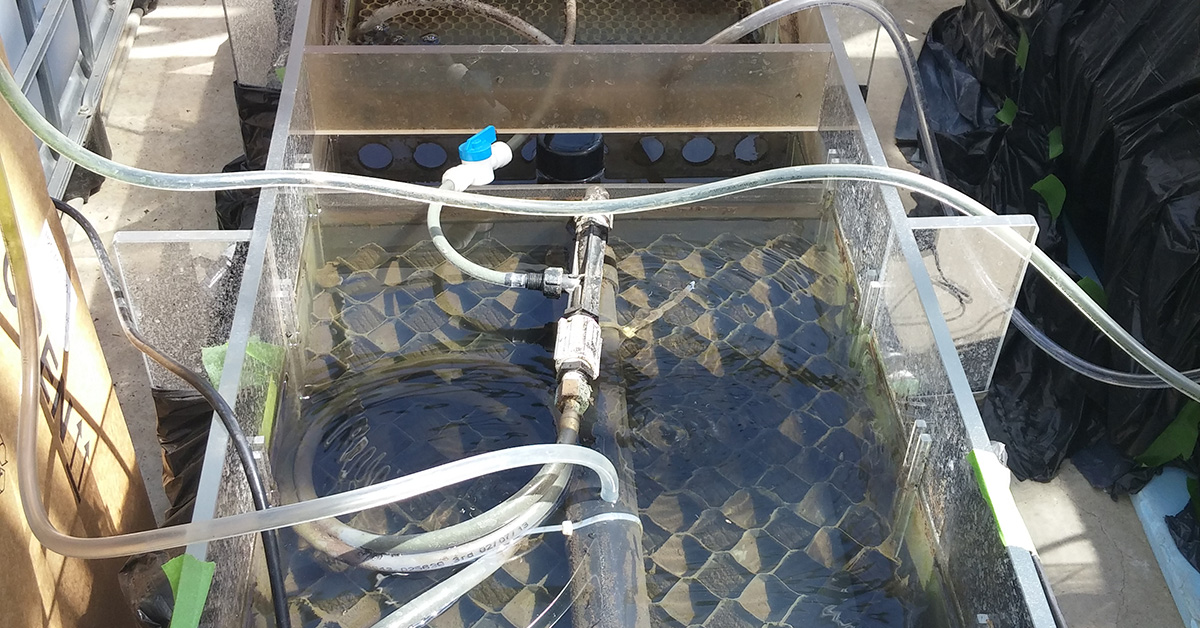
This spring, the centre’s pond was divided in two with a lake divider curtain — a piece of research equipment made of durable plastic. The top contains Styrofoam and floats on the water surface, while the bottom is weighted with chain and sinks into the sediment at the bottom of a water body, effectively dividing it in two. On each side of the curtain, a floating island was launched. Floating islands are artificial islands, strong enough to support a mix of wetland plants; installed on a eutrophied body of water, they act as natural wetlands, filtering nutrients from water.

Lakeland’s experiment compared the efficiency of floating islands at removing agricultural nutrients from water in two different scenarios. On one side of the pond, water circulated naturally, while on the other side circulation was boosted by a solar-powered submersible water pump.

Water was sampled weekly through the spring and summer and analyzed for ammonia, nitrate, nitrite, and phosphorous levels. Results of the work could lead to more widespread efforts to counter the eutrophication of ponds, rivers and lakes.


About Lakeland College

All colleges say they are educating the leaders of tomorrow. At Lakeland College in Alberta, our students are leading today. Students have the opportunity to... Learn more

A barren patch of ground becomes a place to grow knowledge

Exposed soil — whether it’s left unprotected by farming, construction or industrial activity — has an increased risk of eroding. The environmental impact of erosion can include loss of farmland, sedimentation of waterways, reduced air quality, and, in severe cases, total abandonment of the land for any productive purpose.

However, there are methods available to temporarily control erosion and minimize its environmental impact during construction and until permanent ground cover can be re-established.

Lakeland College’s Centre for Sustainable Innovation became a candidate for temporary erosion control when a section of its grounds was left bare after a gasifier and solar concentrator were installed. That gave students from the Environmental Conservation and Reclamation program a chance to put what they were learning into practice.

The students were asked to develop an erosion-control strategy for the site. They decided to seed the land with a native seed mix before installing temporary erosion-control matting to protect against erosion while the seeds germinated and grew.

Matting was chosen because the site was small, it’s easy to install and affordable. However, the students took the opportunity to use the site to test and compare three types of matting with different lifespans — wood fibre, which lasts 12 months, straw, which lasts 18-24 months, and coconut fibre which persists for more than 36 months. The question was whether a more persistent mat would influence regrowth on the site; students continue to evaluate and report on that experiment.

Funded by: College and Community Innovation Program, Innovation Enhancement (IE) Grant, NSERC

About Lakeland College

All colleges say they are educating the leaders of tomorrow. At Lakeland College in Alberta, our students are leading today. Students have the opportunity to... Learn more

Focused on power: researching a bright new way to use the sun’s energy

Focusing energy increases productivity: it’s true for people, so no surprise it’s true for the sun, as a unique device called a solar concentrator demonstrates. Lakeland College’s Centre for Sustainable Innovation site is now home to a solar concentrator prototype, which can concentrate the sun’s energy to temperatures in excess of 2,000 °C, hot enough to melt metal.

The concentrator works by reflecting the sun’s light from one mirror to a curved mirror, which in turn concentrates the light into a focused circular beam aimed at a target. Controlling and directing the beam is done by tilting the mirrors and adjusting the vertical and horizontal position of the target for maximum effect. The concentrator uses solar-tracking sensors and two motors to follow the sun.

Work being done with the concentrator includes Lakeland researchers making various types of targets to evaluate their performance on different industrial tasks, such as drying materials or heating liquids and gases. The first target tested was for heating water; it consisted of a metal plate covered in coiled copper tubing, which intercepted the concentrated sunlight at its focal point. The temperature of water flowing through the tube could be raised from 15° C to upwards of 70° C in a matter of seconds.

When it’s concentrated, solar energy can reach the high temperatures required by some industrial processes, which opens many more opportunities for harnessing the sun’s power. Testing will continue on exploring potential uses for concentrated sunlight.

About Lakeland College

All colleges say they are educating the leaders of tomorrow. At Lakeland College in Alberta, our students are leading today. Students have the opportunity to... Learn more

What goes around (water) comes around (as heat)

In February 2015, Lakeland College opened the doors of its new Bio-Energy Centre. The building features a micro cogeneration unit built by Yanmar Energy Systems Co. Ltd. of Japan. The cogen unit uses an engine fueled by natural gas to generate electricity; at the same time, water is heated by the engine’s warmth. Heat from the engine’s water jacket and exhaust is collected through heat exchangers and used to provide base heat to the centre. The Yanmar unit is rated to simultaneously produce 10 kW of electricity and 16.8 kW of heat.

The cogen starts up automatically when the building needs heat and begins to generate electricity; any electricity not used in the building is exported to the Lakeland College grid for use at the main campus. Electricity generated from the cogen is generally less expensive than purchasing grid electricity because natural gas is much less expensive than electricity — according to the Government of Alberta’s Utilities Consumer website, the average cost of electricity in 2014 was $0.0764/kWh, which is equivalent to $21.22 per gigajoule. The average price for natural gas over the same period was $4.51 per gigajoule, less than a quarter the cost.

Because the cogen is so efficient, Lakeland anticipated heating the building for free; researchers were monitoring results to determine if that were true.

About Lakeland College

All colleges say they are educating the leaders of tomorrow. At Lakeland College in Alberta, our students are leading today. Students have the opportunity to... Learn more

Repairing the riparian area — riverbank rejuvenation in Vermilion

Lakeland College’s Vermilion campus was founded in 1913 as an agricultural school and is surrounded by land used for studying and researching farming. In addition to space for farming and grazing, the fields contain wetlands which, with growing recognition of their importance in the overall health of the environment, are increasingly the subject of research themselves.

That’s because riparian (literally, river bank) areas provide habitat for wildlife, have an important role in protecting water quality and limit the damage caused by floods. But the banks of wetlands and rivers are often badly degraded — by animals seeking water and by how the adjacent land is used.

An assessment done before research started recommended fencing several wetlands to keep cattle off and let the riparian areas return to their natural state. However, only one wetland, a dugout, was fenced (water was provided for the cattle elsewhere). Instead, the college is aiming to develop a collaborative, sustainable and realistic approach to improving the overall health of college wetlands, in the belief many small improvements will lead to positive changes.

Research on college property began with making inventories of wetland plant species and a project measuring water quality.

In a related project, researchers are also reassessing a fenced off riparian area in Vermilion Provincial Park, to assess whether the fences have improved the health of the riparian area (which had been degraded by livestock). They have developed a set of protocols to use in the reassessment and in future monitoring. Students involved in the project focused on studying the amount of biomass produced in the area through assessments of grazing cages that had been set up for three years before the fences were built.

In the future, students may be involved in yearly assessments of the riparian areas within the fences.

Funded by: Innovation Enhancement (IE) Grant

About Lakeland College

All colleges say they are educating the leaders of tomorrow. At Lakeland College in Alberta, our students are leading today. Students have the opportunity to... Learn more

Hands-on work on remote control

Off-the-grid technology can present a problem for operators when it’s also out-of-reach. Toronto’s Clear Blue Technologies Inc. has more than two decades of experience in linking environmentally friendly green energy with the hardware and software necessary to monitor and manage it.

The company has worked with Centennial students and faculty several times over the years, most recently on a new piece of technology, the Macaw charge controller, which communicates vital information on off-grid hardware (including solar and wind-driven equipment) to remote operators. Macaw can provide users with a range of information, from functional problems to data on the amount of energy the green device is saving. Centennial College was instrumental in all facets of the device’s production and development.

Over the course of the project, Centennial did humidity and ambient temperature tests on the equipment, built the mechanical housing for motor generator sets, and installed a UGE wind turbine on campus, adding controllers and sensory equipment for monitoring.

Students fine-tuned campus solar panels by using Macaw algorithms, and designed the protective enclosure for its controller boards, factoring in corrosion, UV, humidity and other variables. Afterward, they built a prototype and tested its ability to communicate.

Co-op student Anna Serbina was involved in the first testing on Macaw. She found that her responsibilities increased along with the challenges did, but says “the teamwork environment was helpful when it came to asking questions.” Anna describes her experience as “extremely hands on.” She is one of three co-op students hired by Clear Blue after their work terms.

The project has also had an impact on Centennial’s curriculum, according to Frank Levstek, innovation program manager for Centennial’s Applied Research, Innovation, and Entrepreneurship Services. College faculty, he says, are using Macaw controllers in labs as a teaching aid.

About Centennial College

Established in 1966, Centennial College is Ontario’s first public college primarily serving the eastern portion of the Greater Toronto Area through five campuses. It has... Learn more

Take heat, be cool

Take heat, be cool. Sounds like a line from a jazz standard, but it’s also a description of solar absorption cooling — a method of air conditioning that uses the power of the sun, rather than electricity, to operate.

Heating buildings through the power of the sun is nothing new, but solar-powered air conditioning seems like a contradiction in terms. In fact, it is merely harnessing the sun’s power another way: it uses water, heated by the sun, to drive the chillers in air conditioners. Not using electricity gives solar absorption cooling a huge advantage, because the electrical grid can get dangerously overloaded during heat waves as commercial and residential energy consumption soars.

Different approaches to solar absorption cooling are in use around the world, but in 2016 a team from Toronto’s Centennial College took on the challenge of building their own system. Team members were Mihail Plesca, who holds a Ph.D. in mechanical engineering (and specializes in solar energy), Centennial’s innovation program manager for energy, Hassan Haji-Esmaeili, and two student researchers, Eromosele Basil Ahunun and Harsh Pandya.

The team ran a software simulation based on the solar absorption cooling system they had designed, and found the optimal temperature for their single effect lithium chloride absorption chiller to operate at was 90° to 100° degrees Celsius.

In August 2016 the team presented their findings on their integrated solar absorption cooling system to the 2016 International Conference & Exhibition on Clean Energy at McGill University, where their results were well received.

The team continues to collect data on how well the prototype chiller performs and how accurately its components match with the simulation results the group presented in Montreal. A close match between theory and practice will make it possible to set the system up in other locations.

Partner(s): Renteknik Group
Funded by: Emerging Technologies for a Carbo-constrained Environment

About Centennial College

Established in 1966, Centennial College is Ontario’s first public college primarily serving the eastern portion of the Greater Toronto Area through five campuses. It has... Learn more

Aclarus

Easy access to high-quality drinking water can be a challenge for people outside urban areas — and it was to improve that access that Aclarus Ozone Water Systems approached Lambton College in Sarnia for help to test, develop and optimize its ozone water purification system.

Aclarus, based in Peterborough, Ontario, specializes in water purification through the use of ozone technology. Ozone, an inorganic molecule, is extremely efficient at removing bacteria, pesticides, odours, chemicals (and more) from water.

In June of 2015, Aclarus partnered with the Lambton Water Centre at Lambton College on a research project to validate its system’s effectiveness in treating and disinfecting bacterial contamination in drinking water. The project included installation of a remote monitoring system that allows the consumer or Aclarus technical staff to monitor the system from a smart phone or central control station.

Dino Evangelista, coordinator of the Lambton Water Centre, led the research project together with faculty researcher Kevin Ryan. Two students from Lambton’s Instrumentation Control and Engineering Technology program worked with them.

The research project with Lambton allowed Aclarus to improve and validate its technology, while at the same time improving the customer experience by creating remote monitoring options for the system. Due to the success of this project, Aclarus is planning to continue doing research projects with the Lambton Water Centre.

Partner(s): Aclarus
Funded by: Applied Research and Development (ARD) Grant, Community and College Social Innovation Fund, NSERC, Ontario Centres of Excellence

About Lambton College

As a post-secondary leader in education, training and research, Lambton College has experienced tremendous growth in recent years. In addition to a significant rise in... Learn more

Feeling better about what goes down the drain

Blue Planet Environmental is an Ontario-based company that has developed an advanced wastewater treatment for both residential and commercial use. The company approached the Centre for Alternative Wastewater Treatment at Fleming College to find ways to improve its new system, so its performance would eventually meet industry certification standards.

The centre launched two consecutive applied research projects to optimize and redesign the system. The first assessed two variations of the system – run in parallel – to determine which removed nitrogen more effectively. The second project, building on the results of the first, modified the system to combine a fixed film filter process with a conventional septic tank. As a result of the second project, the Blue Planet system was further refined.

Four students assisted with the projects, which were directly related to their programs of study. They gained skills in sample collection, lab analysis and laboratory health and safety.
Systems like Blue Planet’s allow houses and businesses in areas without sewer systems to treat their wastewater efficiently and effectively, preserving water and protecting the environment.

Because of the two applied research projects at Fleming College, the advanced wastewater treatment system’s capabilities have been greatly improved. Blue Planet has deeper knowledge of how its technology works and data to back up that understanding. Thanks to the system provided by Fleming’s Centre for Alternative Wastewater Treatment, Blue Planet can speak with confidence of its technology’s capabilities and is in a better position to complete development and validation of the system.

Funded by: Engage Plus Grant

About Fleming College

Located in the heart of Central Ontario, Fleming College has campus locations in Peterborough, Lindsay, and Haliburton. Named for famous Canadian inventor and engineer Sir... Learn more

Aqua Greens – From Seed to Restaurant

In a contest of whether Humber College or fish were more important in the success of Aqua Greens, a company that supplies organic greens to restaurants and markets in Toronto, the fish would probably win. But Humber would be a close second.

Tilapia are an essential part of the aquaponics system that Aqua Greens uses to supply restaurants and grocery stores in Toronto with several varieties of basil, as well as dandelions and mustard greens. Aquaponics is a water-based growing method that requires no soil: instead, the plant roots are bathed in highly oxygenated water that draws its nutrients from the waste generated by the fish living in tanks in another part of the system.

As the water is pumped from the fish tanks to the tanks that feed the plants, the ammonia in it is converted to nitrate fertilizer. In turn, as the plants draw on the water, they filter and clean it before it is returned to the fish, in what is called a re-circulating, closed loop ecosystem. A full 90 per cent of the water is recycled.

Aquaponics can significantly reduce the ecological footprint of growing food. Aqua Greens’s indoor aquaponic system conserves land, reduces the distance food travels and uses no pesticides, herbicides or added fertilizers.

Where does Humber come into this? The founders of Aqua Greens, Pablo Alvarez and Craig Petten, are graduates of Humber. Both were working as waiters when they decided they wanted to do something more with their lives. Both enrolled in Humber’s Sustainable Energy and Building Technology program. They did their final project together, on aquaponics — seeing an opportunity to combine their passion for sustainability with their love of good food.

But the company has another tie to Humber: Aqua Greens received funding from the Humber New Ventures Seed Fund and later won the Humber Launch Pad Entrepreneur Award, which led to more than $30,000 in funding as well as giving access to mentors, business plans and business coaches.

Partner(s): Aquagreens
Funded by: Humber College

About Humber Polytechnic

Humber Polytechnic is one of Canada’s leading postsecondary institutions, combining deep theoretical learning with applied, hands-on experience. Humber offers a wide variety of credentials including... Learn more