
Glasses-free 3D Technology for iPads

Humber College’s School of Applied Technology has recently completed a research project that involved designing and patenting 3D software for iPads.

Humber faculty member Odin Cappello partnered with Ooyavah Inc., a leading Ontario business in stereoscopic technology, to develop a prototype for glasses-free 3D visualization on the Apple iPad.

Ooyavah’s innovative technology required that users could easily mount the lens to their iPad with high precision, that iPad aesthetics and functionality were not compromised, and that the lens could be conveniently stored when not in use. To address this design challenge, Cappello led a team of Humber students who worked with Ooyavah to design and create a prototype of a case that integrates their 3D screen and to develop the user interface for the new product. Students from Humber’s Bachelor of Industrial Design program designed, printed, and evaluated several prototypes to design the hardware to house Ooyavah’s 3D lens. The team also collaborated with Sheridan College’s Centre for Advanced Manufacturing and Design Technologies.

The student researchers and faculty in Industrial design are all named with industry partner Ihor Petelycky as inventors on the patent pending for the case. Students from Humber’s Multimedia Design and Development diploma program worked with Ooyavah to design a user interface application and create a visually appealing experience for users. Working closely with Ooyavah and under faculty supervision, the student design team contributed to the development of a fully functional prototype ready for use by Ooyavah.

“The client gets the benefit of working with excited young people, and students get the benefit of having a really cool design project under their belts,” notes Capello, Faculty Lead in Humber’s School of Applied Technology.


Partner(s): Ooyavah Inc.
Funded by: Ontario Centres of Excellence

About Humber Polytechnic

Humber Polytechnic is one of Canada’s leading postsecondary institutions, combining deep theoretical learning with applied, hands-on experience. Humber offers a wide variety of credentials including... Learn more

Giving the Aerospace Industry an Upgrade

Aerospace manufacturing companies build parts using computer numerical control (CNC) machines, high-tech sculpting machines that program the path of the cutting tool in core materials. In this rapidly changing technology field, parts often become obsolete and cost-effective solutions must be found to replace them.

When one of its aerospace clients’ CNC machines needed new memory cards, Nexas Networks collaborated with Centennial College to find a solution. Partnering with the college’s Applied Research and Innovation Centre (ARIC), Nexas Networks and Professor Glen Taylor worked with students to design and prototype a new memory card for the CNC machines.

In four months, they reverse-engineered the old card, and made a newer, faster, and smaller model. They also added new features, including back-up power, so the machine will not forget the shape programmed into it when power fails. The new card was also cheaper to produce, at less than a quarter of the original’s price. The memory card prototypes developed by Centennial students for this project were built at Brantco, an aboriginal-owned company located on a reserve.

The industry partner was grateful for this breakthrough and Tom Gaasenbeek, president of Nexas Networks, was so impressed with the team that he hired one of the student researchers. The company has plans to commercialize the new product and is looking forward to more applied research projects with Centennial College. The college also realized lasting benefits as faculty modified their curriculum based on inputs from Nexas Networks and their research experience.

Students who worked on the project were offered a real world problem where they had to use their training and out-of-the-box thinking to explore all possible solutions and deliver a working prototype.

Industry: Manufacturing
Partner(s): Nexas Networks

About Centennial College

Established in 1966, Centennial College is Ontario’s first public college primarily serving the eastern portion of the Greater Toronto Area through five campuses. It has... Learn more

From the Restaurant to Your Kitchen

Scaccia is a family owned Italian restaurant in downtown Toronto. Their signature dish is the “scaccia” itself – a variety of delicious, healthy vegetables, cheeses, and meats placed between two layers of dough and baked to perfection.

Looking to break into the ready-made market, Scaccia restaurant came to George Brown College’s Food Innovation and Research Studio (FIRSt) to develop a frozen microwaveable version of their scaccia sandwich. The product had to be individually portioned for the food service industry, nutritionally responsible, and as tasty as the original.

College researchers worked closely with Scaccia owners and head chef throughout the development process for four popular scaccia flavors. The FIRSt team evaluated Scaccia’s restaurant ingredients and matched them with commercially viable options able to withstand freeze/thaw cycles.

In addition to sourcing special freezing technologies, the research team also developed a unique sauce system to ensure fillings were contained within the open-sided sandwich. After 24 months, and more than 60 iterations of sauces, fillings and Italian style dough using a variety of preparation processes, Scaccia was given four formulations and product specifications to take to a co-manufacturer, complete with sensory evaluations.

Through an additional collaboration with George Brown School of Business students, the product was tested on location at Scaccia Restaurant to get customer feedback on this new sandwich. This gave the company valuable consumer insights to develop the right marketing strategy for this innovative food product.

Industry: Food

About George Brown Polytechnic

George Brown strives to build a seamless bridge between learners and employment by developing dynamic programs that are informed by industry and workplace-ready graduates who... Learn more

Seniors Care

Dr. Veronique Boscart is the CIHR/Schlegel Industrial Research Chair for Colleges in Seniors Care at Conestoga College working on studies to improve care for seniors and training for gerontology nurses in Canada.

Dr. Boscart leads Conestoga’s activities with the Schlegel-University of Waterloo Research Institute for Aging, in Kitchener, Ontario. The institute’s mandate is to enhance the quality of life and care for older adults through research, education, and practice. The focus of Dr. Boscart’s efforts is the development of evidence-informed training programs for staff already working in long term care, and for students in post-secondary programs that lead to careers working with seniors.

Dr. Boscart has extensive experience as a clinician, nurse educator, manager, and researcher and is committed to advancing education and research to improve care for Canada’s growing population of seniors. She holds graduate degrees in both Nursing and Education and completed her PhD at the University of Toronto.

“Most health care programs in Canada don’t have a mandatory component in gerontology,” said Boscart. “The majority of training is still focused on acute care, when in fact, most seniors require chronic care management in a community setting.”

Studies project that by 2036, one in four Canadians will be over the age of 65, and one in 11 will suffer from dementia. This demographic shift will have a tremendous impact on our health care system. According to Statistics Canada, three in 10 Canadians require long term care by age 65, and five in 10 require such care by age 75.

To address the gap between evidence-informed knowledge and practice in the area of seniors care, Boscart conducts applied research studies to identify practices that will improve quality of care for older adults, to adapt curriculum to improve graduates’ knowledge, skills and attitudes for seniors care, and to develop future leaders for gerontological nursing.

“We need to focus on innovative education strategies,” Dr. Boscart said. “Students and new grads don’t always learn how complex the care for seniors can be, and how important it is to fully understand what is happening to their patients.”

Dr. Boscart’s research has been instrumental in the development of new training strategies to improve care for older adults, including the establishment of collaborative Living Classrooms that provide students with experiential learning opportunities working with seniors in real-world, long term care environments. In addition to her role as research chair, Dr. Boscart continues to work as a gerontological nurse in an emergency department and in long term care. She is president-elect of the Canadian Gerontological Nursing Association.

According to Josie d’Avernas, vice president of the Schlegel-UW Research Institute for Aging, “Veronique’s leadership as CIHR-Schlegel Industrial Research Chair for Colleges in Seniors Care has touched the lives of residents living in our Villages and beyond, and will continue to do so for years to come. Students in Nursing and PSW programs have a new enthusiasm for pursuing careers working with older adults, thanks to enhanced gerontology content, teaching and mentorship by Dr. Boscart. A new way of learning is finding its roots in the living classroom model – where students learn in situ within a long term care environment.”

About Conestoga College

Conestoga College Institute of Technology and Advanced Learning is a leader in polytechnic education and one of Ontario’s fastest growing colleges, delivering a full range... Learn more

Animal Semen Sexing

Being able to determine the sex of animal offspring is of significant value for animal producers, and offers opportunities for research to develop new commercial processes. The only sexing tool currently on the market is expensive, leads to lower fertility, and is only effective with heifers.

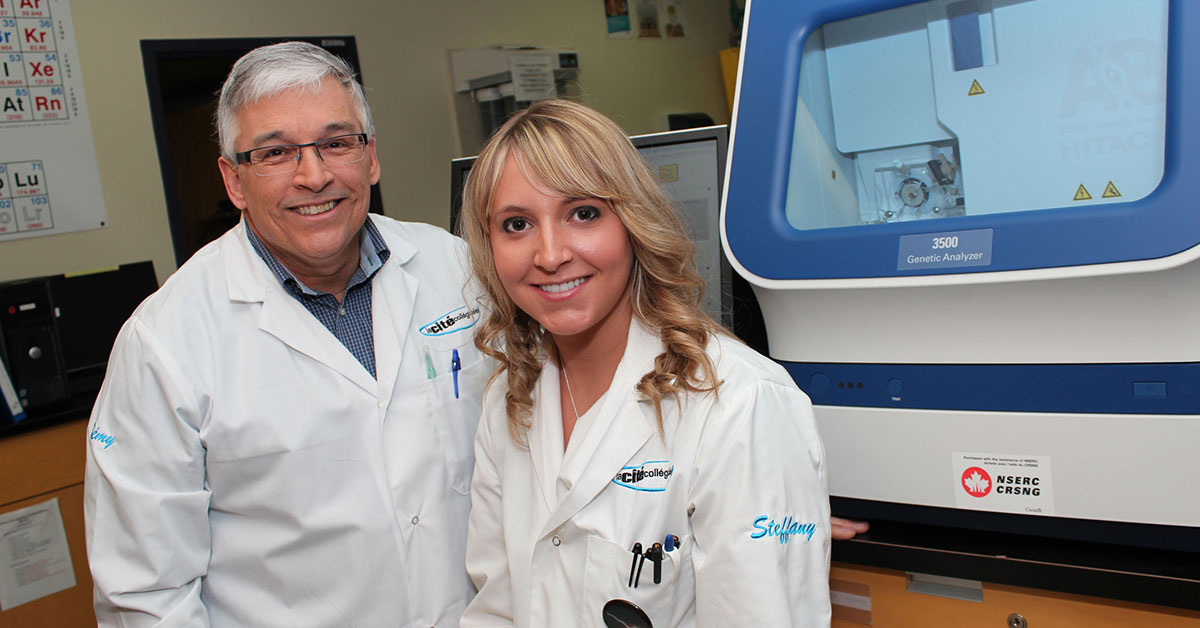
Ab Biotech Inc. in Gatineau, Quebec is a company working to develop an immunological approach to sexing semen for all species, including humans. It has collaborated with the Centre de recherche en biovalorisation (CRAB) at La Cité since 2009 to design a process for producing and purifying antibodies in animal semen sexing.

New equipment at La Cité purchased through an Applied Research Tools and Instruments grant allows the research team to 1) produce recombinant immunogens and antibodies using an accelerated process 2) produce bacteriophages for the immunocapture of sperm cells, and 3) do genotyping and quantification of fractionated animal semen and sex-specific embryos.

Ab Biotech President Robert Letellier says, “Ab Biotech has benefitted tremendously from the ultramodern equipment acquired by La Cité over the past several years. This helps biotech companies like ours a lot because a number of us can share expensive tools we truly need but call on only occasionally. It’s saved us hundreds of thousands of dollars and attracted investors. We’re extremely thankful.”

La Cité’s professors and technologists bring their scientific expertise to these bio-industrial innovation research projects and help to train highly specialized workers for cutting-edge fields. Through the Ab Biotech Inc. partnership, four students a year complete co-op work terms, get part-time jobs, and complete practical in-course projects. Six of the program’s graduates have secured jobs with Ab Biotech.

Industry: Agriculture
Partner(s): Ab Biotech Inc.
Funded by: Applied Research Tools and Instruments (ARTI) Grant

About La Cité

La Cité est un collège d’arts appliqués et de technologie situé à Ottawa, la capitale nationale du Canada. L’établissement est le seul collège francophone de... Learn more

Precision Agriculture and Environmental Technologies

Dr. Mike Duncan knows all about the promise and potential benefits of combining agriculture and “big data”. For the past six years, he has worked with government, technology companies, and farming partners to develop a computerized planning system for precise planting and pest control. Duncan’s aim is to improve the growers’ ability to produce higher quality food, and obtain higher crop yields with better environmental stewardship and reduced costs.

The best opportunity to maximize production from currently farmed land is by increasing the yield. Precision agriculture aims to increase yield, while decreasing fertilizer inputs, which reduces costs, increases revenue, and minimizes environmental impact. Dr. Duncan and his team have developed a variety of web applications that provide real-time data, mapping, map analysis, and farmer guidance.

Precision Agriculture Automatic, or PrAgMatic, is an integrated system being developed by Dr. Duncan and a research team at Niagara College that collects and synthesizes relevant farm data from GPSand sensor-enabled combines and spreaders and provide useful and timely information for the grower.

Dr. Duncan has been studying atmospheric and farm field variability, the two biggest factors in determining crop health, as well as potential and realized yields. Agricultural researchers have found a connection between field topography and crop yield variability, and Dr. Duncan’s work is using this concept to define several management zones within a field that need to be planted and maintained differently for maximum yield.

Two of Dr. Duncan’s farm partners have been tracking and using management zones to great advantage over the last decade. With these partners and collaborators from Ontario Ministry of Agriculture, Food and Rural Affairs, Dr. Duncan’s team is developing tools to map management zones. These tools operate on data from satellite photographs and sophisticated UAV-based LiDAR and multi-spectral sensors. The team’s work is now at the stage where it can be applied with growers and crop consultants to increase their productivity and competitiveness.

Through an Applied Research Tools and Instruments Grant, the team recently acquired a start-of-the-art server and disk system, and a world-class computer engine to properly apply and test precision agriculture theories with 15 to 30 growers in a quick data turnaround. At the end of the project, the algorithms and the system will be developed into an automated entity that has the capacity to process data from thousands of farms in a timely manner.

In 2002, Dr. Duncan was one of the first recipients of an Ontario Innovation Trust (OIT) grant for colleges. He received funding for an NSERC College and Community Innovation (CCI) pilot projects and was one of the first CCI research awardees in 2009 for research on land-use technologies. He received of the ORION Discovery award for his GPS data analyzing system, PrAgMatic, that has been the focus of his research as Industrial Research Chair.

About Niagara College

Established in 1967, Niagara College has grown to become a leading global college and one of Canada’s most enterprising postsecondary institutions. With a mission to... Learn more

Catering with a Conscience

As a successful business that caters thousands of meals each year, Café Belong found that the potential for waste was very high.

While plastic single serving cups and utensils are convenient in the moment, they can live on for decades in landfills. A large proportion of conventional single serve food ware materials is also derived from petroleum, a limited natural resource.

Café Belong wanted to switch to compostable, bio-based food service ware as an alternative to disposable plastic.

The company came to George Brown College’s Centre for Construction and Engineering Technologies to find a way to produce fully edible, biodegradable serving cups. Faculty and students began developing the prototype for a heat-setting mold device that Café Belong could use to produce their serving cups as needed.

The result? A sleek, custom-built, spring-loaded device able to compress edible discs into single-serving cups in one press. The design has an interchangeable component to allow for different thicknesses, and is completely reusable. The already green-minded company now has a competitive advantage and a renewed commitment to sustainability.

Café Belong plans to work with the Food Innovation & Research Studio (FIRSt) at George Brown to perfect the formulation for the cups. All the ingredients for an innovative recipe for change are in place, giving Café Belong the chance to reach the catering industry and beyond.

Industry: Food
Partner(s): Café Belong

About George Brown Polytechnic

George Brown strives to build a seamless bridge between learners and employment by developing dynamic programs that are informed by industry and workplace-ready graduates who... Learn more

Greek Spoon Sweets with Local Fruit

In preparation for opening a Greek yogurt bar in Toronto, an Ontario food company wanted to develop a Canadian version of a Mediterranean spoon sweet, a fruit preserve served with yogurt.

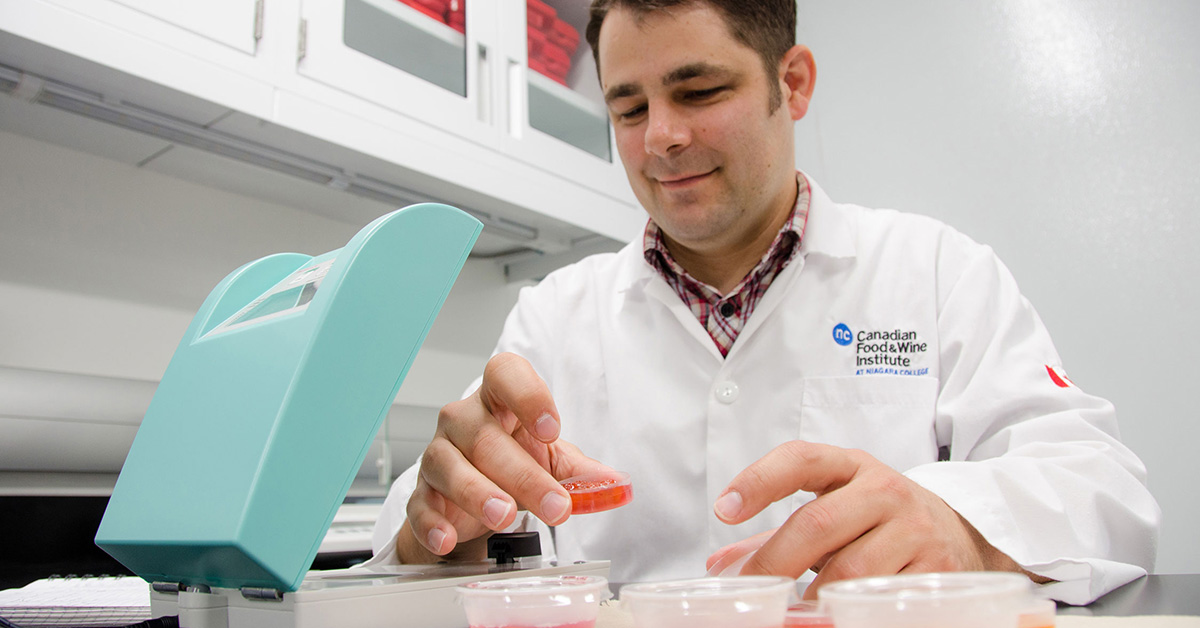
Colossus is a company that produces authentic Greek dishes for customers around the world. Its products are Greek spreads hand made by expert chefs from traditional recipes with no additives or preservatives. The company approached Niagara College’s Canadian Food & Wine Institute Innovation Centre to help develop a new spread, using Niagara-grown fruit instead of more expensive Greek imports.

Niagara’s research team developed several recipes and tested them using sensory panels. The panels identified the three top recipes for further refinement and commercialization in 2014.

A Niagara College business team conducted market research to understand the competitive landscape and identify market niche opportunities for this product line in food services and retail distribution. Several products were tested through consumer taste tests to determine product preferences, and flavours were refined and sampled by a trained sensory panel to assure quality. Finally, shelf-stability testing, packaging, and labeling were completed for each product, and a co-manufacturer was identified to scale-up production.

The new Spoon Sweets made their debut at the company’s Greek Yogurt Bar and Movenpick Marché in Toronto in the fall of 2014.

Industry: Food
Partner(s): Colossus Foods

About Niagara College

Established in 1967, Niagara College has grown to become a leading global college and one of Canada’s most enterprising postsecondary institutions. With a mission to... Learn more

MADD About Craft-Brewed Lager

The idea for an authentic-tasting but alcohol-free lager was conceived by a Toronto company that sells a full line of alcohol-free drinks and donates a portion of net sales to Mothers Against Drunk Driving (MADD) Canada.

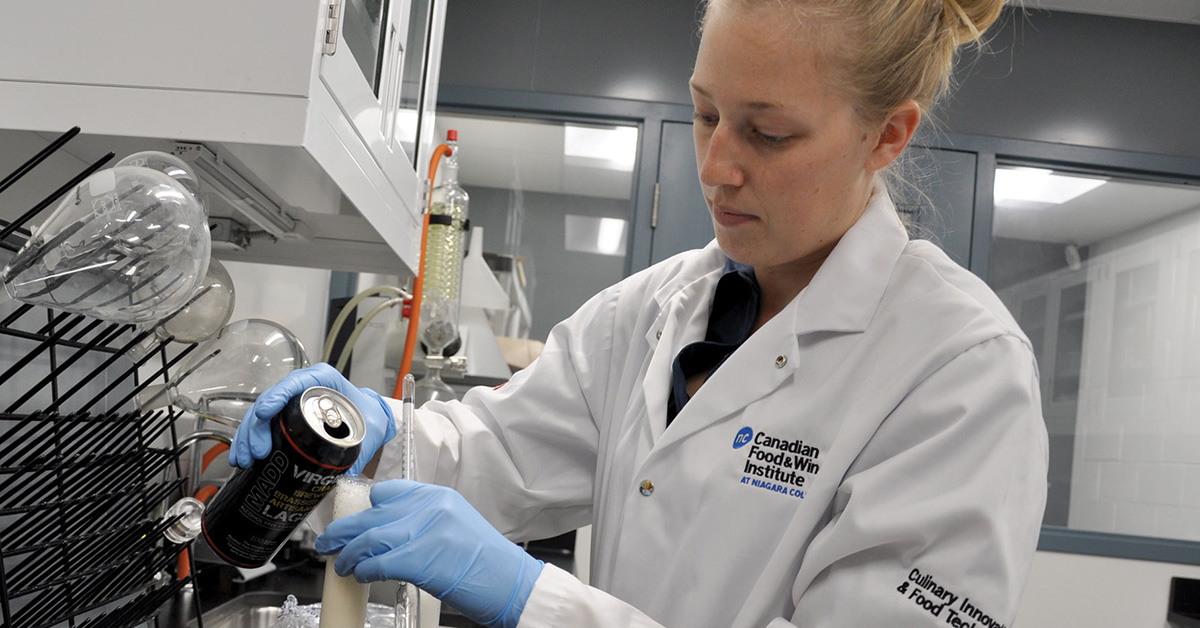
To help develop MADD Virgin Craft-Brewed Lager, the company tapped into the expertise of the Canadian Food & Wine Institute (CFWI) Innovation Centre at Niagara College. The research team developed a unique recipe, finding a way to eliminate all alcohol, while maintaining the flavours and aromas associated with a good lager. Researchers then tested the recipe through
consumer taste-testing panels.

As a result, MADD Virgin Craft Brewed Lager was the first alcohol-free craft beer on the market. In June 2014, it was made available for purchase at more than 3,000 Walgreens stores across the United States, and has since made its way into Canadian retail chains, including Rexall pharmacies. Less than a month later, MADD Virgin Craft Brewed Lager achieved international recognition by winning the gold medal at the 2014 U.S. Open Beer Championship in the non-alcoholic category.

“Without access to Niagara College’s faculty, students, equipment, and network of co-packers, MADD Virgin Craft Brewed Lager would not have been possible, let alone become one of our best sellers in the U.S. market,” says Brian Bolshin, MADD Virgin Drinks president and CEO.

Industry: Food
Partner(s): MADD Virgin Drinks

About Niagara College

Established in 1967, Niagara College has grown to become a leading global college and one of Canada’s most enterprising postsecondary institutions. With a mission to... Learn more

Advanced Material Development for Generation, Storage and Integration of Renewable Energy

As modern societies become more populous and a variety of new technologies, the need for advanced and novel materials has been widely recognized.

This need for engineered materials is nowhere greater and more urgent than in the electric power sector where cost-effective, reliable and long-term energy generation and storage technologies are essential for keeping pace with the ever-growing need for electricity in Canada and elsewhere.

Renewable energy technologies such as wind and solar offer alternatives to conventional technologies. However, their intermittent production and relatively high cost have slowed widespread penetration into the electricity market. Affordable energy storage technologies have great potential to improve the existing electric power grid, to facilitate the expansion of renewable energy technologies, and to offer an alternative to fossil-based fuels in the transportation sector.

Dr. Shahram Karimi, the Industrial Research Chair for Colleges at Lambton College, leads a dynamic research team working on green energy conversion and storage technologies. This team designs nano-engineered materials and processes that are economically viable, socially acceptable and environmentally benign. A major focus of Dr. Karimi’s research group has been the synthesis and optimization of new nano-materials for use in lithium-ion and lithium-polymer batteries, fuel cells, electrolyzers and photo-reactors. This research group is working to develop simple, cost-effective manufacturing schemes, where smart, functional films and surfaces with unique properties are put together for a wide range of industrial applications, including oil and gas and renewable energy conversion and storage.

The Industrial Research Chair for Colleges (IRCC) grant has provided Lambton College an opportunity to enhance and expand its applied research program, help local and regional companies with their research needs, and train highly qualified workers. This applied research also increases faculty involvement and enhances the college’s technology and business programs. The IRCC program at Lambton College has been involved in a number of projects:

  • State-of-Charge Estimation for Li-Ion and LiPolymer Batteries in collaboration with Volta Energy Inc.
  • Development of High-Efficiency and Low-Cost Fuel Cell Stack for a novel BioGenerator in collaboration with BioGenerator Energy Solutions Inc.
  • An Optimized Distributed LED Power Supply Model in collaboration with Volta Energy Inc.
  • Optimization of Lithium Ion Battery as an internal technology development
  • Innovative Accelerated Corrosion Technique for Industrial Protective Coatings based on electrochemical impedance spectroscopy in collaboration with Toolrite Engineering

As a result, the research program has made significant contributions and commitments in support of local innovation through renewable energy education and building a robust and dynamic applied research program that is responsive to the needs of local small and medium-sized enterprises.

“Our active collaboration with Dr. Karimi and his research team at Lambton College on clean energy generation and storage has provided us with a great opportunity to develop solutions to some of the most challenging issues facing humanity. These collaborations have presented immeasurable opportunities and rewards and we are looking forward to working with them in the years to come,” says Dr. Denis Kouroussis, President of Volta Energy Inc.

About Lambton College

As a post-secondary leader in education, training and research, Lambton College has experienced tremendous growth in recent years. In addition to a significant rise in... Learn more