
Assessing Heat Stress in Solar Panels

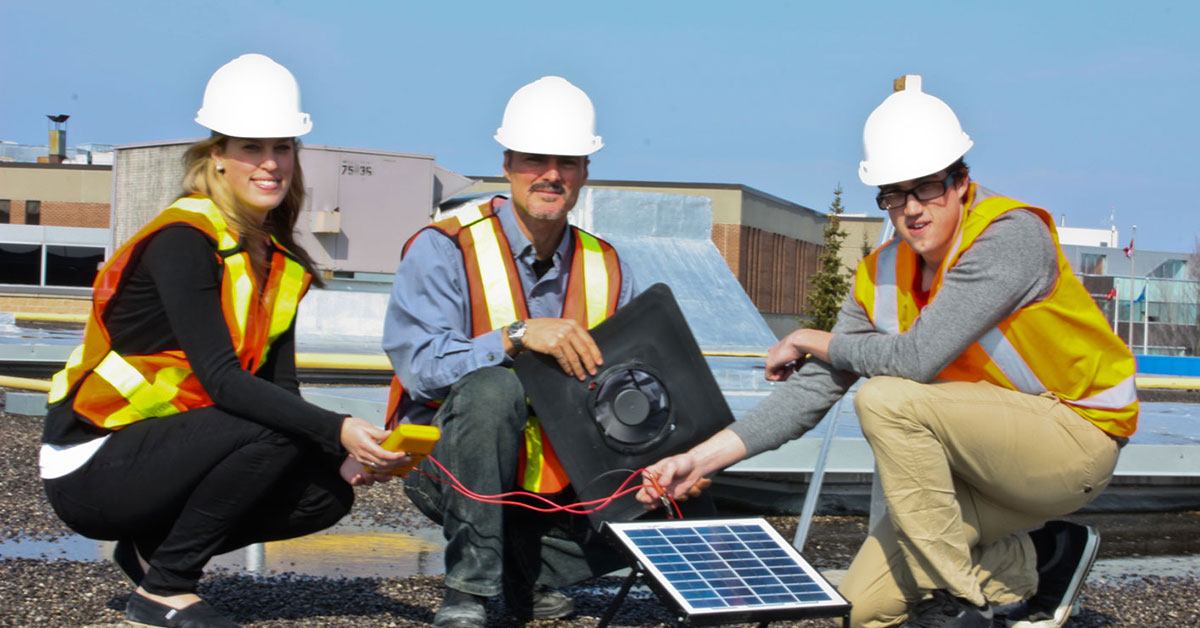
Heat trapped under solar energy panels is reported to reduce the energy production of rooftop installations of photovoltaic panels. Georgian College researchers are analyzing existing systems to determine how to resolve this issue.

PowerStream is the second largest municipally-owned electricity distribution company in Ontario, supplying electricity to 335,000 residential and business customers. The company has created a business unit, PowerStream Solar, which leases industrial, commercial and institutional rooftops for installation of photovoltaic panels.

Nine photovoltaic arrays from multiple manufacturers have been mounted on a number of different panel mount styles on the rooftop of the Barrie office of PowerStream, where they can be used for research and development. Students working with PowerStream through Georgian College’s Center for Applied Research and Innovation have identified environmental factors that warrant further investigation.

Heat, generated by and trapped under the panel arrays, reduces their efficiency. No current models quantify the relationship between outside temperatures and weather conditions in Southern Ontario to the heat produced under photovoltaic panels and its effect on photovoltaic output. An applied research project currently underway at Georgian College supports a student in the Environmental Technology program during co-op work terms. The student is analyzing performance data and environmental data to determine the effects on efficiency of the photovoltaic panels. The resulting report will allow PowerStream to forecast operational efficiencies more accurately based on local conditions.

“PowerStream is very interested in determining the effects of environmental effects including heating that impact the performance of the roof top solar systems,” says Derek Quigley, C.E.T. Manager of Renewable Energy. “In collaboration with Georgian College student researchers the results from this research initiative will be invaluable to PowerStream in designing and installing optimum rooftop solar systems that have no negative affect on the roofing materials.”

Partner(s): SPINCORE, PowerStream
Funded by: Applied Research and Development (ARD) Grant

About Georgian College of Applied Arts and Technology

However you define your goals, the best learning to get you there extends far beyond the classroom. Georgian’s leadership in co-op, student work experience and... Learn more

3D Imagery Helps Students Learn How to Give Needles

Health care students know that practice pays off when it comes to learning how to give a needle or insert an intravenous line. But what if new 3D sensory technology could provide feedback on whether or not students are turning their hands at a correct angle or applying suitable pressure when they’re carrying out these clinical procedures?

It’s an area of research that prompted Saskatchewan Polytechnic to team up with IRG Informatics Inc., a Canadian health information management company. The company wanted to test hardware and software that track and analyze body mechanics, such as coordination, dexterity, and fine-motor movement. IRG and the polytechnic had nursing students and faculty perform intramuscular injections on mannequins of varying sizes – paediatric, adult and geriatric – using 3D imagery.

IRG is now patenting the technology and plans to incorporate it in a highly sensitive training device, such as a sensor-embedded glove.

“The students’ and faculty’s continual feedback during these tests helped us fine-tune the design and calibration of the technology,” says Dr. Vahid Anvari, Director of Research and Development, IRG Informatics Inc.

The company expects that end-users of the technology will include educational institutions seeking cost-effective, high-tech training opportunities, and community-based clinics and health-care delivery organizations.

Funded by: Applied Research and Development (ARD) Grant

About Saskatchewan Polytechnic

Saskatchewan Polytechnic serves students through applied learning opportunities on Treaty 4 and Treaty 6 Territories and the homeland of the Métis people. Learning takes place... Learn more

New Technology Helps Asthma Patients Breathe Easy

Globally, 180,000 people die of acute asthma attacks every year, many with a rescue inhaler in hand. Some of these asthmatics are resistant to available medications, but for most the rescue medicine could not penetrate their constricted airways.

SAIT Polytechnic is working with industry partner SolAeroMed to develop the first innovation in asthma treatment in more than 30 years. SolAeroMed has patented a drug, S-1226, that can overcome the shortcomings in current standards of care for acute airway constriction. But the company met a stumbling block after it was approved for human trials. Compressed CO2 is the key to success for SolAeroMed’s treatment and also created the largest challenge in bringing it to market.

That’s where SAIT Polytechnic came in.

SolAeroMed contacted SAIT Polytechnic’s Applied Research and Innovation Services (ARIS) and asked its Sports and Wellness Engineering Technologies researchers to help develop a safe drug-delivery system to administer S-1226, which relies on compressed CO2 to open pathways in the lungs.

SAIT Polytechnic engineers designed and fabricated a prototype, producing a smaller and easy-to-use alternative to its predecessor – a bulky CO2 canister. This asthma drug-delivery system will allow emergency responders and emergency room doctors to administer this fast-acting airway opener in time to save lives.

Beyond the potential for S-1226 to improve the quality of life for asthmatics, the drug is projected to save Canada nearly $500 million per year in health care costs by shortening or eliminating visits to intensive care units.

Partner(s): SolAeroMed
Funded by: Applied Research and Development (ARD) Grant

About SAIT

SAIT (Southern Alberta Institute of Technology) is a leader in action-based learning, delivering relevant, skill-oriented education. We offer two baccalaureate degrees, three applied degrees, 73... Learn more

Growing Microalgae for Biofuel

Green algae harvested from Nova Scotia shores are being used by a local entrepreneur to produce biofuel for industrial use. And Nova Scotia Community College (NSCC) is helping him refine his process._x000D_
_x000D_
SabrTech is a Nova Scotia-based company using microalgae to design the next generation of biofuel, animal feed, and bioremediation. The company has partnered with NSCC and Acadia University to complete prototyping and optimize production of their algal biomass in a real world setting. The research team identified non-invasive and continuous quality assessment of algae as a key for achieving an optimum rate of production during microalgae cultivation. NSCC research provided a roadmap for designing an in-situ monitoring device to assess the maturity of the algal biomass for biofuel extraction._x000D_
_x000D_
NSCC students played a direct role, gaining technical skills in microalgae cultivation in varied growth conditions. The project results could significantly contribute to Canada’s economy and reduce the environmental impacts of using fossil fuels by helping develop a sustainable biofuel and bringing Canada into a leading position in global micro-algal markets._x000D_
_x000D_

Mather Carscallen, President & CEO of SabrTech Inc., says “Working with the NSCC yielded not only positive results for our project, but additional unexpected findings that will help us advance our technology in the years to come.”

Partner(s): SabrTech Inc.
Funded by: Applied Research and Development (ARD) Grant

About Nova Scotia Community College

Nova Scotia Community College (NSCC) is committed to building Nova Scotia’s economy and quality of life through education and innovation, transforming Nova Scotia one learner... Learn more