
Aging in Place with Online Help

Helping seniors stay flexible and mobile is critical to their ability to live independently. A small Ontario company has been working with Sheridan College to create an online program to help older adults keep their functional mobility through exercise at home.

Attune Aging Strategies and Solutions is a husband and wife team that developed an idea for reaching frail older adults who have no way to get to the therapeutic care they need after an injury or operation. With the help of Sheridan College’s Centre for Elder Care, the physiotherapist and occupational therapist designed a technology-supported exercise program for physiotherapy so older patients could do their rehabilitation exercises at home. The exercise program is now on sale and Attune is working on ways to train home support workers to deliver better care when they go in to check on patients.

“The opportunity to partner with the Sheridan Centre for Elder Research and NSERC allowed our ‘idea’ for serving older adults in the community to develop into a new Canadian business,” says Anita Salituri, owner of Attune Aging Strategies and Solutions. “The applied research study helped us to better understand the clients we serve, and findings were used to create our first product, which was released to the marketplace in November 2014. Sheridan’s expertise, resources and professional consultation throughout this process has been invaluable and they have played a tremendous role in assisting us through our entrepreneurial journey.”

The Sheridan Centre for Elder Research has seen tremendous impacts on both students and industry partners during the five year research program. Students from a number of programs have worked as research assistants and volunteers on applied research projects. They consistently cite their real-world experience in applied research as the reason they graduate as highly-competitive job candidates, and often secure high-quality jobs immediately after graduating.

Funded by: Innovation Enhancement (IE) Grant

About Sheridan College

Sheridan College is one of Canada’s leading postsecondary institutions, serving over 23,000 full time students at four campuses in the western Greater Toronto Area. We... Learn more

Clear Skies with Advanced Green Technology

Clear Blue Technologies designs on-grid and off-grid wind and solar energy devices for renewable energy manufacturers.

In 2012, Clear Blue and George Brown partnered to develop, manufacture, and test 20 prototypes of a key product. Clear Blue and the college have partnered again recently to develop a manufacturing process for Clear Blue’s Blackbird and Eagle releases.

The goal is to improve and scale the current manufacturability of its products and automate the existing manual manufacturing and testing of their systems. The company expects product quality and reliability to improve with proper reliability testing. This latest phase has supported Clear Blue in developing the process for a manufacturable for an outsourced subcontract Blackbird product. This involved working through an alpha version, a beta version and a version 1.0 of the Eagle product, and product and production testing processes. Clear Blue now has seven employees building, selling, and marketing these solar- and wind-powered solutions, and anticipates increasing their staff to 15-25 people over the next 18 months.

“Working with George Brown, we benefited from education programs specific to our industry, worked with great faculty, and had a strong and talented pool to draw from, leading to one of our first employees. Their faculty have assisted us as well – they provided assistance to review technology / hardware, as well as access to some equipment we didn’t have,” says Clear Blue Technologies.

This partnership has been mutually beneficial, matching industry experience with academic rigour, while serving as a conduit to the commercialization of green technology and student training. To date, Clear Blue’s application has had pilot systems installed at Mercedes Benz, Texas University, Stresscrete Alabama, Burlington Hydro, and George Brown College. Patents for their products have been filed in Canada and the U.S.

See video for more information.

Industry: Manufacturing

About George Brown Polytechnic

George Brown strives to build a seamless bridge between learners and employment by developing dynamic programs that are informed by industry and workplace-ready graduates who... Learn more

Improving Highway Line Painting Technology

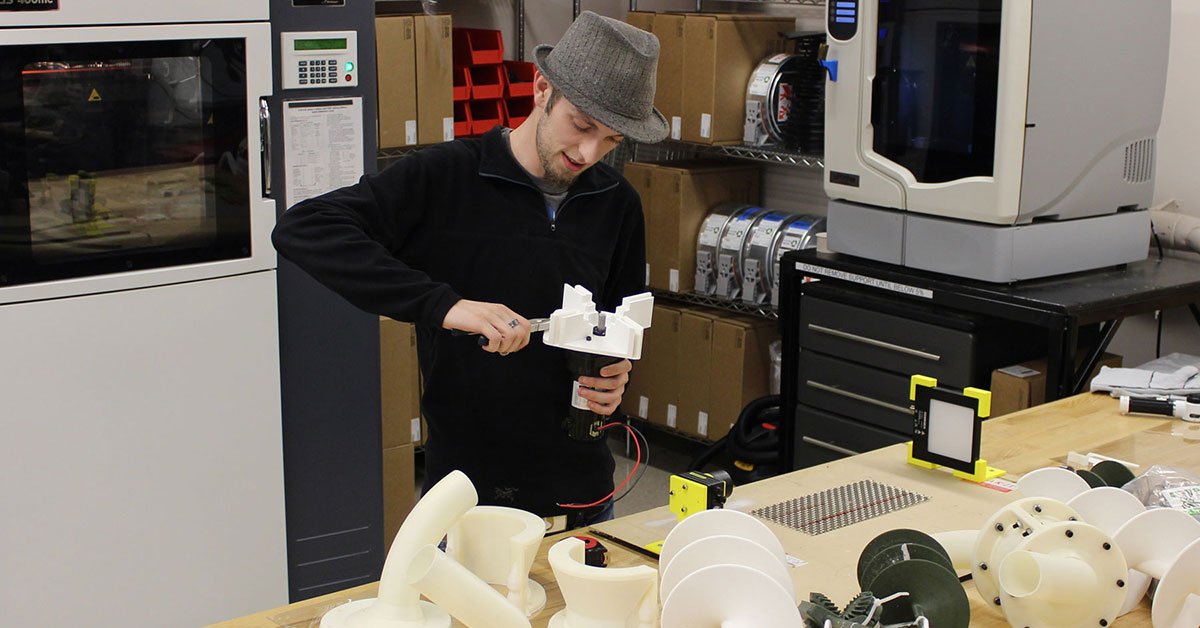
Niagara College’s state-of-the-art capacity in 3D design and 3D printing has offered local companies exciting new possibilities to improve their products and services.

One such company is Linetech Equipment Mfg. Ltd., one of Canada’s leading manufacturers of equipment to paint lines on roads and highways. About 100 of the company’s truck-mounted machines are in use across Canada, the United States, and in other parts of the world.

Several years ago, Linetech worked with the college’s digital media team to update software and test a mobile monitoring device that gauges the thickness of existing road markings. After a successful research partnership with Niagara on this project, Linetech turned to the Advanced Manufacturing Innovation Centre team for help improving its equipment production.

The Centre’s research team redesigned one part of Linetech’s equipment to make it lighter and smaller, and re-engineered the manufacturing process to involve fewer parts, which allows quicker changes on the line. They were also able to create the finished part with the college’s 3D printer. In the end, the team provided a more cost-effective process to Linetech, using less material for production and, in one case, creating potential for an expanded product line. The company was producing fourand six-inch parts, but with the new material and process, college engineers were able to create an eight-inch part to serve the company’s needs better.

Industry: Manufacturing
Funded by: Technology Access Centre (TAC) Grant

About Niagara College

Established in 1967, Niagara College has grown to become a leading global college and one of Canada’s most enterprising postsecondary institutions. With a mission to... Learn more

Making the Shoe Fit Every Time

Science has solved many conundrums, but finding the shoe that fits perfectly was never on the list.

At Centennial College’s Applied Research and Innovation Centre, researchers are dedicated to using science to solve practical, real-life problems. Custom shoe manufacturing typically requires complex processes like plaster casts. Toronto firm PodoTech aimed to create a three-dimensional foot scanning system to make measurements simpler and more accurate.

Waterloo University researchers developed a proof-of-concept Orthotic Design System, which led to the creation of photo scanner hardware and basic software to make a 3D model from the image. However, the software had been created using a commercial tool too expensive for the industry.

PodoTech CEO Tezera Ketama, an alumni of Centennial College, brought the project to a team of students at ARIC. The goal was to make new hardware and software for the technology, and put it together in a package that could be commercialized.

The team worked with PodoTech for 18 months using the open-source tool MeshLab to write the software.

The scanner they developed contains a laser and eight different cameras. The laser glides along a foot, and the cameras take a series of photographs. Image processing software then deletes everything in each picture except the laser stripe, and reduces that stripe to a tiny line, a process called “skeletonization”. Complex math converts it to 3D data, and a model of the foot is then created. These 3D files are in a non-restricted format that can then be sent to a shoemaker to create something that fits perfectly.

The team’s biggest accomplishment was taking all the steps needed to make the 3D model, and incorporating them into a single piece of software.

“Now we can press a button and the image is processed and reconstructed,” Ketama says. “We can go straight from A to Z.”

One team member describes their achievement as “a farewell to measuring tape,” ensuring a perfect set of measurements to make a set of custom shoes, orthotics, or medical brace. And because it’s a cheaper, easier way to measure the human foot, the cost of these custom orthopedic products could be drastically reduced. It could also be used where traditional measurement is impossible, for diabetics with reduced sensation in their feet.

Ketama also partnered with Centennial to design and program a mobile app and a website, illustrating how to use the technology, measure a foot correctly at home, and record measurements online. The design team came up with the slogan “We care about what makes you stand up every day” to describe PodoTech’s mission.

Industry: Manufacturing
Partner(s): PodoTech

About Centennial College

Established in 1966, Centennial College is Ontario’s first public college primarily serving the eastern portion of the Greater Toronto Area through five campuses. It has... Learn more

Building with Peat Blocks

Housing development in Ontario’s far north is limited, largely because of the high cost of materials and construction challenges created by harsh weather conditions and permafrost. But local peat moss may offer an affordable alternative.

Cambrian College and its industry partners wanted to find a solution to the cost of shipping building materials in Northern Ontario by exploring the use of indigenous sphagnum peat moss as an aggregate in cemented peat construction blocks.

Peat moss has already been used for heat and electricity. The challenge for this project was to understand the technical issues in developing a handling and processing method that was adequate for block fabrication. The project aimed to perfect a mixture of peat, cement and binders to create a usable construction product. Cambrian Innovates, the college’s applied research centre, brought together a highly skilled team of industry partners, faculty and students.

Commercialization of peat building blocks would directly benefit Northern Ontario communities like those in the Hudson Bay Lowlands, which contains the largest peat reserve in the world. The potential new “green” building material comes at an opportune time, as the global building materials market is expected to grow and reach almost $890 billion in 2015.

Once the development of this product is completed, the industry partners Rainbow Concrete Ltd. and Sustainable Building and Energy Consultants Inc. plan to commercialize the product and manufacturing method.

Industry: Building

About Cambrian College of Applied Arts and Technology

A Cambrian education is the total package. Based in Sudbury, Ontario, Cambrian College offers practical, hands-on experience in every program, a vibrant campus life, and... Learn more

Cleaning Condo Air Quality

Condominiums and high-rise apartment buildings are often designed with ineffective corridor ventilation. In these buildings, fresh air is pumped into the hallways and then pulled into individual units. This means that most of the air in a unit comes from beneath the condo door, and can be full of tobacco, allergens, pollutants and dust from nearby construction sites.

Bordin Racing Inc. envisioned a lightweight retrofit that could be easily installed by a condo owner to help filter out most of these unwanted pollutants. Faculty and student researchers from the Mechanical Engineering program at George Brown College helped the company with suggestions for prototype refinement and fabrication, as well as research on building codes and testing.

The solution was a partial weather stripping of the apartment unit entry door while maintaining a modified opening with a custom filtration device—essentially “trapping” pollutants before they enter the unit while still allowing air to flow.

The company took the student designs and research and refined them, moving to the manufacturing stage and extruding the design in plastic. The product — now called the Door Filter — is equipped with a dense particulate filter capable of eliminating pests, allergens and even unpleasant odours or unwanted noise or light. It has been patented in six countries with three design patents and is being sold in Canadian and international markets. Door Filter has attracted a great deal of interest among international contractors eager to find a cost-effective, non-intrusive solution to high-rise living.

“We knew the concept could work. We knew it was a good idea. It was really a matter of where to go next. That’s why we came to George Brown. Help from the college was a great asset…it became almost a conversation in itself about the product’s credibility,” says Andrew Bordin, CEO and founder of Bordin Racing.

Industry: Building

About George Brown Polytechnic

George Brown strives to build a seamless bridge between learners and employment by developing dynamic programs that are informed by industry and workplace-ready graduates who... Learn more

Feeling the Heat – the Furnace Minder

In the fall of 2013, a local heating and air-conditioning company contacted Humber College’s instructor of the Electronics Engineering Technician program to discuss the development of a new idea to remind customers about furnace maintenance.

Mike Martino of Martino Contractors envisioned the MB Furnace Minder as an automated device that will remind homeowners when it is time for regular maintenance of their furnaces. An Electronics Engineering Technician student and a Bachelor of Industrial Design student were hired as research assistants. Under the direction of instructor Georges Livanos, students worked with Martino staff to design and test their proposed automated system. The patent for the MB Furnace Minder was filed in March 2014, and the product is now undergoing final testing. Martino plans to make the MB Furnace Minder available to their clients for commercial use this year.

Martino Contractors is a family-owned company that provides heating, air conditioning and air quality products and services to their clients. Established in 1987, Martino has installed 70,000 furnaces and air conditioners in the greater Toronto and Ottawa regions.

“It’s awesome to work with the diverse professionals, with students as well as experienced coordinators and staff … to see how they undertake real projects was really helpful. It gives insight into the real world of design and production,” said Michael Voitov, a student in the Bachelor of Industrial Design program at Humber.

Industry: Building

About Humber Polytechnic

Humber Polytechnic is one of Canada’s leading postsecondary institutions, combining deep theoretical learning with applied, hands-on experience. Humber offers a wide variety of credentials including... Learn more

Using Radar for Outdoor Perimeter Security

Algonquin College student researchers have been key players in the design and testing of a new 3D radar system that an Ottawa security company is developing for perimeter surveillance of military bases and pipelines.

3D Sentry Corp. is a company founded by security industry entrepreneurs, Dr Keith Harman and David Baird, to develop the next generation of advanced outdoor perimeter security sensors. Such systems could provide improved protection of the outdoor perimeters of critical infrastructure facilities, such as military bases, power stations, petrochemical plants, and pipelines.

3D Sentry recently completed a successful project with Algonquin’s Applied Research and Innovation Centre to advance the development of a “Ported Coaxial Cable” prototype, a covert terrain-following cable-guided radar. The work was carried out at Algonquin by a student research team led by Dr. Theo Mirtchev and at the company’s purpose-built development site in Almonte, Ontario.

Completing the prototype represents a critical milestone in the company’s development. It allows 3D Sentry to continue the development, then test and start selling a fully functional Evaluation System. The prototype will possess all of the major attributes, functionality and characteristics specified for the final production system. This will allow the company to demonstrate the advanced capabilities of the system to customers, strategic partners, consultants, testing agencies and investors. 3D Sentry will then undertake further development to produce a market-ready final product.

“This project included the design and integration of advanced hardware controlled by Labview software. In my view this work would be challenging for an experienced team of engineers,” says Dr. Harman, Chief Scientist at 3D Sentry Corporation. “The success of the project has led to a system that can be demonstrated to customers and potential venture capital people. This was only possible with the enthusiastic efforts of the students and the dedicated work of Dr. Mirtchev.”

Industry: Building
Funded by: Innovation Enhancement (IE) Grant

About Algonquin College

The mission of Algonquin College is to transform hopes and dreams into lifelong success. Algonquin College, a national leader in applied and online learning, offers... Learn more

Using Wood Ash as Fertilizer

For decades, the forestry industry has operated under difficult financial conditions, and little attention has been given to potential innovations and research opportunities. This has created opportunities for collaboration with post-secondary institutions, because research and innovation are an essential part of the industry’s long-term sustainability. A 2014 study, undertaken by Collège Boréal and a timber company near Sudbury, has demonstrated the value gained from a college-industry research partnership.

A forestry company with a mill in Nairn Centre, 50 kilometres east of Sudbury, uses wooden biomass to heat and provide electricity for its operations. The waste produced is wood ash, which could be used to promote plant growth by enhancing or retaining soil nutrients. However, the company currently discards the ash at landfill sites creating additional costs for landfill fees and transportation to the dump.

Collège Boréal was asked by the company to determine the efficacy of using wood ash from the mill on foliage and soil in the Greater Sudbury area. The college’s forestry researchers and students set up a six-month plot sample with a variety of soil conditions in the college’s greenhouse. The results of soil and foliage analysis showed that the wood ash improved the soil conditions and generated greater plant growth than control conditions without ash added. This initiative provided empirical evidence to support the idea of wood ash as the company’s new co-product.

Through the study, the company has identified a new co-product that is available to its customers, and will lead to higher sales for the company. They have also lowered their operational costs because the wood ash is no longer deposited at landfill sites so the company has eliminated transportation and landfill fees.

About Collège Boréal

Créé en 1995, le Collège Boréal est un établissement de formation et d’enseignement postsecondaire de langue française qui œuvre au développement et à l’épanouissement des... Learn more

3D Cloud Design for Mining Hydraulics

A leading specialist in industrial drive and control technologies was contracted to manufacture and install a hydraulic system at the Ontario Graphite mine site in remote Kearney, Ontario. But the company, Bosch Rexroth, did not have the means to obtain the precise measurements of existing plant components that were needed to manufacture the new hydraulic system for the mine.

Bosch Rexroth asked for assistance from the Advanced Manufacturing Innovation Centre team at Niagara College, which used the Faro Focus 3D laser scanner to scan the plant to capture geometric and physical proportions of the machinery. This innovative program used cloud-capacities to reveal the internal design limitations of the building in 3D images. The team then developed the scan data for the mine, and provided Bosch Rexroth with design information for its engineering team to use as the base for the hydraulic piping layout.

“By using 3D point cloud technology, the project team completed the entire design process ahead of schedule and below budget,” according to Jim Lambert, C.E.T., Design Manager with Bosch Rexroth. “Fully detailed piping drawings were created, allowing all pipes to be prefabricated ahead of time, eliminating the need for costly welding equipment and trades people on-site during the installation phase.”

Bosch estimates a 42 per cent savings in time and labour will be realized using the services and expertise at Niagara College and the Faro Focus and related software, purchased with an Applied Research Tools and Instruments grant.

Industry: Manufacturing
Partner(s): Bosch Rexroth
Funded by: Applied Research Tools and Instruments (ARTI) Grant

About Niagara College

Established in 1967, Niagara College has grown to become a leading global college and one of Canada’s most enterprising postsecondary institutions. With a mission to... Learn more