
Plugging in and Planning for Crisis

Where do youth in crisis turn? To the phones that never leave their hands? To friends? To the emergency department, perhaps taken there by desperate family?

Studies done in Peel, just west of Toronto, suggest youth are much more likely to turn to friends, siblings, parents and faith leaders than to teachers, telephone help lines or community crisis workers. They also show the region’s population is comprised of 58 per cent minority ethnic groups. People from different cultures and beliefs react differently to mental health and addiction issues.

Those factors may be keeping youth from getting the help they need, so their first point of contact with mental health and addiction services is in a crisis — often through the emergency department or justice system, according to Elise Hodson, of George Brown College.

She is project director for a team from George Brown and the Centre for Addiction and Mental Health that is looking for ways that will work to connect youth in crisis with services.

“Our goal is to work with youth, find out what kind of support they need and see what role technology can play in preventing and managing crisis.”

Their definition of crisis is broad, because what has an impact on mental health and addiction varies by individual and context. “It can be any situation where they felt overwhelmed and unable to cope on their own — homelessness, a break up, failing in school,” said Hodson.

The project is running on a grant from the Social Services and Humanities Research Council’s Community and College Social Innovation Fund. The Peel Services Collaborative (one of 18 set up around the province to close gaps in mental health and addiction care for children and youth) is a collaborator.

The plan is to create a digital crisis planning tool designed to develop care plans for youth and their families that draw on natural supports, and focuses on person-centred care rather than expert-driven services. Ideally, the plan will be used to keep an issue from escalating into a crisis.

Hodson is chair of the School of Design at George Brown; its role in the project is to design interactive technology that will connect youth in crisis with the support they need. They hope to show how interactive design can improve communication and relationships between users and service deliverers, but it is too soon to say what that will look like. Hodson said there is a “staggering” number of mental health apps available, many of which are well-intentioned but poorly designed, often not backed with any counselling expertise.

The design process will be collaborative, including youth, friends and family as well as 15 service providers, 10 interaction design students and faculty from George Brown, and staff from The Centre for Addiction and Mental Health’s Provincial System Support Program. The team also includes Co-Design’s Connie Chisholm, a designer and educator who brings design students and marginalized groups together to collaborate on projects.

About George Brown Polytechnic

George Brown strives to build a seamless bridge between learners and employment by developing dynamic programs that are informed by industry and workplace-ready graduates who... Learn more

Is it a tool? Is it a toy? Tablets in very small hands

Showing very small children how to use a tool that was invented after you started teaching is not easy. How to do it in a way that advances learning while using the full range of what the tool has to offer is a challenge for the researchers who are studying the best uses of the tablet computer.

Tablets weren’t available when today’s crop of early childhood educators and kindergarten teachers did their training. As a result, they don’t know how to help students use tablets effectively, according to Monica McGlynn-Stewart, of George Brown College’s Centre for Early Childhood Development.

Nor does anyone else, judging by the lack of research on the topic, said McGlynn-Stewart, principal investigator on a project called “Toys or tools? Using tablet computers for open-ended literacy learning.” If you accept that computers will continue to change the way we live, it only makes sense to adapt teaching to use digital technology from the earliest years, she explained. The goal of her project is to explore effective ways to do that. “We have to figure out the way to use it to help children become resourceful, creative, critical problem solvers.”

Toys or tools is one of 27 projects funded by the Social Sciences and Humanities Research Council through its Community and College Social Innovation Fund. It’s a partnership between George Brown and the Peel District School Board, where McGlynn-Stewart is working with researcher and instructional coach Tiffany MacKay. Three tablet computers have been introduced in each of the 14 classrooms in both Peel Region and several of George Brown’s “lab schools” (which offer early learning and care to infants through to full-day kindergarten children while training college students).

One advantage to computers in the classroom is they may level the playing field. Many children are taught to use technology at home. Others may never do more than play a game on a phone. In later grades, when they need to put together a project or do research, some children (usually those already disadvantaged) will be left behind.

The tablets in the project run an app called 30 Hands. It has many functions but no content — the children are not watching cartoons. Instead, it makes the tablet another tool (or toy), like crayons or modelling clay. They can draw pictures right on it, or take photos or make videos and sound recordings of their stories, observations and plans. A child might, for instance, make a model in clay, then make a video tape of it, describing what they made and why. That is reflective learning, and it’s a cornerstone of effective learning at every level.

Classroom educators are supported in the project by George Brown students, who visit weekly to troubleshoot, and share ideas from the other classrooms they visit. The researchers also observe classrooms regularly, to see how tablets are deployed and answer questions. Focus group meetings give the educators opportunities to get together and talk about what is working, or not, in their classes.

About George Brown Polytechnic

George Brown strives to build a seamless bridge between learners and employment by developing dynamic programs that are informed by industry and workplace-ready graduates who... Learn more

Evidence-Based Policing with the Help of Humber College

With their phone numbers out there and their BlackBerrys always in their hands, Toronto’s Neighbourhood Police Team members are just a call or a text away. Their job is to listen to what’s worrying people who live in some of the city’s toughest areas, calm their fears and help them act to make things better. But is it working?

With help of a grant from the Social Sciences and Humanities Research Council, researchers from Humber College are trying to answer that question — and at the same time, move Toronto into an era of “evidence-based policing.”

“The Toronto police are really under pressure to look at efficiencies and economies but there is a real commitment to not cutting the wrong things,” said Jeanine Webber, associate dean of the School of Social and Community Services at Humber College in Toronto. “They understand there may be costs to this program that in the long term may pay off and they need to be conscious of that.”

Webber is director of a Community and College Social Innovation Fund project, using a grant from SSHRC to assess the impact of the Toronto Police Service’s Neighbourhood Policing Program. The two year project will conduct a far-reaching evaluation of how effective the neighbourhood officers have been toward their goals of reducing crime, improving relations between Toronto police and the community, and making residents feel safer in their neighbourhoods.

Neighbourhood police were introduced in 2013, in response to poor community-police relations. The officers are directly accessible, their cell phone numbers easily available. They put their time into getting to know people, listening, and — if possible — dealing with issues before they become crimes, or picking up intelligence on criminal activity.

There is a well-established relationship between Toronto police and Humber College, which offers a police foundations diploma, a bachelor of applied arts in criminal justice and a police leadership program, the last designed for officers who do not have college or university degrees. The longstanding partnership between Toronto police and Humber was why the Service earlier turned to Webber and her team to do an evaluation of neighbourhood policing, but it was a limited pilot study, done only in English and excluding youth, a population police have particular difficulties with.

The SSHRC Social Innovation grant has made it possible to expand the pilot, assessing 44 months of operation, all 17 neighbourhood teams instead of just eight, adding focus groups and surveys in a variety of languages and including youth from 14 to 18. It should produce a much more detailed picture of the impact of the program. “We have trends that indicate neighbourhood policing is meeting its goals,” said Webber, “But I want to be able to collect data from a wider group to make sure it is.”

The project is a good opportunity for several Humber students interested in aspects of policing to learn more about the topic and about research skills, who will be involved in collecting and analysing data. The project coordinator is a Humber graduate who just earned an MA in criminal justice.

About Humber Polytechnic

Humber Polytechnic is one of Canada’s leading postsecondary institutions, combining deep theoretical learning with applied, hands-on experience. Humber offers a wide variety of credentials including... Learn more

One goal, two perspectives

One group is students with developmental disabilities. One group is students training to work in community services. Both groups need experience working. Neither of them could have better teachers than the other.

With help from a grant, provided by the Social Sciences and Humanities Research Council’s Community and College Social Innovation Fund, two groups of students will share work placements, designed to deal with the difficulties of integrating youth and adults with developmental handicaps into the community and the labour market.

All the students attend Ottawa’s college La Cité. The students with developmental disabilities are part of the college’s Intégration communautaire par l’éducation coopérative (ICEC) program, which lasts two years and helps students prepare for work and life in the community.

Along with them will be students training for careers working with the developmentally disabled, in a program called Interventions auprès des personnes ayant un handicap (IPH). It will be their final work placement before graduation.

“The inclusion we are seeking goes well beyond the workplace and extends to full social and environmental inclusion,” said Claudette Migneault, director of community participation services at Association pour l’intégration sociale d’Ottawa (AISO). “When we talk about social inclusion of people with development disabilities we mean inclusion in all aspects of their lives.”

AISO is a francophone agency serving developmentally disabled people and their families and also La Cité’s community partner on this social innovation project. AISO has offered employment services for many years, such as internships, employer and employee coaching and workshops on health and safety or food handling to make their clients more employable.

The belief is social integration begins with employment and La Cité’s ICEC program shares that value, working with people with disabilities to consolidate the skills they have, help them acquire new ones for specific work environments, and also to learn habits that will improve their social inclusion in the workplace and beyond it. They can also take college courses, adapted to their abilities, and earn a completion certificate.

For the project, three students from the IPH program (who study to become support workers for the developmentally disabled) will be matched by La Cité with five ICEC students each. For their final internship, the IPH students will be supervised by a senior advisor from AISO and will accompany the students with disabilities, helping them to integrate and settle in as they demonstrate to potential employers they have the skills to do the job, or the ability to learn them.

The first phase of this collaborative research project will be a literature review, gathering best practices for internships and training for professionals working with people with developmental disabilities.  The goal is to guide the development of the common internship project between the two programs from La Cité.  During the internship phase, the IPH students will be asked to record their experiences for analysis and evaluation. The final phase will an evaluation of the internship. Lessons learned will be applied to the common internship between the two programs and will be shared with other organizations in the community.

About La Cité

La Cité est un collège d’arts appliqués et de technologie situé à Ottawa, la capitale nationale du Canada. L’établissement est le seul collège francophone de... Learn more

Loneliness and Isolation in Older Immigrant

Immigrants face great upheaval and life challenges by coming to a new country. Sadly, many of them must confront others — loneliness and isolation— as they grow old.

There is increasing evidence that loneliness and social isolation damage seniors’ quality of life. That and the growing number of people over 65 (expected to rise from 5 million people in 2011 to 10.4 million by 2036), combined with the increasing number of older immigrants arriving or aging in Canada, suggest a considerable problem on the horizon. Immigrant seniors have been called the most powerless and forgotten segment of the ethnic population.

Researchers at Sheridan College’s Centre for Elder Research are collaborating with ethno-specific and mainstream agencies to look at loneliness in older immigrant on a grant from the Community and College Social Innovation Fund of the Social Services and Humanities Research Council. The goal is to develop tools for identifying lonely older immigrants and to find ways to increase supports for them.

“You can be lonely even if you’re living with other people,” said Patricia Spadafora, director of the Elder Research centre. She is project director on the grant, which has four community partners.

Spadafora was making the point that loneliness and isolation are not the same thing, though they often co-exist. In addition to problems many older adults face that can contribute to loneliness and isolation — such as lack of transportation, small pensions or poor health — older immigrants may be further cut off by not speaking English very well, or at all.

Cultural expectations lead many older immigrants to live with their children, perhaps expected to provide daycare. Then, when the children go off to school, the grandparents are alone. In other cases, parents who had expected to live with their sons or daughters find themselves without the family support they always counted on.

There are efforts to help immigrant seniors. Sheridan’s partners on the project (Community Development Halton, Dixie Bloor Neighbourhood Centre, India Rainbow Community Services of Peel and the Yee Hong Centre for Geriatric Care) all have services for older immigrants.

The project is starting with eight Sheridan students developing a database of services and strategies for reaching older immigrants in the regions of Halton and Peel, where the research is focused. “You can’t propose solutions until you know what’s being done,” Spadafora said. “We don’t want to duplicate efforts.”

After that, older adults will be interviewed, to learn more about their needs and interests and to help them make social connections and access services. The interviews will focus on people from China, South Asia, the Philippines and Poland — the choices based on significant populations in Halton and Peel.

When the data are gathered and analyzed, the researchers and partners will create culturally competent program models and resources, including technological options that will let staff in agencies access resources to help them serve clients better.

About Sheridan College

Sheridan College is one of Canada’s leading postsecondary institutions, serving over 23,000 full time students at four campuses in the western Greater Toronto Area. We... Learn more

A cool new way (literally!) to make ethanol

Biofuels, processed from agricultural waste and other living matter, have long been seen as a key element in providing cleaner energy and fighting global warming. For more than two decades, scientists and engineers have been developing methods for producing ethanol from straw, wood chips, corn cobs and other waste material, called biomass.

But use of ethanol has been limited by the high cost of producing it. One key driver of cost is the inability of the microorganisms used in the process (which are usually genetically modified) to tolerate high levels of ethanol.

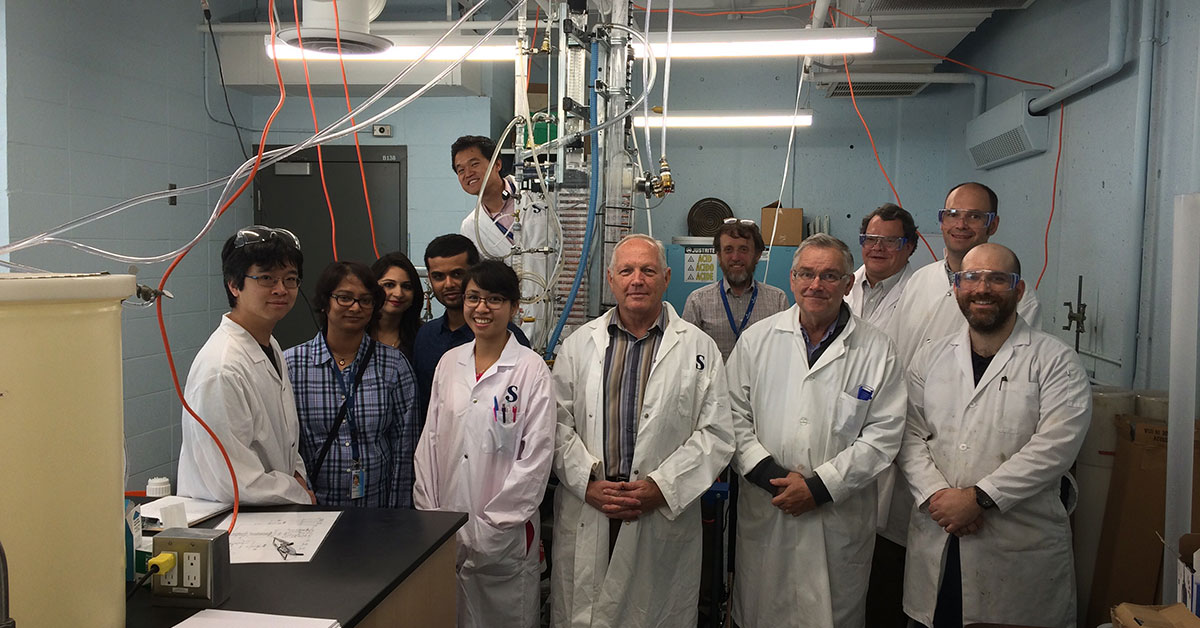
This was the focus of a partnership between Sheridan College and Drystill, a company that has developed an innovative process known as pass-through distillation. Its advantage is that it can be done at lower temperatures than most distillation, which preserves the expensive enzymes needed to create ethanol from biomass, thus greatly reducing cost.

The aim of the project was to design, construct, commission and test a pilot unit to demonstrate whether pass-through distillation can passively remove volatile components from a fermentation broth at room temperature and absorb them into a non-toxic brine solution with no net heat input in the process. The answer was yes, and once commercialized, this technology has the potential to make biofuel — such as ethanol made from agricultural residue — economically feasible.

The project took nine months from developing the proposal to completion, and involved four students. Two were Chemical Engineering Technology students, mainly involved in designing the process and constructing peripheral processes and the auxiliary equipment driving the pilot unit. Two Environmental Control students were involved in commissioning the unit and analysing samples from the trials. Because the process was so novel, many of the students’ activities focused on problem-solving and rapid prototyping, which allowed them to gain new skills that are in demand in Canada’s growing biofuel sector.

Every country that signed the Paris Agreement, including Canada, pledged to slow the build-up of carbon dioxide in the atmosphere. Biofuels such as ethanol are seen by governments and advocacy groups as one way to help do that. However, the high cost of producing them has stood in the way of widespread use. By distilling the ethanol economically at room temperature, this project could make advanced biofuels profitable to manufacture and sell.

Industry: Environmental
Funded by: College and Community Innovation Program, Engage Grant, NSERC

About Sheridan College

Sheridan College is one of Canada’s leading postsecondary institutions, serving over 23,000 full time students at four campuses in the western Greater Toronto Area. We... Learn more

Easing Parenthood with an Internet Connection

A Toronto business woman, with an idea about connecting new parents with qualified and prescreened caregivers, wanted to develop an online search system that was seamless and easy to use. MotherEaze and George Brown College worked together to devise a business plan and a scheduling and payment system for the company website. This project involved extensive background research and analysis of the existing website and documentation of the system and user interface requirements for all desired features.

MotherEaze’s intensive candidate screening is what sets the enterprise apart from rival services. The company’s qualified caregivers include early childhood education workers, nurses, and professional caregivers, complete with biographies and profiles to help mothers decide which candidate fits their families.

MotherEaze also sought George Brown’s assistance to design, develop and integrate an automated scheduling and payment system for the existing website. The system had to allow parents to review biographies and availability of service providers, and book, pay and rate services. It also had to allow service providers to upload bios and availability, view upcoming company meetings, receive payment and confirm bookings, as well as allow administrative oversight of data and e-commerce and payment integration.

After reaching out to George Brown College to help develop the idea, Mothereaze.com launched early this summer. The company is in the process of streamlining user paths and polishing the interface. In the meantime, it is putting together a pool of qualified applicants that parents can choose from for help.

Partner(s): MotherEaze

About George Brown Polytechnic

George Brown strives to build a seamless bridge between learners and employment by developing dynamic programs that are informed by industry and workplace-ready graduates who... Learn more

Different People, Regular Roommates

Finding a roommate who’s a good fit is a relief for most of us. For people with intellectual disabilities, it could be a lifeline — an opportunity for more inclusion in society. “Friendly Housemates” is a joint program being developed by Centennial College researchers and Community Living Toronto to make that lifeline available to more people.

The idea of Friendly Housemates is to pair people with an intellectual disability and undergraduate students in shared living arrangements. The students get free accommodation, a bursary and a guaranteed summer job in exchange for their role in helping their “friendly housemate” to live a life that’s more integrated with society and more independent, but still in a secure and supportive environment.

The project is operating with a grant from the Community and College Social Innovation Fund set up by the Social Sciences and Humanities Research Council.

“It’s as normal a housemates relationship as possible,” principal investigator Marilyn Herie said in an interview. “[The students] are not providing personal care or support. You have a roommate or housemate, you watch TV together, you might make proper meals, you might listen to music or share a coffee. The idea is, if there is an emergency, there is someone else in the house,” said Herie, dean of learning, teaching and scholarship at Centennial College.

People with an intellectual disability and their families sometimes worry group homes do not give their residents the opportunity to live life as independently as they’re capable of. “The families are saying we have worked so hard to create full citizenship for this individual, and they are not sure they’ll be supported in that in a group home.”

The SSHRC grant, awarded in 2015, is building on a pilot project that provided some insight into what works and what doesn’t. In theory, for example, any student could be a friendly housemate, but in practice, families prefer human-services students. The Social Innovation project will delve deeper, using semi-structured interviews to identify best practices and what resources are needed to make friendly housemates a viable housing option. It may be possible to replicate the model for people with medical disabilities or the elderly.

Setting up the households has to be done carefully. There are vulnerabilities on both sides. Community Living Toronto helps identify likely housemate candidates from among its membership and also vets the students who apply. Students must have a good grade point average and are asked about their reasons for applying and their perspectives on people with disabilities. Community Living also ensures the students are prepared with some general training (first aid, CPR, an orientation session) and by offering coaches and drop ins where they can come to discuss any issues that arise they need help with.

About Centennial College

Established in 1966, Centennial College is Ontario’s first public college primarily serving the eastern portion of the Greater Toronto Area through five campuses. It has... Learn more

A Light of Hope at a Dark Time

Services for victims of crime have been multiplying in recent decades, as a kind of formalized compassion in the face of pain that was often terrible to witness, let alone experience.

Those services, however, were more instinctive than scientific in design and information on how victims navigate their way through the system that’s intended to help them is sparse. Researchers at Algonquin College in Ottawa are exploring how victims of violence navigate obstacles as they deal with the aftermath of a crime, and whether negotiating the system and their own trauma helps them develop resilience.

“So much focus goes on the harm and vulnerability, that if those are the conversations you are always having, it can reinforce the negatives,” said Benjamin Roebuck, coordinator of Algonquin’s graduate Victimology program. He is the principal investigator on a Community and College Social Innovation Fund project, sponsored by the Social Sciences and Humanities Research Council.

Roebuck is a strong believer in focusing on strengths. “We can learn a great deal about how to help people rebuild their lives by talking about the deep resilience some people develop.”

While aware people who have been traumatized should not be pressured to look for a bright side, Roebuck finds some people are very glad to talk about how they are coping and what they have been able to do to navigate the aftermath of the crime they suffered.

“You wouldn’t go to the parents of a murdered child and ask positive-toned questions,” he explained. “But we have so many examples of people talking about strengths, and if you can share with other survivors stories of people who really found a way to live again, it provides hope.”

Timing, knowing what not to say, and recognizing that trauma and strength exist side by side in many people are all crucial in efforts to draw out resilience, Roebuck said. But learning about growth factors — when people feel resilience, and what helped or hindered it growing — will allow the research team to build them into lessons in the college’s victim assistance training program.

The multiphase project involves victims and service providers throughout — asking in interviews and questionnaires about what services have been most helpful, what gaps there are in knowledge about resilience and how it is built. Broadly distributed questionnaires will be followed up by one-on-one interviews to explore experiences of strength and resilience.

Partners in the research include the Victim Justice Network, which connects victims of crime, victim services providers and victim advocacy organizations across the country. It is one of several groups wanting to improve services for victims. Indeed, enhanced training on victims’ particular vulnerabilities and sensitivities has frequently been recommended for people who work with them, including service providers and legal professionals.

Funded by: College and Community Innovation Program

About Algonquin College

The mission of Algonquin College is to transform hopes and dreams into lifelong success. Algonquin College, a national leader in applied and online learning, offers... Learn more

Tracking your Gym Time

Student researchers at Ottawa’s Algonquin College have helped advance the next generation of fitness through a Virtual Personal Training app developed in partnership with an Ottawa start-up company, Gymtrack.

Gymtrack’s two young founders approached the Health and Wellness Research Centre at Algonquin College for assistance with the research and development of a novel concept using a combination of hardware and software to track workouts in fitness facilities. The system keeps track of clients’ workouts using a bracelet worn by each member and a “smart pin” attached to each piece of exercise equipment.

A research project was established which included two Algonquin students hired to work with the Gymtrack team at a local start-up garage in the summer of 2014. The student designer and programmer helped develop the mobile app for the Gymtrack system, as well as honing the company’s corporate image. During this time, Gymtrack was invited into the prestigious 500 Start-ups Accelerator in San Francisco, which included a $100,000 equity contribution. The team took part in a 500 Start-ups demo day in late October and their product received glowing reviews by both Tech Crunch and The Next Web.

Pablo Srugo, Founder & Co-CEO of Gymtrack Inc. says “Assistance from the Health and Wellness Research at Algonquin College helped us leverage the limited resources we had and connected us with top students who were able to help us design and develop our software applications. Not only did we ultimately end up hiring the students on a fulltime basis, but their work ultimately helped us land follow-on investments and grow our company to 15 full time staff in six months.”

Algonquin’s Research Centre is now assisting with the next stage of the product development in collaboration with the students’ association, which operates a large scale fitness facility on campus. This follow-up project will test and assess the first large scale implementation of the Gymtrack system with a cross section of gym users from students trying to stay fit to advanced varsity athletes.

Partner(s): Gymtrack

About Algonquin College

The mission of Algonquin College is to transform hopes and dreams into lifelong success. Algonquin College, a national leader in applied and online learning, offers... Learn more