
Improving Highway Line Painting Technology

Niagara College’s state-of-the-art capacity in 3D design and 3D printing has offered local companies exciting new possibilities to improve their products and services.

One such company is Linetech Equipment Mfg. Ltd., one of Canada’s leading manufacturers of equipment to paint lines on roads and highways. About 100 of the company’s truck-mounted machines are in use across Canada, the United States, and in other parts of the world.

Several years ago, Linetech worked with the college’s digital media team to update software and test a mobile monitoring device that gauges the thickness of existing road markings. After a successful research partnership with Niagara on this project, Linetech turned to the Advanced Manufacturing Innovation Centre team for help improving its equipment production.

The Centre’s research team redesigned one part of Linetech’s equipment to make it lighter and smaller, and re-engineered the manufacturing process to involve fewer parts, which allows quicker changes on the line. They were also able to create the finished part with the college’s 3D printer. In the end, the team provided a more cost-effective process to Linetech, using less material for production and, in one case, creating potential for an expanded product line. The company was producing fourand six-inch parts, but with the new material and process, college engineers were able to create an eight-inch part to serve the company’s needs better.


Industry: Manufacturing
Funded by: Technology Access Centre (TAC) Grant

About Niagara College

Established in 1967, Niagara College has grown to become a leading global college and one of Canada’s most enterprising postsecondary institutions. With a mission to... Learn more

Simulating Olympic Sports

An exciting new sports innovation idea will bring the Olympic experience of bobsled racing and canoe kayaking to B.C families this spring. Camosun College’s applied research centre, Camosun Innovates, is playing an important role in supporting the success of the new Richmond Olympic Experience developed in partnership with VROX Sport Simulation.

VROX is the company behind the research and development of new sports simulators. Camosun Innovates and the Camosun Technology Access Centre (CTAC) were hired by VROX to design and fabricate bobsled, sit-ski, and canoe kayak shells to work with motion capture platforms to create state-of-the-art sports simulators. These simulators are unique and will be an important part of the interactive rides soon to open at Richmond Olympic Experience (ROX) in Richmond BC.

This project allowed Camosun to hire a new graduate from the Mechanical Engineering Technology program to work with CTAC, designing and fabricating three exciting rides. In addition, this project has expanded Camosun’s capabilities of fabricating composite molds utilizing the college’s 5 Axis milling equipment. Involvement with this project has encouraged the Mechanical Engineering Department to expand its curriculum to include advanced composite manufacturing.

Camosun College’s expertise and technology allowed VROX to develop the new technology they required for a spring opening of Richmond Olympic Experience. For a taste of this interactive experience, click here.

The Richmond Olympic Experience (ROX) will be a highly interactive visitor experience celebrating the Olympic Spirit, the 2010 Olympic and Paralympic Winter Games (when Richmond was an Olympic Venue City), and the history of sport in Richmond. The ROX will have three floors of gallery space featuring displays, interactive media, and hands-on sporting simulations – offering visitors the experience of what it’s like to participate in an Olympic Sport.

Industry: Manufacturing
Funded by: Technology Access Centre (TAC) Grant

About Camosun College

Camosun College is located in beautiful Victoria, British Columbia. Our two campuses serve approximately 18,000 learners a year in certificate, diploma, bachelor’s degree and continuing... Learn more

Diagnosing the Health of Honey Bees

Concerns about declining bee populations in North America have been major news in the past couple of years as many beekeepers have suffered large losses of bees. There has been increased urgency to find causes for the deaths of bees in hives across Canada.

The National Bee Diagnostic Centre (NBDC) is a state-of-the-art laboratory of Grande Prairie Regional College that opened in April 2013 through a partnership with Agriculture and AgriFood Canada. The same month, it was awarded an NSERC Technology Access Centre grant which helped expand its mandate to include applied research, training, outreach, and innovation for the beekeeping industry.

The Centre has grown exponentially since then, training students and working on applied research projects with beekeepers as well as provincial and federal researchers, and delivering timely and reliable results.

The centre is now able to provide new diagnostics and expand to all Canadian provinces. The NBDC research team has recently been chosen to lead a four-year industry initiated ‘National Honey Bee Health Survey’ aiming to establish the nature, extent and incidence of endemic and exotic pathogens affecting bee colonies. This study will provide information that will help maintain a healthy, dynamic, and profitable beekeeping industry in Canada.

The bee diagnostic centre is already making a difference to Canadian beekeepers. In the words of one of its clients, “It wasn’t until I took bee samples to the National Bee Diagnostic Centre did an accurate diagnosis occur. I am now in the position to treat properly for my problem. Needless to say, the two years with the wrong diagnosis have cost me in excess of $100,000 dollars.”

Industry: Agriculture
Funded by: Technology Access Centre (TAC) Grant

About Northwestern Polytechnic

Northwestern Polytechnic (NWP), formerly known as Grande Prairie Regional College (GPRC), is a comprehensive community institution, publicly supported to provide opportunities in post-secondary education in... Learn more

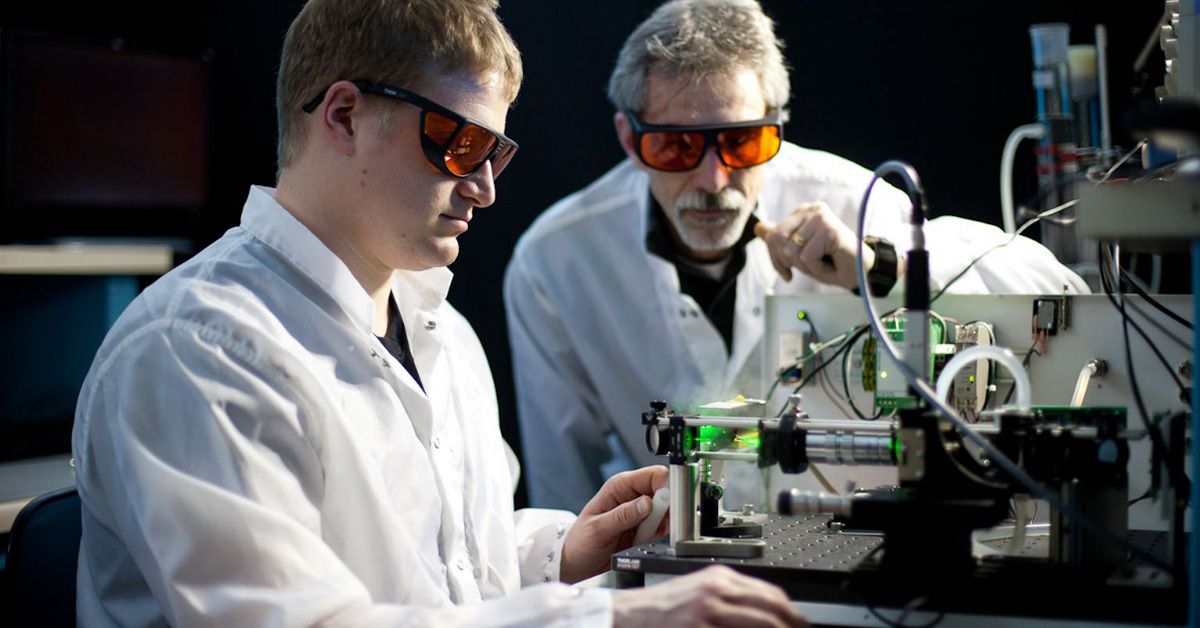
Dark Laser Detects Nano Particles of Oil in Water

NAIT’s Nanotechnology Centre for Applied Research, Industry Training and Services (NanoCARTS) was established in 2012 with a Technology Access Centre grant from the Natural Science Engineering Research Council of Canada. The centre provides nanotechnology and microtechnology support to small-and medium-sized enterprises (SMEs) in the areas of prototyping, product development and enhancement, testing, as well as characterization and training.

One of the projects within nanoCARTS involves a collaborative effort between NAIT, Alberta Nano-Monitoring Systems (ANMS), Benchmark Instrumentation and Analytical Services and a major Alberta oil sands company. The project is focused on the development of a unique structured “dark” laser beam, based on IPSA® which stands for Individual Particle Sensing Approach, developed by ANMS. This approach enables automatic, continuous, on-line monitoring of particle sizes (including nano-particles) and concentrations, in liquids, air or vacuum.

A field trial of this new technology’s application for detecting oil particles in a steam-assisted gravity drainage (SAGD) process occurred in December 2014. The system developed by ANMS and NAIT successfully detected emulsified oil in produced water while ignoring the background hydrocarbon solution, addressing the current challenge with conventional analytical and monitoring equipment.

The intent of the field trial was to analyze the oil content in produced water samples collected from different treatment stages (warm-lime softener (WLS), organic removal filter (ORF) and skim tank outlet) in the SAGD process.  The new system measurements were compared to a conventional method that provides the oil in water analysis at the facility by means of solvent extraction and fluorescence.

“Preliminary results from the field trial demonstrated excellent correlation between the number of droplets counted and the concentration measured. We continue to be very optimistic about the exploitation of this technology for solving difficult measurement challenges that are important to Alberta, as well as Canada. We look forward to an ongoing mutually beneficial relationship between the organizations and to seeing NAIT establish themselves as a partner in the technology development arena in Alberta.” Steven McDougall, M.E.Sc., P.Eng., Vice President, Operations of Benchmark Instrumentation and Analytical Services Inc.

Industry: Environmental
Funded by: Technology Access Centre (TAC) Grant

About Northern Alberta Institute of Technology (NAIT)

For 60 years, the Northern Alberta Institute of Technology (NAIT) has delivered experiential, hands-on, technology-based education to meet the demands of industry. NAIT’s proudly polytechnic... Learn more