
Making Technology Accessible for Wheelchair Users

People with mobility issues often have difficulties using smart phones and other common electronic devices.

In an attempt to meet this need, a small Toronto technology start-up has developed a set of open software and hardware tools called Tecla that facilitates access to electronic devices for people with mobility impairments. Komodo Open Labs (KOL) envisioned a user-friendly Bluetooth interface device that would give individuals with special needs access to commercial smart phones. But the goal went further: the company wanted to make it smaller, mountable, and lower-cost, letting more people join the conversation.

The device had to be easy to access, simple to install and maintain, and still affordable. For help with this, KOL came to George Brown College’s Centre for Construction and Engineering Technology (CCET). The students were challenged to design a device that allowed someone with limited mobility to join the same communication network that able-bodied people access easily.

After many rounds of prototypes, CCET students developed a product that is a compact and less costly version of KOL’s initial prototype. The result was an aesthetically pleasing, unobtrusive device to mount on a wheelchair. Students gained much from the collaboration, learning that ultimately, accessibility is something that all good design should accommodate.

“George Brown’s students bring more ‘out of the box’ thinking,” said Mauricio Meza, head of Business Development at KOL. “They try to find more creative solutions to the project.”


Partner(s): Komodo Open Labs
Funded by: Innovation Enhancement (IE) Grant

About George Brown Polytechnic

George Brown strives to build a seamless bridge between learners and employment by developing dynamic programs that are informed by industry and workplace-ready graduates who... Learn more

Using Drones for Aerial Mapping

Unmanned aerial vehicles may offer new potential for more accurate and cost-effective aerial surveys of Northern forests.

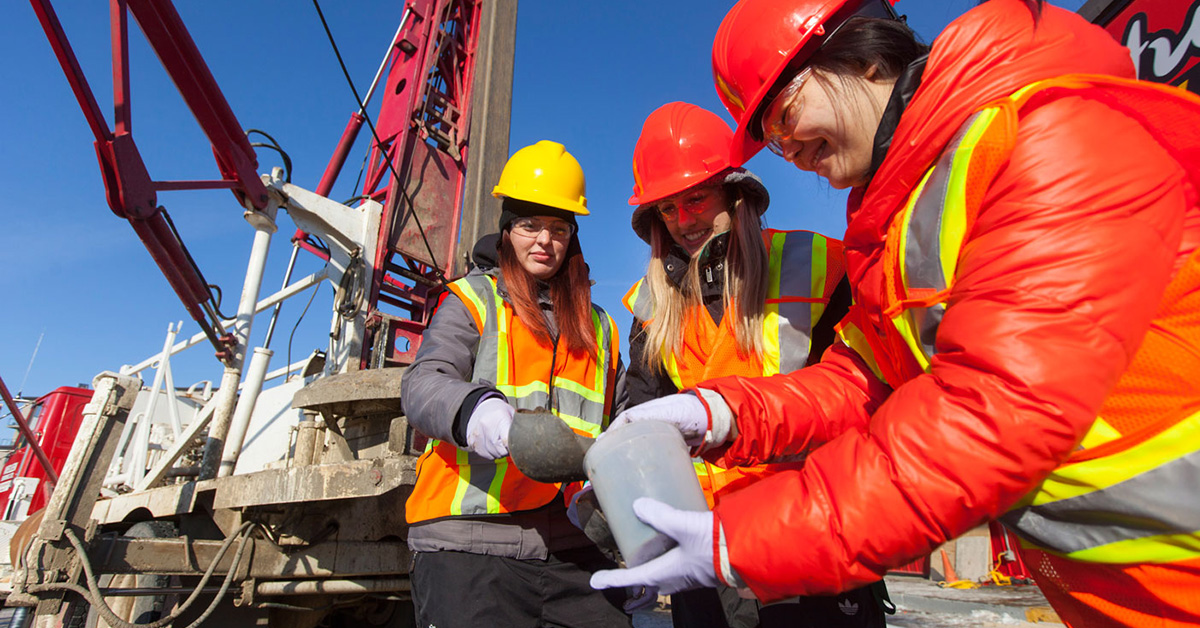
An applied research project at Confederation College in Thunder Bay, Ontario is comparing the quality and accuracy of data acquired using Unmanned Aerial Vehicles (UAV), more commonly known as drones, to current industry methods of data acquisition using manned aircraft.

LiDAR (Light Imaging Distance and Ranging) sensors are currently the standard for the collection of surface elevation data and are the best option for capturing ground elevation data where a heavy vegetative canopy is present. Photo-derived elevation models are an alternative to LiDAR for data capture projects where the landscape is mostly free of vegetative cover. They are also well suited for stockpile surveys and forested areas during the leaf-off period in early spring and fall.

UAVs offer greater flexibility in capturing survey data on a scheduled basis. They fly at a much lower altitude than manned aircraft and can capture data below the cloud ceiling. These systems will cover up to 15 square kilometres per day, making them more cost effective for smaller scale jobs. The project UAV has a twin sensor design which allows for multispectral image capture and has the capacity to be outfitted with other miniaturized sensors. Should the UAV acquired data be validated, KBM can offer their clients an expanded suite of aerial survey data options to better suit client needs and budgets.

“The development of UAVs in the Canadian and U.S. marketplace is projected to grow exponentially over the next five years. Through this project and other related R&D initiatives we hope to be able to bring to market new and innovative sensor configurations and product deliverable for our clients,” says KBM Resources Group.

About Confederation College

Confederation College is located in Thunder Bay, Ontario amongst beautiful tree grounds, a shallow twisting river, and a network of walking paths. The institution values... Learn more

Electric Vehicle Research

As more electric cars are purchased by energy-conscious consumers, there is a need for information about who is buying them and how often they need to re-charge them.

Georgian College is delivering a range of education and applied research services related to electricity use, energy distribution, and grid performance. With a new four bay solar-assisted charging station and a sophisticated monitoring and control system, the college is collaborating with industry to accelerate the delivery of new products and services. It is also researching ways to optimize energy use and distribution.

One of the initiatives undertaken by faculty and students at the college is the electric vehicle research project. Researchers are investigating consumer trends in purchasing plug-in electric vehicles, as well as the true costs and benefits of vehicle operation. Georgian researchers are analyzing consumer surveys and existing data as well as field testing plug-in electric vehicles. Using this information, they will model the impact of the plug-in electric vehicle market and identify opportunities for business and the electrical utility sector.

About Georgian College of Applied Arts and Technology

However you define your goals, the best learning to get you there extends far beyond the classroom. Georgian is a recognized leader in student work... Learn more

Power Conservation for Traffic Detection Sensors

You see them along every highway – traffic counting monitors collecting data essential for city and highway planning. Many of them are powered by solar energy or batteries with limited energy supplies.

An Ontario company providing advanced highway detection technologies approached Durham College for help to find ways to extend the operating life of existing traffic detection sensors through energy harvesting components and intelligent energy management strategies.

North Line Canada collaborated with Durham College to test hardware and develop a prototype to test the possibility of obtaining sufficient voltage/current from a miniature hybrid power harvesting generator to power temporary and in-road sensors and detectors.

Durham College faculty and students developed a power conservation module by designing and implementing a smart sleep system. The battery life of road sensors is increased by stopping the draw of battery power when no activity is detected on the road. This way, traffic sensors have a longer active life. As an outcome of this project, a new technology has been developed and will be implemented in remote monitoring of highway traffic.

This device will enable North Line Canada to fill a gap in traffic and highway management using new harvesting energy principles to store energy in solar as well as super capacitors. It will give the company an advantage and make it more competitive in this sector.

About Durham College

At Durham College, the student experience comes first. With campuses in Oshawa and Whitby, Ont. along with a learning site in Pickering, the college offers... Learn more

Manmade Vortexes for Electricity

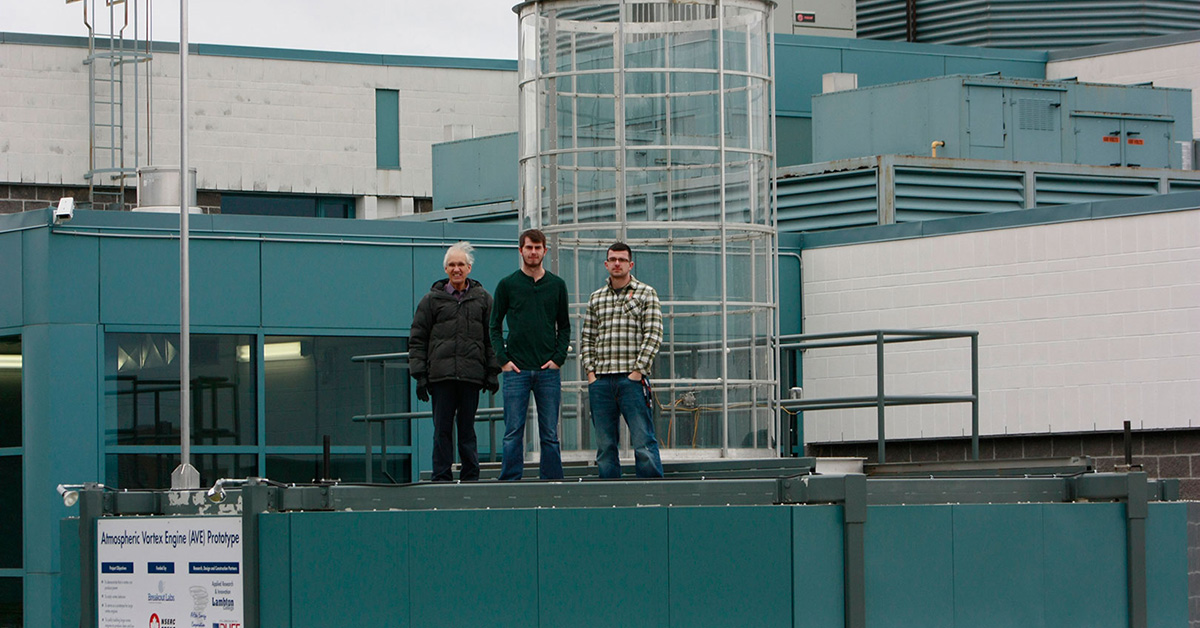
The Atmospheric Vortex Engine (AVE), now being tested by Lambton College researchers, has potential to produce vast quantities of carbon-free electricity using low temperature waste heat to create energy through a tornado-like vortex.

Lambton College’s research team was asked by the company developing AVE technology to test a small scale prototype that produces energy from an atmospheric vortex with a diameter of 50 centimetres and a height of 40 metres. The project will demonstrate the feasibility and safety of AVE technology and optimize the design, justifying investment in larger scale implementations and commercialization.

The college team, including faculty and student researchers, installed instruments on a prototype to monitor process parameters. Researchers are currently analyzing the data collected and corelating it with data from their meteorological station to improve the design and provide scale-up analysis.

Louis Michaud, Chief Technology Officer of AVEtec Energy Corporation explains, “The prototype has been invaluable for AVEtec Energy Corporation. The college instrumentation and data acquisition capabilities were appropriate for the project. AVEtec is exploring several options for commercializing the vortex engine which have been helped by the Lambton College project.”

AVEtec Energy Corporation holds international patents and is a 99 per cent Canadian-owned Ontario corporation. AVEtec’s prototype is being funded by the Thiel Foundation’s Breakout Labs program. Development of low cost green energy and clean-tech applications would give Canadian industry a significant competitive advantage. Developing and commercializing this technology also has enormous potential for revenue and job creation in Canada.

About Lambton College

As a post-secondary leader in education, training and research, Lambton College has experienced tremendous growth in recent years. In addition to a significant rise in... Learn more

Wastewater Recovery

There is a growing interest in water and wastewater treatment technologies and systems across Canada.

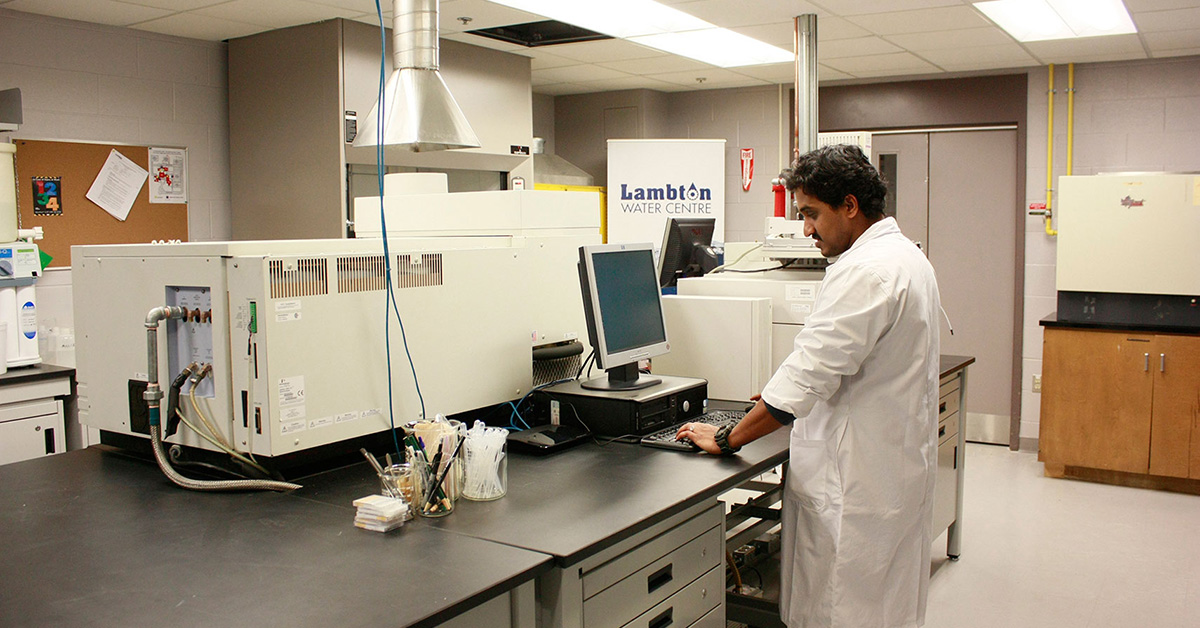
The Lambton Water Centre (LWC) increases the capacity for Lambton College and its partners to conduct applied research in the area of wastewater, water treatment with services that include design and automation, instrumentation, optimization, maintenance/operation scheduling and remote facility management systems.

The Water Centre has formed partnerships with companies and organizations in the water and wastewater value chain including municipalities, manufacturers, operators, consultants, universities and First Nations organizations.

One project under the LWC Corp. is with KMX Membrane Technologies. KMX is currently undertaking pilot scale recovery of ‘frack’ water from Alberta well drilling and development. Fracking, or hydraulic fracturing, uses huge volumes of pressurized water, sand and chemicals to release oil and gas from rock formations.

Lambton researchers are working to help KMX automate, control and optimize their membrane-based wastewater recovery pilot plant. The LWC faculty researchers have expertise ranging from instrumentation and control, to process control and chemical analysis. Students and faculty from these college programs are able to develop their skills and knowledge as they apply to the water sector while working on development of viable products for local companies.

Harvey Vowels, New Business Development, KMX Corporation says “The partnership with Lambton College has been very beneficial in allowing us to automate and optimize our new wastewater recovery technology targeted at the oil and gas and mining sectors. Based on our very positive experience with Lambton College, we look forward to collaborating on additional new process technology
developments.”

The LWC initiative also helps stimulate economic development through technology transfer to the partners, local and regional business and municipalities.

Industry: Environmental

About Lambton College

As a post-secondary leader in education, training and research, Lambton College has experienced tremendous growth in recent years. In addition to a significant rise in... Learn more

Innovative Oil Spill Clean-up

Oil and gas spills have the potential to do serious harm in aquatic environments.

Containing and collecting oil quickly can reduce the drastic effects of a petroleum spill.

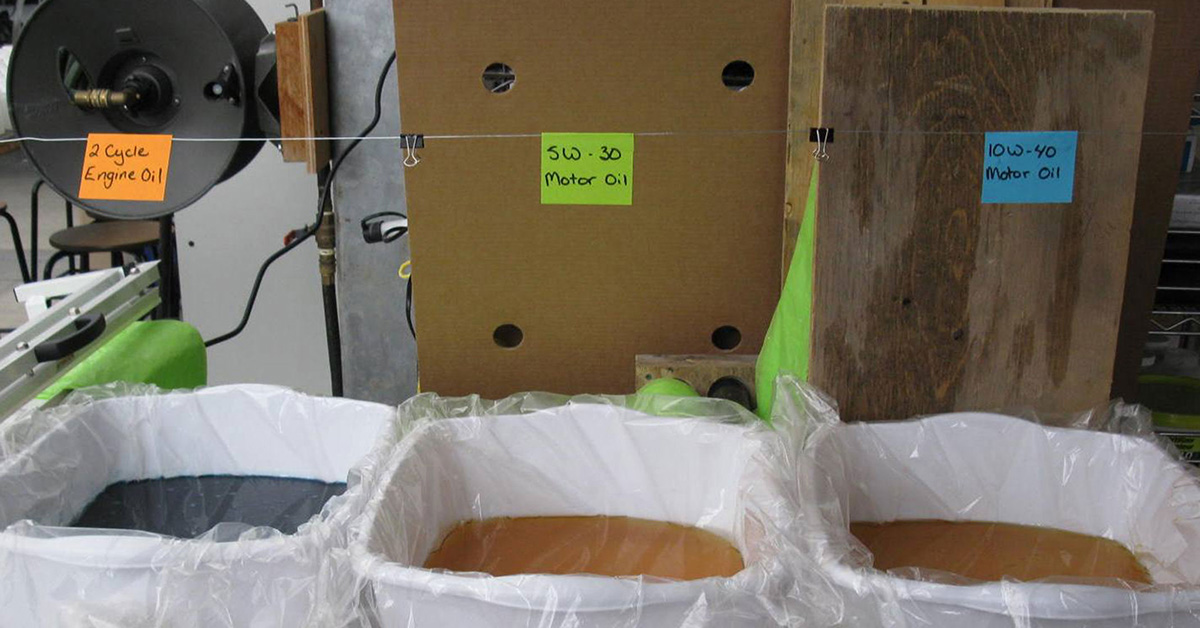
The Centre for Alternative Wastewater Treatment (CAWT) at Fleming College has been working with the Murrenhil Corporation on applied research projects on products that can be used as a first response oil containment system.

Rapid Oil Containment (ROC) Barrier™ and Oil Cling Pads™ are two forms of polyethylene laminate pads that can be thrown onto a spill in a lake or ocean to soak up oil or gas. The ROC Barrier™ is made up of oil adsorptive pads designed to protect aquatic environments from oil and gas by collecting the hydrocarbons without also collecting water.

“Unlike similar absorbing materials, ROC Barrier is an oil-adsorbing poly that is hydrophobic. It floats on water but will not absorb water,” says Glenn Murray, President of Murrenhil Corporation.

These adsorptive pads are folded into packages small enough to be carried in small watercrafts and stored in marinas or ships.

Fleming College researchers assisted with research and development, as well as product testing and verification. As a result of this applied research, Murrenhil was able to improve their product and bring the ROC Barrier™ to market. CAWT staff also assisted with patenting and with marketing.

Murrenhil has since met new contacts that can further distribute and increase sales of the product, and is now approaching worldwide industry leaders for global licensing opportunities.

“Our partnership with the CAWT has proved to be invaluable, and imperative to Murrenhil Corporation’s success,” Murray says.

Industry: Environmental

About Fleming College

Located in the heart of Central Ontario, Fleming College has campus locations in Peterborough, Lindsay, and Haliburton. Named for famous Canadian inventor and engineer Sir... Learn more