
What’s On My Mind? With Pari Johnston.
First and foremost, a sincere thank you to Elder Martin Heavy Head and Samantha Fox, Interim President of Red Crow Community College (CICan’s newest member) for welcoming us so warmly to Treaty 7 and allowing us to have these important conversations on their traditional Territory.
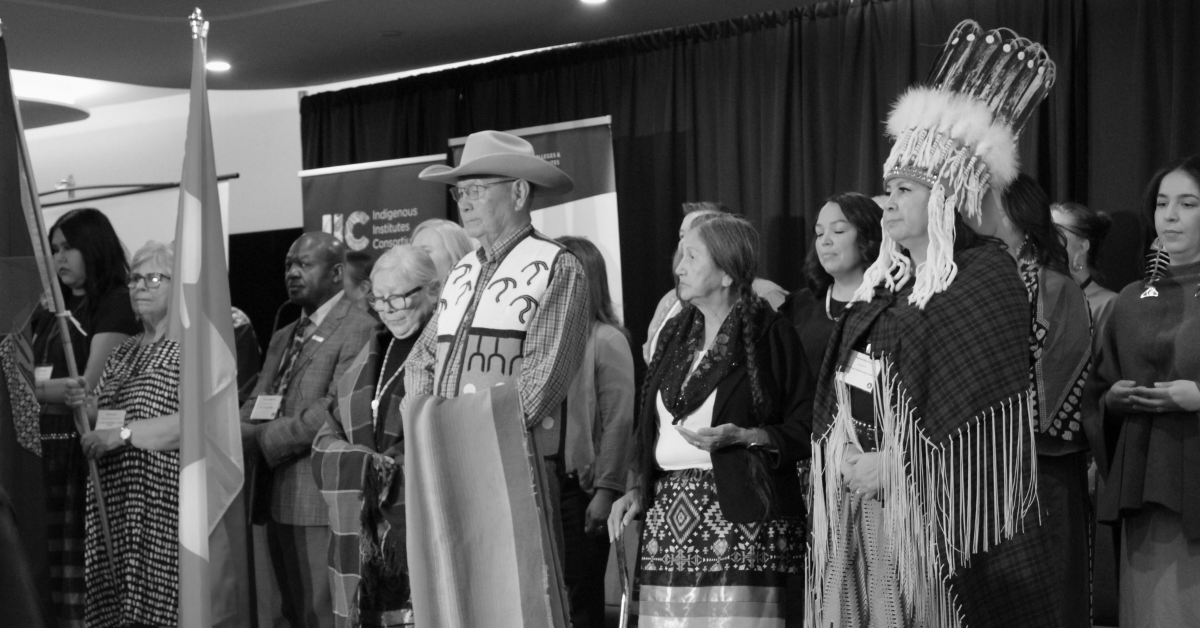
I’m completely inspired coming off the heels of the National Indigenous Education Symposium in Calgary at the end of October. Huge thanks to Marsha Joseph and our co-host partners at the Indigenous Institutes Consortium.
My Key Takeaways?
From Michael Fox of Indigenous Community Engagement, I was struck by the Four Ps of economic reconciliation: participation, partnership, procurement, and proponency. I am enriched by the understanding that by working together on community-oriented joint ventures, we can leverage opportunities to deliver more and be more effective with Indigenous communities and for a better Canada. Thanks for your powerful storytelling, and call to action – that the major projects of national importance must be grounded in Indigenous rights and opportunities.
From Carol Anne Hilton of Indigenomics, I’ll forever remember your astute observation about the appropriateness – and the inappropriateness – of the intersections between Indigenous knowledge systems and tools like AI: knowing where and why they do not and cannot mix. As you said so powerfully, AI can serve, but never replace, Indigenous knowledge and wisdom from Elders and the land.
From Tia Larocque-Graham of Saskatchewan Indian Institute of Technologies, Jennifer Taback of Design de Plume and Cambrian College, and Lora Tisi of Niagara College – who participated in the Indigenous Women in Leadership and Entrepreneurship Panel that I had the privilege of moderating – I applaud your advice to the participants: that true leadership means trusting your voice, even when you’re the only Indigenous person in the room. That it’s more important than ever for Indigenous youth, who are the next generation of leaders, to see Indigenous peoples thriving across all fields. Your collective message thundered: You can’t be what you can’t see.
Of course, there were many more rich conversations among the more than 200 participants – from Elders and Knowledge Holders to students – during interactive sessions showcasing institutional examples of change and progress. We were once again reminded that we have much to learn and gain from Indigenous-led approaches, in the true spirit of building and nurturing partnerships, that benefit all we do, and all we work with.
I am also grateful to Dr. Maurice Manyfingers and President Misheck Mwaba of Bow Valley College for their partnership and hospitality.
A First for CICan, But Not the Last
It was a monumental milestone and celebration as CICan embarked on its first national Indigenous-led initiative – a historic partnership between CICan, the Nicola Valley Institute of Technology, the Saskatchewan Indian Institute of Technologies, and Six Nations Polytechnic.
It was a profoundly humbling and powerful experience to be invited into the Circle, to participate in the traditional pipe ceremony that signified the binding of our partnership and “treaty” – as CICan and the three Indigenous Institutes furthered the sharing of partnership ceremonies and solidified our commitment, with all symposium participants as witnesses.
The additional signing of the Memorandum of Understanding was a demonstration of respectful relations and reconciliation.
We are grateful to the guidance and funding provided by the BHP Foundation.
As an organization, we embrace Mamawi – meaning “working together”. We have a tremendous opportunity to work together with Indigenous learners and communities and CICan members to benefit all Canadians in an exploration of building business, entrepreneurship, and economic research with a new lens – grounded in Indigenous ways of knowing and being.
We look forward to the values to be taught by First Nations, Inuit, and Métis experts.
- If You Missed It: Read the news release with quotes from each member of the Governing Circle and my conversation with the Calgary Herald.
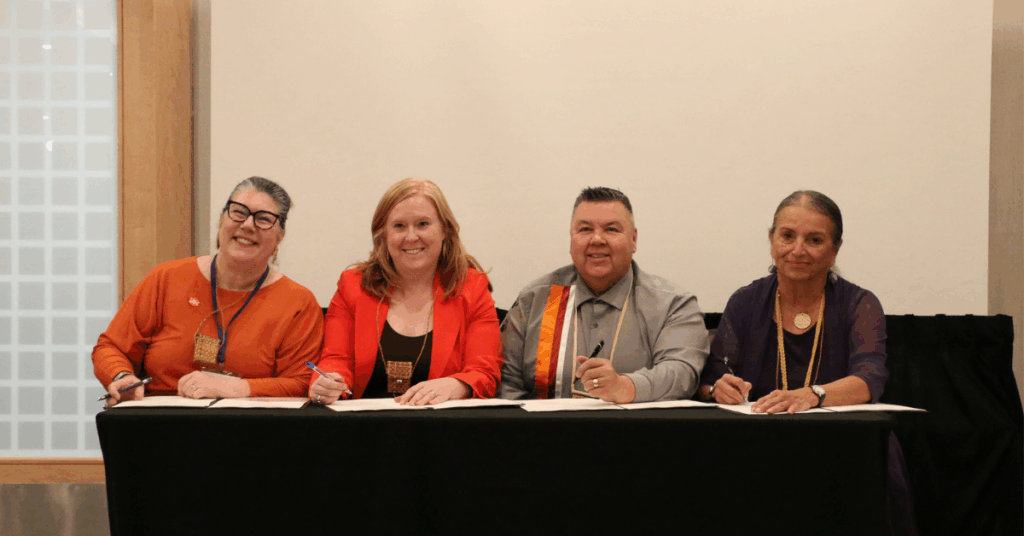
We hope that together with our partners, Mamawi will demonstrate meaningful reconciliation through action. By supporting Indigenous-led approaches, we will expand more inclusive, community-driven collaboration and successful outcomes across the entire college system.
Through Mamawi, we are supporting capacity building to benefit learners, communities, and institutions across the country. In upholding an Indigenous-led approach, a newly formed Governing Circle will oversee the initiative and partnership accountability.
We understand our role in this collective responsibility as mutual stewards of this initiative to advance greater economic reconciliation in this country. CICan and I are committed to this learning journey.
Turning Principles into Action
For those who attended the 2024 National Indigenous Education Symposium in Halifax, you’ll remember the focus to engage the community in discussions to renew CICan’s Indigenous Education Protocol, marking its 10th anniversary.
A year later, it’s my pleasure and honour and to recognize the work of CICan’s National Indigenous Education Advisory Committee – chaired by Denise Pictou-Maloney of Nova Scotia Community College.
In reaffirming and renewing the Protocol I commend the Advisory Committee Members:
- Kory Wilson, Executive Director, Indigenous Initiatives and Partnerships, British Columbia Institute of Technology
- John Chenoweth, President, Nicola Valley Institute of Technology
- Jason La Rochelle, Director, Office of Indigenization, Justice Institute of British Columbia
- Anita Cameron, Manager, Indigenous Strategic Relations, Saskatchewan Polytechnic
- Mara-Lee Moroz, Chief People & Culture Officer, Olds College
- Robert Rayko, Cultural and Community Facilitator, Portage College
- Tracy Brant, Chair, Indigenous Education Programs, Red River College
- Jason Seright, Vice-President, Inclusion and Belonging, Humber College
- Dany Losier, Chef de développement et Formation continue, Collège communautaire du Nouveau-Brunswick
- Neil Cooke, President & CEO, Manitoba Institute of Trades and Technology (MITT)
- Kim Martin, Dean of Indigenous Education, Cégep John Abott College
- Along with CICan’s former VP of External and Members Relations, Anna Tonneguzzo
The Protocol – grounded in Indigenous ways of knowing and being, justice and accountability – further demonstrates CICan’s ongoing commitment to its membership.
We’re excited to share that we have 77 signatories to the Protocol, representing 60% of CICan’s membership. Over the coming months, you’ll hear more about the renewed principles of the Protocol, and how you can access resources associated with it.
Stay tuned for more – on how we turn words into reconciliACTION.
What Comes Next
As I continue to reflect on what was shared and what I heard through the Symposium, I’m reminded of the tough work ahead and the importance of listening and learning from our partners and members – Indigenous and non-Indigenous alike. We will continue on our journey to be the national association our members – and Canada – need us to be right now and in the future.
Mamawi and the Protocol are cornerstones to our progress and the work that lies ahead.
I remain energized and focused in strengthening CICan to be an innovative leader and champion to our members.
I’m thankful for the support from our Executive Indigenous Advisor, Wendelyn Johnson, our National Indigenous Education Advisory Committee, the Mamawi Governing Circle and our partners.
Being gifted with the Two Row Wampum from Six Nations Polytechnic inspires us to become a stronger ally to our partners and to Indigenous Peoples, while respecting the distinct and unique differences of who we are, and what we know.
CICan is open to growing and learning with you.