
September 13, 2024

Building Skills, Building Homes

As we navigate the shifting landscape of post-secondary education, CICan’s focus is sharper than ever. 

For the first time, our vision is defined around five new Impact Goals that will direct our efforts around priority areas where we want to drive tangible change – where colleges and institutes can deliver results for their communities and the country. 

Boosting Canada’s Job-ready Workforce 

A key part of this vision is serving as the national voice for the innovative and inclusive training programs offered by colleges and institutes. These cutting-edge programs, including upskilling and reskilling initiatives, create fast and effective pathways to employment to address Canada’s critical labour shortages. They train the builders, makers, caregivers, first responders, and innovators shaping Canada’s economic future. 
Why does this matter? Because a job-ready workforce is the only way to meet Canada’s – and the world’s – biggest challenges.

The Challenge: Build More Homes 

Building a typical home involves more than 30 different skilled trades and technical occupations, from carpenters to painters, plumbers to electricians, masons to roofers and on-site managers, many of which are expected to retire by 2028. Preparation for these jobs comes directly from colleges and institutes.  
  • In fact, as experts in hands-on learning, colleges and institutes offer over 300 pre-apprenticeship programs in over 20 skilled trades. And, over 80 of those programs are designed to support groups that are traditionally underrepresented in the trades.

Harnessing the full potential of colleges and institutes to develop the homebuilding workforce will be key to realizing the success and greater downstream impact of federal housing investments. 

The Challenge: Build Better Homes

Boosting innovation and labour productivity is pivotal for the future of Canada’s construction sector. According to a new report by economists at Toronto-Dominion Bank, Canada may face declining living standards if productivity does not improve, highlighting the construction sector as a particular concern due to this moribund productivity.  

Colleges and institutes with strong community ties and expertise in skills training, applied research, and technology transfer, are essential partners in driving progress. They are building and reskilling the technical workforce required to meet future demands and build better homes through cutting-edge, inclusive training, upskilling and reskilling programs. 

To further support educators in delivering the skills shaping the construction sector—particularly in sustainability—CICan recently launched four Green Training Modules. These free modules equip educators with the tools to integrate climate awareness, eco-friendly practices, and Indigenous perspectives into their lessons, preparing students to build smart, sustainable housing that addresses environmental and community needs.

Colleges and institutes also play a role in driving innovative, sustainable research. For example, BCIT’s High Performance Building Lab explores designs and technologies to reduce energy consumption while enhancing comfort, while Cégep de Trois-Rivières is developing bio-based materials like hemp concrete to support greener, more energy-efficient construction.

Investing in the homebuilding workforce Canada needs  

Looking ahead, CICan is focused on securing increased federal funding for college and-institute-based skills and training initiatives. We are calling for investments that accelerate housing construction while enhancing productivity and innovation in the construction workforce. Our fall 2024 recommendations to the House of Commons Standing Committee on Finance include expanding training opportunities and pathways in trades, supporting business innovation, and modernizing critical skills infrastructure.

Read: Canada’s Colleges and Institutes: Partners in Building Productivity

By fully leveraging colleges and institutes as high-value partners, Canada can equip its construction sector with the modern skills and innovative practices needed to drive productivity and build more and better homes faster.

July 18, 2024

The Future of Canada’s Trades Sector Lies with Colleges and Institutes

Fact: In the past 24 months, more than 2,200 high school students have explored the possibility of pursuing fulfilling careers in the skilled trades and related fields through summits hosted by 17 colleges and institutes across the country.  

It’s an example of the work our sector does to nurture 21st century talent – with the right skills – ready to meet workforce demands in areas like construction and manufacturing that respond to Canada’s big challenges. 

The good news is that the work we do brings Canada’s colleges and institutes together to develop solutions.  

Between the 2022 and 2024 academic years, our members hosted 31 skilled trades summits through our Explore Trades and Technologies program. With 50 hands-on workshops in areas like automotive, manufacturing, and construction the summits empowered high school students to explore skilled careers, challenged traditional stereotypes, and showcased skilled trades as ambitious and rewarding career paths accessible to everyone. 

So far, we’ve achieved a lot:  

  • In particular, the summits saw nearly 50% female participants, highlighting a push to diversify the trades and encourage more women to explore traditionally male-dominated fields – essential to filling Canada’s skills gaps. Read more about how colleges and institutes empower women. 
  • And, the summits were some of the largest events of their kind. In Manitoba, the summit hosted by Assiniboine College, was one of the largest in the province – with an increase in participation of more than 50% over previous similar events. (From 200 students in 2023 to 320 in 2024)!  

In the context of Canada’s big challenges – things like providing sustainable and affordable housing and transitioning to clean energies – it’s more important than ever that we take advantage of colleges and institutes as educators and partners to be a bigger part of the solution. 

  • Empowering the next generation of Canadian leaders, innovators, and entrepreneurs to pursue rewarding careers aligned with their passions and talents is a start.
June 28, 2024

Winners: CICan’s 2024 Student Art Contest

CICan is thrilled to announce the winners of our 2024 Student Art Contest. This annual competition, which began ten years ago, provides students at CICan member institutions across Canada with a platform to showcase their creative skills and engage in art-making. It also gives us an opportunity to celebrate the diverse artistic talents of students nationwide.

This year’s theme, “Unbounded Creativity,” truly challenged the participants by removing any thematic constraints; the only limit was their imagination. 

We received 85 submissions across five categories: photography, drawing and painting, textile and mixed media, sculpture and printmaking, and digital illustration or animation. Out of these submissions, five talented students were selected as winners. 

The winners in each category will receive a cash prize of $500, courtesy of our affinity partner, TD Insurance, and have their artwork displayed at our national headquarters in Ottawa.

Thank you to everyone who participated! 

The winners of the 2024 CICan Student Art Contest are:

Drawing

Cavia Porcellus 

Ashaya Hargreaves | Red Deer Polytechnic

Painting

White Buffalo Calf Woman 

Natalia Sokolianska-Kiba | Bow Valley College

Photography

Black And White

Kannan Ravi Sundar | Confederation College

Digital illustration or animation

Shinrin Yoku 

Kim Earlie Sadang | Bow Valley College

Textile, mixed media, sculpture or printmaking

The Creature of Fire

Yin Chi Lam | St. Lawrence College

June 17, 2024

By the Numbers: Indigenous Post-Secondary Education in Canada

Indigenous postsecondary education in Canada is a dynamic landscape marked by resilience, progress, and ongoing challenges. The latest data from Statistics Canada (StatsCan), as well as the 2021 census data, sheds light on this landscape, emphasizing the pivotal role of colleges and institutes and the need for ongoing efforts to ensure equitable access for these students. 

Let’s take a look!

Indigenous Post-Secondary Education Trends

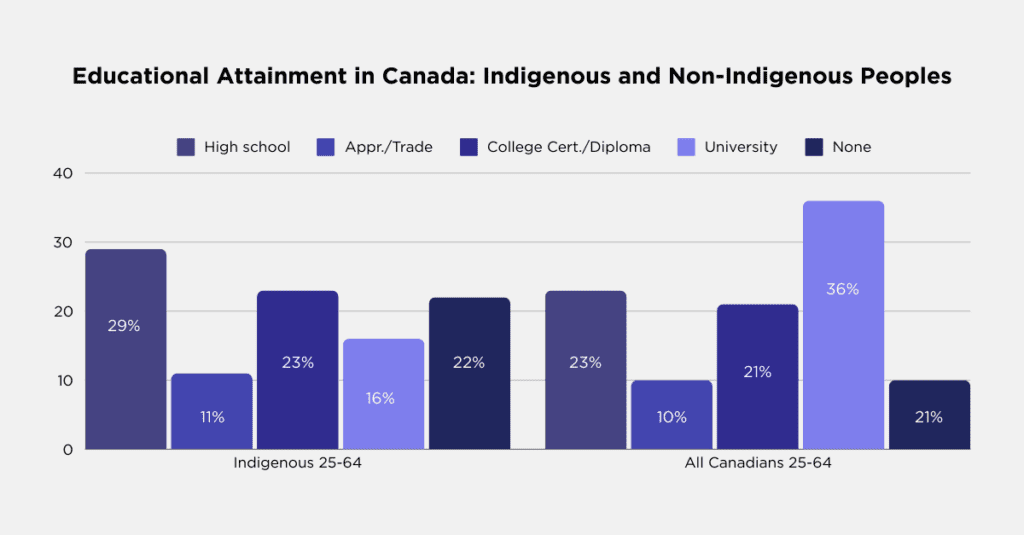
Despite facing challenges, Indigenous Peoples have made notable strides in education. While 16% of Indigenous peoples hold a university degree (compared to 36% of the overall population), 23% have obtained a college credential, and 11% have completed apprenticeships—figures that surpass those of the general population (Statistics Canada, 2021). Nevertheless, while the share of Indigenous adults with a bachelor’s degree or higher has increased since 2016, the gap between Indigenous and non-Indigenous populations has widened.

Source: Melvin, Alexandria. 2023. “Postsecondary educational attainment and labour market outcomes among Indigenous peoples in Canada, findings from the 2021 Census”. Insights on Canadian Society. October. Statistics Canada Catalogue no. 75-006-X.

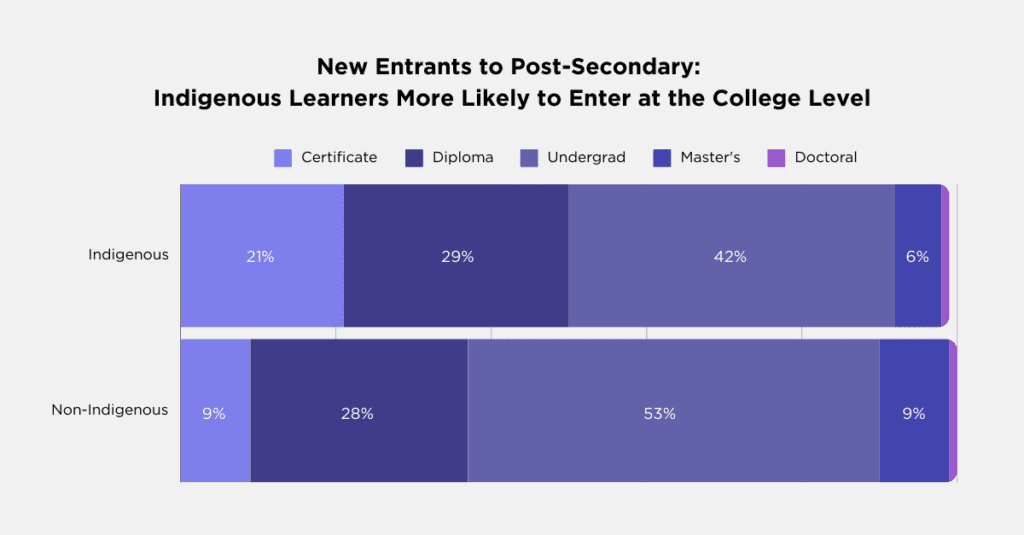
Did you know? Half of Indigenous new postsecondary entrants start their journey at colleges, compared to 37% of non-Indigenous entrants (Statistic Canada, 2024). Additionally, Indigenous new entrants at colleges are far more likely to be women and more likely to be 20 years or older compared to non-Indigenous new entrants. These statistics underscore the critical role colleges play in providing accessible and supportive educational opportunitiesincluding delivery in community and essential wrap-around services – for Indigenous learners at any stage in their lives, regardless of their life circumstances.

Source: Statistics Canada. Table 37-10-0264-01 New entrants to postsecondary education by Indigenous identity, educational qualification, field of study (STEM and BHASE (non-STEM) groupings), gender and age.

Navigating Challenges: Regional Disparities and Remote Living 

The educational journey for Indigenous peoples isn’t without its challenges. Historical and ongoing injustices, such as the legacy of residential schools and intergenerational trauma, coupled with ongoing structural challenges like limited access to educational institutions, food insecurity and lack of childcare options while in school, have long cast a shadow over Indigenous education.

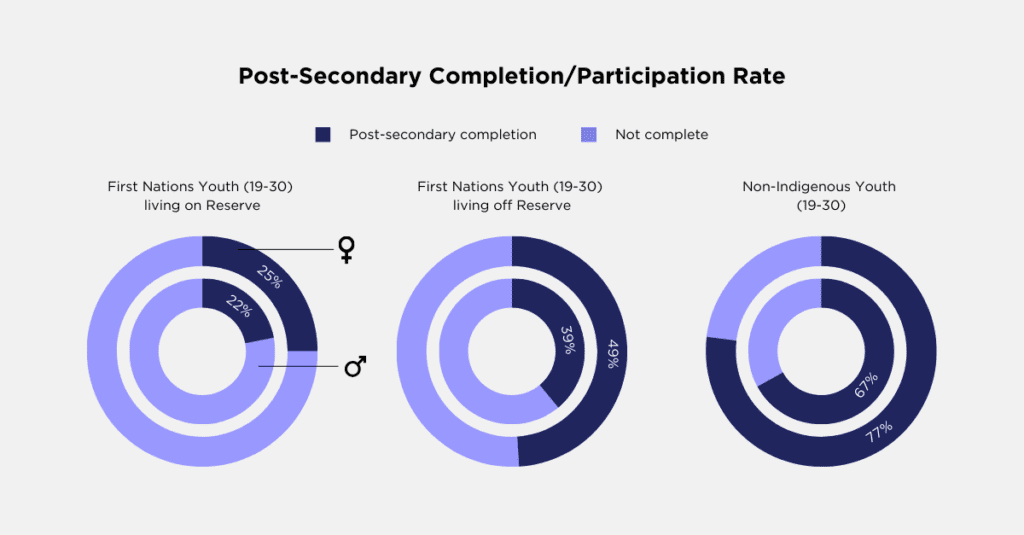
Among Indigenous populations, First Nations youth, in particular, face numerous challenges. These include higher rates of young parenthood, low-income households, and rural residence, contributing to a disparity in postsecondary completion rates compared to non-Indigenous youth. As a result of these challenges, non-Indigenous youth are nearly twice as likely (72%) to have completed or recently attended a postsecondary program as First Nations youth (37%) (Statistics Canada, 2023).

Source: Layton, Jaclyn. 2023. “First Nations youth: Experiences and outcomes in secondary and postsecondary learning.” June. Statistics Canada Catalogue no. 81-599-X.

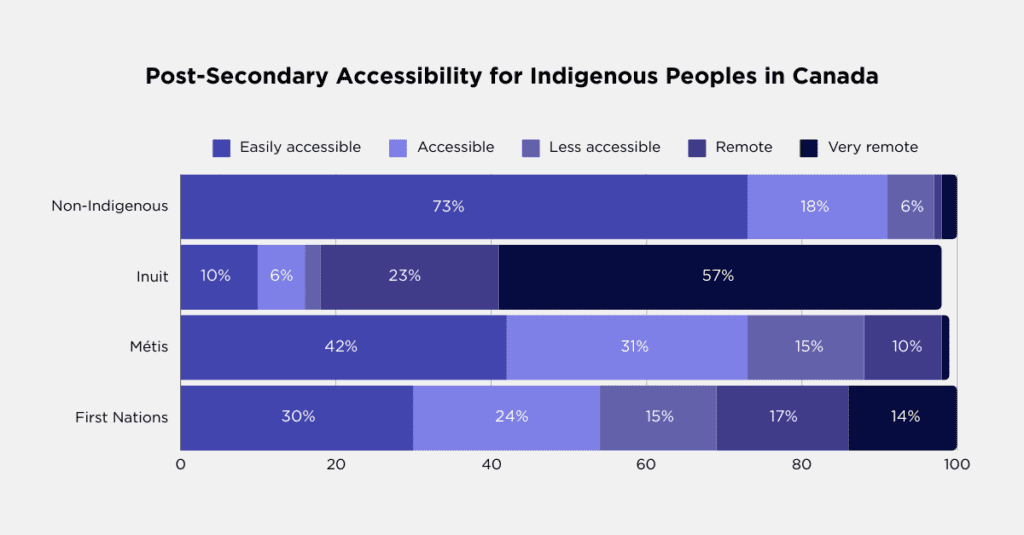
Adding to the complexity, Indigenous communities are disproportionately situated in rural and remote areas. In 2016, 26% of Indigenous individuals aged 19 to 45 lived in these regions, in stark contrast to just 3% of the non-Indigenous population (Statistics Canada, 2023). 

How does this translate into educational outcomes? Those who lived in easily accessible areas completed high school in much higher proportions than those in very remote areas. An expanded age analysis also reveals that there are higher rates of high school completion and postsecondary education attendance among First Nations individuals living outside rural areas, with almost half of females and over a third of males attending or completing postsecondary education.

Source: Layton, Jaclyn. 2023. “Distance as a Factor for First Nations, Métis, and Inuit High School Completion.” Education, learning and training: Research Paper Series. June. Statistics Canada Catalogue no. 81-595-M.

Proximity to postsecondary institutions, therefore, plays a crucial role in the success of Indigenous learners. Fortunately, 86% of Indigenous Peoples live within 50km of a college campus or service centre. However, proximity alone is not enough. Offering flexible, adaptable, and culturally responsive options—such as outreach programs, community partnerships, and online resources—is essential to bridging the gap in postsecondary education and empowering Indigenous learners to achieve their full potential.

Indigenous-led institutes across the country, such as those in Ontario, Saskatchewan, Alberta and British Columbia along with Northern colleges like Nunavut Arctic College and Yukon University, also play a unique leadership role. Their locations, combined with their capacity and cultural understanding, enable them to address community-driven needs and deliver programs that are relevant, accessible, and empowering for Indigenous learners.

Looking Ahead: Empowering Indigenous Youth for a Stronger Future

The Public Policy Forum reports that by 2026, around 350,000 Indigenous youth will reach adulthood. Empowering these individuals with high-quality, culturally relevant postsecondary education and training will not only promote social inclusion and justice but also help Canada address its underemployment and skill gaps. It is estimated that supporting these young people can boost our economy by a significant $27.7 billion each year (Public Policy Forum, 2024).

With their unique insights, Indigenous knowledge systems offer valuable solutions for addressing Canada’s pressing issues. More and more colleges are recognizing this and engaging in applied research community partnerships with Indigenous organizations as part of their commitment to social innovation and partner-driven research. At SAIT’s Centre for Innovation and Research in Unmanned Systems, for example, researchers are working with the Stoney Nakoda First Nations and Alberta Health Services to develop a scalable drone fleet that can support medical delivery and amplify drone signals in remote areas.

Indigenous-Focused Programs & Support

As the primary postsecondary education providers for Indigenous learners from across Canada, colleges and institutes continually strive to listen, learn, and collaborate with Indigenous Peoples to enhance the educational experiences of Indigenous learners. We offer flexible learning formats and support services such as childcare, counselling, and mentorship, along with nearly 300 Indigenous-focused programs and courses across Canada’s ten provinces and territories.

Through CICan’s national programs, such as Skills Compass, colleges and institutes are also making a significant impact by supporting Indigenous and newcomer youth not currently in education, employment, or training. The accessible initiative helps Indigenous youth develop essential skills and become career-ready and equips members with a Skills Compass Curriculum Framework—a lasting resource to help institutes tailor their programs to the unique needs of Indigenous youth.  

Colleges and institutes also foster connections for Indigenous learners globally through Global Skills Opportunity (GSO). This initiative enables Canadian post-secondary students to gain new global skills, enhancing their resilience, adaptability, and readiness for success. For instance, I’M SIENT (International Mobility Supporting Indigenous Entrepreneurs), funded under GSO at Sault College in Ontario, empowers Indigenous students by enhancing technical and analytical skills in collaboration with Indigenous entrepreneurs in Mexico’s Yucatan region.

Recognizing that Indigenous reconciliation is an ongoing journey, we remain committed to culturally responsive approaches. Through continued dedication, the potential for positive change and empowerment within Indigenous communities is immense.

Take Action:

Colleges and institutes can advance their commitment by joining the 72 institutions that have signed CICan’s Indigenous Education Protocol. This protocol – created in 2014 – highlights the need for tailored structures and approaches to meet the educational needs of Indigenous peoples, supporting their self-determination and the socio-economic development of their communities.

To mark its 10th year anniversary and reflect on progress and stubborn gaps, CICan will be initiating a refresh of the protocol – and how to mobilize greater take by our member institutions – at our upcoming Indigenous Education Symposium in Halifax from October 27-29 that we are hosting in partnership with the Indigenous Institutes Consortium (IIC).

May 24, 2024

The Future of Education is Challenge-Driven

Published on TheFutureEconomy.ca May 17, 2024.

“Canada’s big public policy questions—things like providing sustainable and affordable housing, ensuring food security, preparing for and preventing large natural disasters, designing cities and spaces that respect our environment, transitioning to clean energies, and taking care of an aging population—aren’t going away.  

These are our shared challenges, nationally and globally. The good news is that Canada has one of the strongest postsecondary sectors in the world. If we think strategically about the who, what, why, when, and how of learning, each challenge becomes a strategic opportunity for colleges and institutes as educators, partners, and innovators to be a bigger part of the solution. ”

Read the full text on TheFutureEconomy.ca.