
2025–2026 Impact Report
Impact Report 2025–2026




A Word from Our CEO & Board Chair
We are proud to present CICan’s Impact Report for 2025-2026.
This is not a moment of incremental change. It is a defining one.
For our sector – and for Canada – the stakes are higher, the challenges more complex, and the expectations more pressing. In this context, this Impact Report captures not only what we have accomplished in the past year, but how we have deliberately transformed to meet what comes next.
Driven by our Roadmap to 2026 and its five Impact Goals, we set out to concentrate the efforts and expertise of Canada’s public colleges, institutes, CEGEPs, polytechnics, and Indigenous Institutes of Education where they matter most for our country – preparing the workforce that sustains our communities, creating partnerships that drive innovation, and supporting growth and critical transitions across industries, from healthcare to housing.
Ambition and Intent
Over the past year, CICan has worked to advance these priorities with purpose, strengthening our voice with governments, deepening engagement with institutional leaders, mobilizing intentional partnerships, and driving collective action across the sector.
In that time, we have also taken decisive steps to evolve.
We committed ourselves to becoming more focused, more agile, and more driven by impact. We realigned our organization with intent, sharpened our priorities, and redefined how we support and advocate for our members to ensure we remain a strong, credible, and forward-looking national association in a rapidly changing environment.
More importantly, to ensure we continue to position our members to support Canadians and their communities.
Our Roadmap to 2030
This report is not an ending, but a launch point for the next four years. It is a call to act with greater ambition – to convene, mobilize, and champion our sector in ways that match the scale of the moment.
As we reflect on the past year, we do so with a clear sense of purpose. Present in every region of the country, our members are essential partners in building a resilient, inclusive, and globally competitive Canada.
We believe deeply in the strength of our network and in what we can achieve together.
This is a time for bold choices, for sustained leadership, and for collective action.
Canada is entering a new chapter – and our sector will help write it.

Pari Johnston
President and CEO

Pierre Zundel
Board Chair
A Strategic National Asset
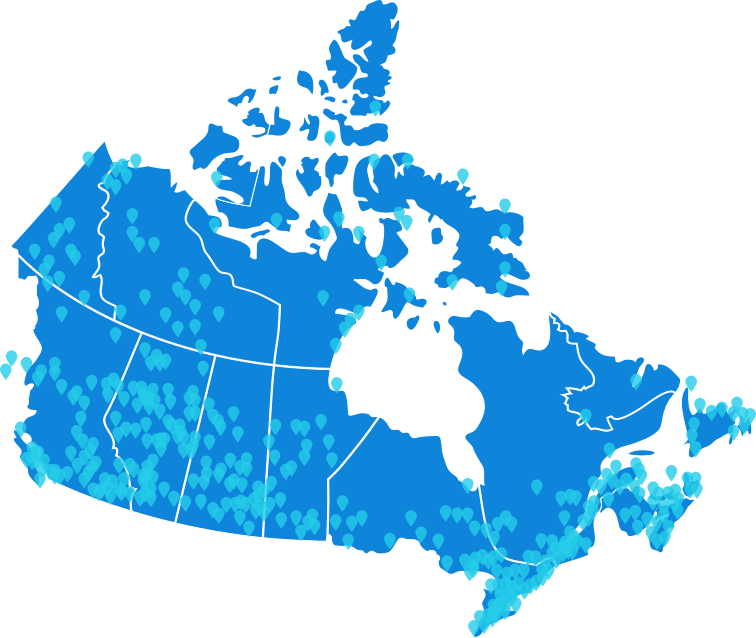
CICan is the high-touch and high-performing national association serving Canada’s public colleges, institutes, CEGEPs, polytechnics, and Indigenous Institutes of Education.
We are proud to convene, mobilize, and champion our members to deliver the results and advance the priorities that matter most to Canadians – including good jobs and a place to live, healthy communities, a thriving economy and a solid and stable future for their children.
In doing so, help position Canada to leverage the best of its public postsecondary institutions as a strategic national asset to deliver on national missions.
Our Membership in Numbers:
A coordinated national network of allied leaders and institutions committed to continued impact.
The key partners that help us put our members in a place to succeed and get things done at pace and scale.
National Reach
More than 95% of Canadians and more than 86% of Indigenous people live within 50km of a college or institute.
High Impact Convening
CICan is the national forum for aligning the sector with strategy and ambition.

It’s Go Time: Bold Action for Canada
In April 2025, CICan convened over 130 leaders from Canada’s public colleges, institutes, CEGEPs, and polytechnics along with key partner organizations for our first-ever Leaders Summit to chart a path that will empower our sector to continue doing what we do best.
The result? A renewed spirit of unity and urgency, driving bold action for Canada.
Building a Strong and Secure Canada – Together
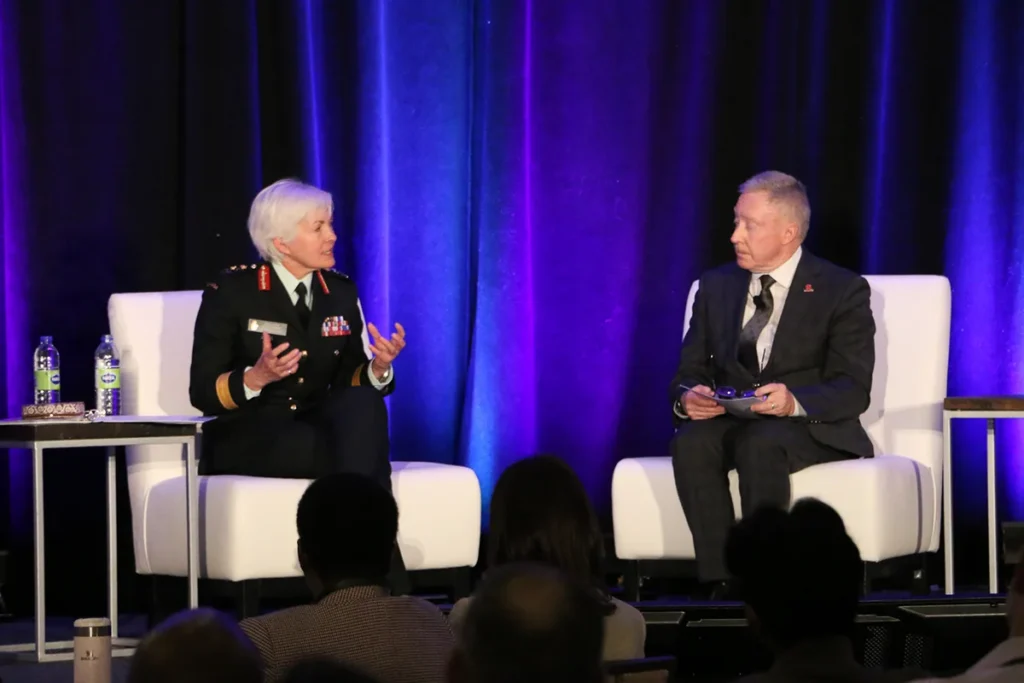
In April 2026, over 560 leaders came together for CICan’s renewed and redesigned national Connections Conference.
We shared ideas, planted seeds, and the sparked connections among our community and with our partners that will spur greater alignment and action to fully centre our institutions in their roles as nation-builders.
At a time of uncertainty, transformation, and disruption, the message was clear: For our country and for our communities, the path forward runs through our sector.
An Exclusive, Trusted Space for College Leaders
As postsecondary leaders navigate policy change and provincial reviews, enrolment fluctuations, campus labour unrest and belt-tightening, increased government oversight, mandate expectations and political pressures, Canada’s postsecondary system is at an inflection point.
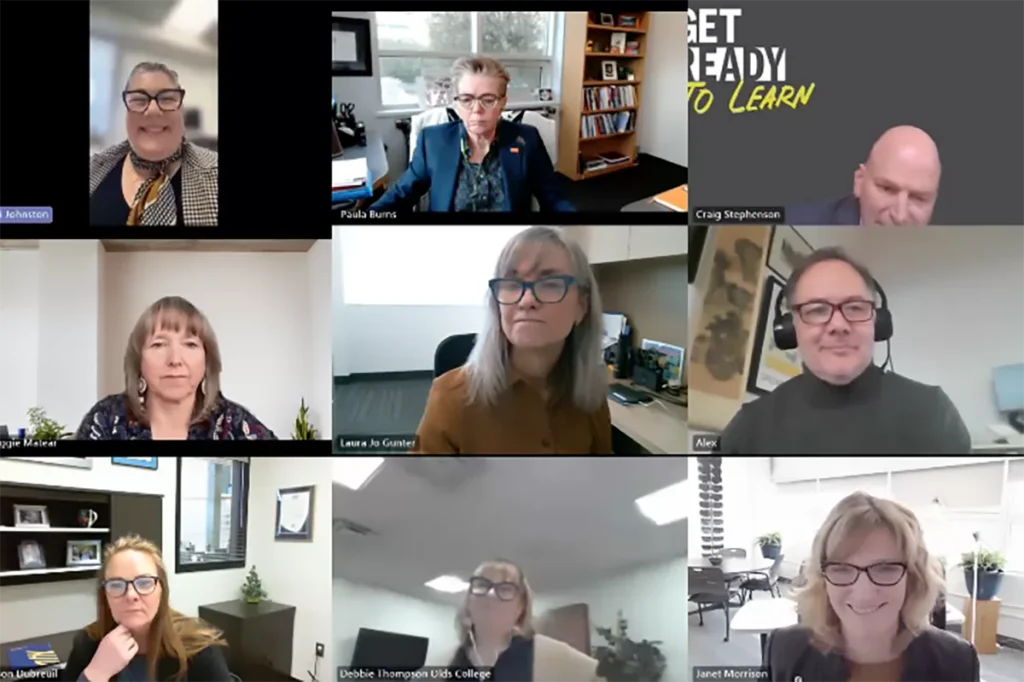
In these times of transition, CICan’s Presidents Circle brought leaders together for monthly, peer-to-peer discussions in an exclusive, trusted space to discuss the most pressing issues facing their institutions and the sector.
Our Strategic Approach
In a year marked by disruption and uncertainty, we set ambitious yet focused goals, anchored in our Roadmap to 2026.
Our work was aligned under three strategic priorities:
Driving a Challenge-Based Advocacy Agenda
Meetings with Parliamentarians, Senior Officials & Research Funders
Submissions & Consultations
Thought Leadership Pieces & Public Apperances

Meeting the Moment
Canada elected a new prime minister in May of 2025 – and CICan was there to position our members as ready and willing partners in Team Canada.
We made the case that, by building up our builders, investing in innovation at the local level, and developing a national workforce strategy, Canada can leverage its dynamic network of public colleges and institutes to meet the moment.
Integrating National and International Programs
in direct financial benefit to members
Members Involved in Projects

Supporting Canada’s Defense Imperative
CICan’s College Defense Training and Innovation Network – with nearly 60 participating institutions from coast to coast and in the North – builds on the strength and expertise of our members, and positions colleges to develop scalable and targeted solutions to meet Canada’s defence needs through coordinated action tables that map readiness and strategic alignment.
Strengthening CICan’s Internal Culture and Systems
NEW
Digital Transformation Team
Staff
NEW
CITalent Staff Professional Development Platform

Farewell to Chateau
After 15 remarkable years at the Château Laurier, this April, we bid farewell with gratitude to a place that has been the backdrop to countless conversations and meaningful milestones.
In May, we officially moved into a new office space that reflects the modern, streamlined, and collaborative association we are.
We look forward to making new memories together in our dynamic new space and providing our members a “home in Ottawa.”
Our Year in Impact
This April marks the culmination of our Roadmap to 2026, an 18-month focused and future-facing plan to sharpen and amplify our national impact.
The Roadmap anchored our work in five clear and ambitious impact goals.
More than aspirations, these goals were direct responses to Canada’s most urgent priorities and the evolving realities of our members. They guided where we invested our energy, how we deployed our resources, and where we delivered change that matters.
Most importantly, they united our members around shared priorities, driving collective action toward a stronger, more resilient Canada.
Impact Goal 1
We committed to accelerating Canada’s economic growth by positioning college and institute applied research at the heart of Canada’s innovation agenda.
Targeted Advocacy
Through targeted advocacy and making the case for a more inclusive, impact-driven approach to Canada’s research ecosystem, our work this year ultimately meant that:
- Canadian businesses are better placed to leverage the expertise of our network and compete in a global world,
- Canada derives greater impact from each dollar invested in college-led research to power solutions like building homes better and faster, strengthening our military and defence capacities, boosting energy production and transition, and getting major projects done; and
- More Canadians benefit downstream from the tangible results of place-based college and institute innovation every day.


Stability & Predictability on International Students
As institutions continued to deal with operational and financial implications of reduced international student numbers in Canada, our focus was on bringing stability to this disruptive policy environment and on helping members navigate the new system.
In December, Immigration, Refugees, and Citizenship Canada (IRCC) confirmed that it does not intend to make further changes to the PGWP-eligible CIP list for the foreseeable future – and that it plans to consult with the sector on how the approach will be managed going forward.
We’re incredibly proud of this big win that was secured by the collective advocacy of our sector and that will bring much needed stability for institutions welcoming international students.
Our continued focus with IRCC is on clarity, consistency, and consultation on the big questions – including securing improved approval rates and processing times for study permits and clearer guidance to help institutions better understand these trends.
Key Accomplishments
Funding Wins & Mobilization
In April 2026, the federal government’s Spring Economic Update announced a renewed investment in the College and Community Innovation Program (CCIP) with $165 million in additional funding over 5 years.
The CCIP renewal is a direct result of the advocacy and mobilization of the sector, especially our letter writing campaign to mobilize members and their industry partners.
With over 130 letters submitted to the Ministers of Industry and Finance, we collectively demonstrated the impact that our members play in Canada’s economy – and the federal government has clearly heard our message: college-led applied research is a critical piece of Canada’s research and innovation ecosystem and must be adequately resourced.
We’re incredibly grateful to our members and to our partners at Tech Access Canada, le Reseau des CCTT’s and Polytechnics Canada for their engagement and support.
Solutions for Canada
In November 2025, we launched a brand-new digital showcase of the impact and reach of college and institute applied research.
Using data from our 2023-2024 Applied Research Survey, the new webpage highlights the unique value of our sector’s placed-based, partnered-focused, mission-driven, and globally envied applied research ecosystem.
The online showcase is now available to help supplement our federal advocacy activities, and available to members to showcase their impact locally and attract new partners.
Strategic Engagement with Research Funders
Over the past year, our team actively made in-roads with key players in Canada’s research ecosystem to underline the importance and value of what colleges and institutes can do.
By facilitating meetings, strategically engaging key offices, appearing before committees and working groups, such as the Standing Committee on Science and Research, and participating in key consultations, our work amplified the voices of college leaders in a coordinated national narrative.
With each meeting, we enabled decisionmakers in Canada’s research ecosystem to hear from the leaders and partners developing solutions for Canada, tour the high-impact college facilities where innovation takes places, and experience firsthand the impact of our network.
Working with CICan’s National Research Advisory Committee and leaders in the college applied research ecosystem, we shaped policies and influenced funders like Canadian Foundation for Innovation, the Canadian Institutes of Health Research, the Digital Research Alliance of Canada, and Mitacs through strategic engagement, roundtables and campus tours as they developed new strategic plans, and pushed Canada’s research ecosystem in a direction that better reflects a college strategy.
Our Recommendations Recognized
By engaging and speaking for our members, we regularly submit recommendations to federal consultations through the House of Commons Standing Committees.
This year, we’re proud that many of these recommendations were reflected in committee reports.
Six of our recommendations were reflected in the SRSR Committee report on research funding distribution, including increasing the share of research funding allocated to colleges through the CCI Program, reviewing how funding can better support the indirect costs of research, amending rules to encourage collaboration between post-secondary institutions, and adapting funding programs to better reflect the unique features and research contributions of colleges.
An additional three of our recommendations were reflected in the INDU committee report on improving productivity, including strengthening support for commercialization through funding mechanisms that promote partnerships between businesses and research institutions, including colleges, and extending eligibility for all federal research programs to Canadian colleges.
Canada’s colleges and institutes are also essential and ready-to-act partners to help deliver an AI-ready, competitive, and productive Canada. As we await Canada’s highly anticipated AI Strategy, we were happy to see many of our recommendations echoed in the final report from Canada’s AI Task Force.
Impact Goal 2
We committed to boosting Canada’s job-ready workforce by promoting the value of industry-focused training in high-demand sectors.
Positioning Our Members
By positioning our members to help Canada’s big bets on nation-building come to life, our work over the past year meant that:
- Colleges and institutes are positioned to support the skilled and ready workforce and an aligned talent pipeline to get Canada’s major Projects of National Interest off the ground,
- Communities across the country are deeply tied into regional hubs for workforce coordination, learner success, in industry-aligned training pathways, and
- A strong and connected domestic and internationally engaged network of college assets will help Canada pivot to new markets both within Canada and around the world.


Emerging Talent & Leadership
For more than 20 years, CICan’s Awards of Excellence have recognized not only individual and institutional excellence, but also the collective strength of a pan-Canadian network united by a common goal, collaboration, and community-focused innovation.
In April 2026 we celebrated 15 exceptional students, staff, faculty, and institutions that embody the ambition and impact of our sector. Their leadership and achievements demonstrate how excellence at the local level strengthens Canada as a whole and reinforce the sector’s identity as a coordinated national force – a cornerstone of Canada’s future workforce, productivity, and community resilience.
Thank you to TD Insurance for their longstanding support for the Awards of Excellence.
Key Accomplishments
Shaping Federal Workforce Supports
Through a year heavily impacted by tariffs, our ongoing engagement with federal departments, leaders, and policymakers positioned the college sector as a vital ally for initiatives supporting workers and building a more resilient labour force.
In particular, we secured a place at the table for the sector in shaping the future of federal workforce alliances, working with the leads to develop governance and engagement models that integrate sector expertise.
As Canada asks the question, Who Will Build Canada?, we’re happy to see our advocacy work this year reflected in the new $6-billion Team Canada Strong initiative that will position the country to leverage the best of its public postsecondary institutions as a strategic national asset to deliver on national missions.
Continued Impact though Virtual Simulations
With 43 participating institutions, over 300 simulations developed, and more than 17,000 students engaged, our Virtu-WIL program advances consistent, practice-oriented learning aligned with evolving skills needs in key sectors of the care economy.
In April 2026, we celebrated a renewed investment that will enable our members to continue delivering scalable, simulation-based work-integrated learning to strengthen workforce readiness across Canada.
Partnerships for Workforce Solutions
We celebrated the success of two of our valuable workforce development partnerships with the Government of Canada that came to an end this March: Upskilling for the Innovation Economy and Career Launcher.
Through these partnerships, our members empowered more than 2,000 young people with paid, career-launching work and learning opportunities, strengthened connections between job seekers and employment opportunities, and addressed critical skills gaps in advanced manufacturing, agricultural and clean technology through hands-on, workplace-based training initiatives and reaching more than 650 Canadians.
These are the real examples of how we turn sector capacity into national impact – by activating the collective strengths of our national and international network to design and test system-wide solutions, disseminate knowledge and learning, and scale member-led coalitions that tackle Canada’s biggest challenges.
Driving Workforce Priorities on a Global Scale
Ending in October 2025 after five years of impact, our Young Africa Works program in Kenya connected 29 Canadian colleges with Kenyan institutions to develop 138 industry-aligned curricula, train more than 17,000 instructors, and support 5,100 young people transitioning into employment.
As Canada looks to pivot toward new global markets, this work is a powerful example our college network as a strategic international asset – demonstrating Canadian expertise in high-demand sectors, building institutional relationships that can lead to future collaboration, and reinforcing the relevance of skills training as a driver of economic growth.
Impact Goal 3
We committed to creating strategic opportunities to address shared global challenges.
Mobilizing Members
By mobilizing members around a renewed and fit for purpose programs and partnerships strategy, our work over the past year meant that:
- Our network is positioned as a coordinated and strategic national asset to meet Canada national missions in defense readiness, the care economy, advanced manufacturing, and homebuilding,
- Canada’s public colleges and institutes are ready to work with industry, labour, and governments in new and bold ways on collaborative projects and initiatives that deliver results at pace and scale, and
- The expertise and assets of our members is positioned to lead inclusive global education and training, workforce development, and trade cooperation.
- Our network is positioned to help Canada pivot to new markets both within Canada and around the world.


Leading through Disruption as a Sector
This year, we were proud to launch the new CICan Academy for College Leadership: the only national, sector‑specific leadership development hub dedicated exclusively to Canada’s public colleges, institutes, CEGEPs, polytechnics, and Indigenous Institutes of Education.
Through future‑ready, accessible, in-person and online programming, the Academy equips leaders with the skills, confidence, and competencies needed to navigate disruption, prepare for their next stage of leadership, and drive system‑wide impact.
By investing in leadership development today, the Academy strengthens institutions and supports long‑term national prosperity.
Key Accomplishments
Talent and Innovation Collaboration in India
In March 2026, we led a small delegation of globally experienced presidents from Canada’s colleges and polytechnics to India.
In Delhi, Bengaluru, and Mumbai, our delegation led 3 Canada-India Industry Roundtables on workforce development and training partnerships and held 12 meetings with national and state-level skills and education ministries, skills development corporations, India’s apex industry and technical education bodies, and the Canadian High-Commission and consulates.
In February, CICan President & CEO Pari Johnston also participated in a mission to India led by Prime Minister Mark Carney. The mission marked the launch of a new Canada-India Talent and Innovation Strategy which will deepen ties centered around education, research, and skills cooperation.
Through this work, we showed both the Canadian government and Indian partners that we’re serious about building strategic talent pipelines between Canadian and Indian businesses and strengthening India’s vocational training system to be more industry-aligned – ultimately building a long-term mutually beneficial economic relationship between our two countries.
We look forward to pursuing a follow-up mission in this coming year.
Partnership Building Activities in Africa
In January 2026, we led a mission of almost 20 colleges and institutes to Ghana and Nigeria with the goal of building strong, diversified partnerships supporting contract training opportunities, student recruitment, and other institutional activities in important markets in Africa.
The mission is also an example of how we position our members as trusted and competitive choices for education and training solutions supporting Canada’s flagship trade initiatives.
The College Defense Training & Innovation Network
In September 2025, we launched CICan’s College Defence Training and Innovation Network – a national community of colleges and institutes, coordinated by CICan, working collectively to meet Canada’s defence needs.
The work of the network includes workforce readiness and talent pipelines, mobilizing defence-related college applied research and innovation, building institutional capacity and readiness, and identifying opportunities through trusted, coordinated engagement with defence partners.
In February 2026, we launched two member-driven Action Tables to advance priorities on Workforce Development & Talent Pipelines and Institutional Capacity.
North American Alignment
This year, we took practical steps to build stronger alignment between CICan and our continental counterparts – the American Association of Community College (AACC), and the Mexican National Association of Universities and Institutes of Higher Education (ANUIES) – to bring the impact of our sector to a continental scale.
Together, we are advancing skills development initiatives aligned with our shared priority sectors, supporting mutual productivity and innovation, and helping to develop tri-lateral talent pipelines between our countries.
This work also laid the foundation for a formal Memorandum of Understanding between CICan and ANUIES, signed during Mexican trades mission in Canada in May 2026. The agreement will strengthen bilateral collaboration between Canada and Mexico in areas such as workforce development, innovation, institutional partnerships, and knowledge exchange.
As Canada moves forward the renewal of the Canada-US-Mexico Agreement we are positioning our sector as a strategic tool for building an integrated, resilient, and sustainable continental economy.
We look forward to coordinating on more bilateral missions and engagements and creating more opportunities for knowledge exchange and meaningful partnerships.
Impact Goal 4
We committed to advancing reconciliation with a renewed and impactful Indigenous Education Protocol and supporting the capacity of Indigenous Institutes of Education.
Positioning Our Members
By initiating work with our Indigenous Advisory Committee to refresh our Protocol and build a plan to mobilize wider sector uptake and to build capacity of Indigenous-led member institutions, our work meant:
- Canada’s public colleges and institutes are better positioned to work with Indigenous-led institutions, businesses, and organizations to drive impact for their communities and for Canada;
- More tailored and culturally appropriate education, training and research leads to greater impact for Indigenous learners and communities; and
- More Indigenous peoples are represented in college and institute governance, research and educational spaces and systems.
- Indigenous-led member institutions have greater capacity to advance their specific goals for leadership, capacity and partnership development to meet community needs.

Key Accomplishments
Turning Ideas and Intentions into Reconcili-ACTION
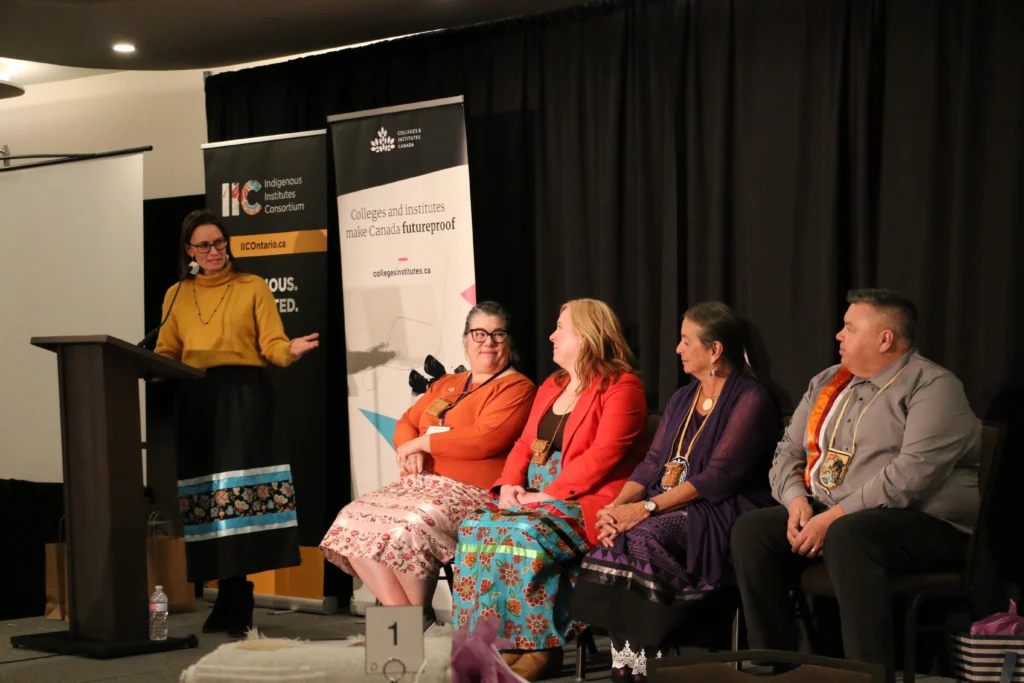
In partnership with the Indigenous Institutes Consortium, we were proud to host the National Indigenous Education Symposium this past October to share knowledge and engage in meaningful dialogue and collaborative solutions-building.
Through powerful keynotes and rich conversations among the more than 250 participants – from Elders and Knowledge Holders to students – we were reminded that we have much to learn and gain from Indigenous-led approaches in the true spirit of building and nurturing partnerships that empower learners, strengthen communities, and address Canada’s most pressing challenges.
A Renewed Indigenous Education Protocol
In October 2025, we officially launched a renewed Indigenous Education Protocol, reaffirming our sector’s shared commitment to advancing reconciliation through action.
Informed by more than a decade of learning, listening, and relationship building, the renewed Protocol reflects Indigenous leadership and aligns more closely with Indigenous led frameworks, contemporary priorities, and lived realities.
We’re incredibly proud of this milestone to mobilize the collective strength of the college and institute system around shared priorities.
A First National Indigenous-led Initiative
In October, CICan and three Indigenous Institutes of Education – Nicola Valley Institute of Technology, Saskatchewan Indian Institute of Technologies, and Six Nations Polytechnic – launched a historic partnership strengthen Indigenous-led entrepreneurship and business education across Canada.
Through the initiative, known as Mamawi, the partners will work together to expand training, mentorship, and applied-research opportunities to improve economic and social outcomes to support Indigenous learners and communities.
The partnership will also strengthen Indigenous institutes’ capacity to design and deliver programming, broaden supports such as access to Elders, Knowledge Holders, and childcare, and promote innovative learning models, including land-based and flexible approaches that improve learner retention.
This first national Indigenous-led initiative delivered through CICan, Mamawi is supported by a US $12 million commitment from the BHP Foundation.
Our First Formal Indigenization Plan
This year, we set out to co-develop CICan’s first formal Indigenization Plan. With much thanks to our Executive Indigenous Advisor, Wendelyn Johnson, who led CICan through staff engagement, workshops, and retreats, this was a pivotal transition point for CICan – moving from cultural awareness to cultural readiness and safety.
We are continuing to learn, to reflect, and to assess where CICan still needs to grow as an organization – in our systems, policies, project guidelines, training plans, and new staff onboarding to bridge the gap between intent and infrastructure, and to ensure that, in everything we do, we contribute meaningfully to Reconciliation.
Impact Goal 5
We committed to supporting and amplifying climate action and energy transitions through our members.
Supporting Research, Resources and Knowledge Mobilization
By supporting research, resources, and knowledge mobilization, sector-wide mentorship, and collaborative opportunities to develop joint climate solutions, our work meant:
- Canada’s colleges and institutes have greater capacity to reduce carbon emissions and energy consumption on campus,
- Canada’s colleges and institutes are empowered to strengthen community climate resilience and energy transformation,
- More college and institute graduates are equipped with the in-demand green skills Canadian business need to adapt – and position Canada as a global leader in sustainability.


Key Accomplishments
Advancing Canada’s Green Economy
Over five years ending in March 2025, the ImpAct-Climate project strengthened awareness and action in support of Canada’s green economy and energy transition.
Working with 21 colleges and institutes, we fostered a sustainable future within Canada’s college and institute through living labs, workshops and communities of practice empowering more than 19,000 Canadians to contribute to Canada’s low-carbon future.
Supporting Global Green Transitions
Over six years, we mobilized members to support the development of green skills capacity across six Caribbean nations.
Wrapping up this year, our Skills to Access the Green Economy program enabled over 665 learners to graduate from strengthened, industry-aligned TVET programs, short courses, and apprenticeships that are building a climate-ready, inclusive workforce.
As Canadian colleges support Canada’s energy transition at home, the program demonstrates how this expertise also travels – and that positioning our members as global leaders in green skills can both strengthen Canada’s reputation around the world and open doors for future international collaboration.

A Transformative Path Forward
Through a year of transformation there is much to be proud of.
Across the country, our members have demonstrated resilience, leadership, and an unwavering commitment to the communities they serve. To respond to the complex challenges we face as a country with clarity and to align our efforts where they matter most.
Still, Canada will expect more from our institutions. The pace of change will not slow, and neither can we. The demands for a skilled workforce, for inclusive growth, and for innovation that delivers tangible results will continue to intensify.
Meeting this moment will require continued evolution in how we lead, partner, and deliver impact. This is why CICan’s transformation is ongoing.
To Convene, Mobilize, Champion, and Excel
Our new Roadmap to 2030 represents our strategic direction to the end of the decade—a clear and ambitious path forward. It is both a guide and a call to action, positioning our sector to lead through uncertainty and to drive the kind of transformation Canada will require.
Grounded in a renewed mission, vision, and values, we are sharpening our focus through four defining pillars.
These are not simply aspirations, they are commitments that will shape how we bring our network together, how we activate collective action, how we amplify your voice, and how we deliver measurable results for our members and for Canada.
The opportunity before us is significant. So too is our responsibility. Together, we will continue to build a stronger, more inclusive, and more resilient Canada. One defined not only by what we achieve, but by the impact we create.
By 2030, we’ll build a future where:
Canada’s public colleges are recognized and resourced as essential federal partners in nation-building.
CICan is recognized as the national table for sectoral alignment and impact.
Our work within CICan and across the sector leads to progress on Reconciliation.
Intentional coalitions and member-led initiatives drive solutions on Canada’s national missions.
CICan is an employer of choice with a unified and high performing Team CICan.
This is the future Canada’s colleges are building — together.
Build Canada’s future with us.
Our Responsibility for Financial Reporting
This summary of Colleges and Institutes Canada’s financial statements has been prepared with information available to March 31, 2026. CICan’s complete financial statements were audited by Deloitte LLP on behalf of the membership. The Board of Directors met on May 21, 2026 and approved the statements.

Acknowledgements
Our achievements this year were made possible by the unwavering support and active engagement of our members – a national association is truly relevant and impactful only when members really participate and shape its work. CICan counts itself very lucky in this regard, and it is not something we take for granted.
We are grateful to our many partners in industry, government, civil society, our network of regional and provincial college associations, and other postsecondary associations in Canada and around the world who share our commitment and vision for fostering positive change in people’s lives, communities, and the planet.
Thank you also to the remarkable members of our Board of Directors, including our Board Chair, Dr. Pierre Zundel and Vice-Chair, Carolyn Campbell. Your strategic insights, guidance, and generous contributions of time and energy have been invaluable in advancing our national mission.
We’d also like to thank all the individuals involved in our national advisory committees whose experienced input ensures we are grounded in institutional realities as we continue to meet the needs of our members.
Finally, thank you to the amazing team at CICan for their continued hard work and dedication to our mission throughout these changing times.
